*This page contains affiliate links. We may earn a commission if you make a purchase through these links.
Six weeks ago this thing was in American cinemas. GKIDS put it back on screens for two nights, July 21 and 22, as part of the franchise’s thirtieth anniversary, and then it went away again. That is a booking aimed squarely at people who already know what they are buying a ticket for. If you are not one of those people, and you have arrived here because a streaming service pushed the title at you, the first useful fact is not that it is good. It is that what you are looking at is the last two episodes of a 1995 television series, made a second time, for cinemas, in 1997. Nobody in Japan reaches for the title in conversation either. It gets called kyu-gekijoban, the old theatrical version, a phrase that only had to be invented once four newer Evangelion films turned up and needed telling apart from it.
I rate it highly and I would not hand it to anybody who has not watched that series first. Those two sentences are the whole review; everything below is the working. The part I like most is Asuka waking up and going to work on nine machines built to kill her, and that sequence still gets me excited, so read my score knowing where my thumb is sitting on the scale. First, where the film actually is.
📺 Where to Watch The End of Evangelion (August 2026)
| Service | Status | Notes |
|---|---|---|
| Netflix | Streaming | Shelved next to the 1995 series |
| The Criterion Channel | Streaming | Streaming since September 1, 2026, with the classic English dub |
| Amazon Video | Buy | Digital purchase. No rental tier listed |
| Apple TV | Buy | Same terms |
| Fandango at Home | Buy | Google Play plus YouTube list it identically |
| Blu-ray (US) | On sale | Bundled with the series. Not sold alone |
| Crunchyroll | Not available | No Evangelion titles in the US catalogue |
| Hulu | Not available | Never licensed in the US |
| Prime Video | Not available | Not included with a Prime subscription |
As of August 31, 2026, the United States has exactly one subscription carrying this film, and on September 1 it gains a second. Netflix has held it since June 21, 2019, alone in that position for over seven years. the Criterion Channel then adds all three original titles to its own shelf: the twenty-six episodes, this film, and the recap feature that sits in the middle. Every other service listed above sells the film rather than lending it. One caution before you sign up. A licence can lapse with no announcement of any kind, which four other Evangelion films demonstrated in the least pleasant way possible earlier this month when they left Prime Video worldwide on a single day. Worth a look at the service page before you pay for a month on the strength of this one title.
From where I am sitting the picture is inverted. Five Japanese subscription services carry this film at the same time: U-NEXT, Hulu, Disney+, DMM TV, Netflix. Abundance turns out to be its own problem. Which of them also holds the twenty-six episodes, and which holds the four newer films, changes from one month to the next. The American arrangement is the tidier one for once. One subscription, no extra charge, and the series you have to watch first shelved right beside it.
👉 If those twenty-six episodes are not behind you yet, start there instead of here: Neon Genesis Evangelion, and where to start in 2026.
🎬 Trailer
No official Japanese trailer from 1997 survives on an official channel, so the one above is the version GKIDS cut for the film’s North American theatrical run. It is also the most restrained anyone has ever managed to be with this particular footage.
Work Info
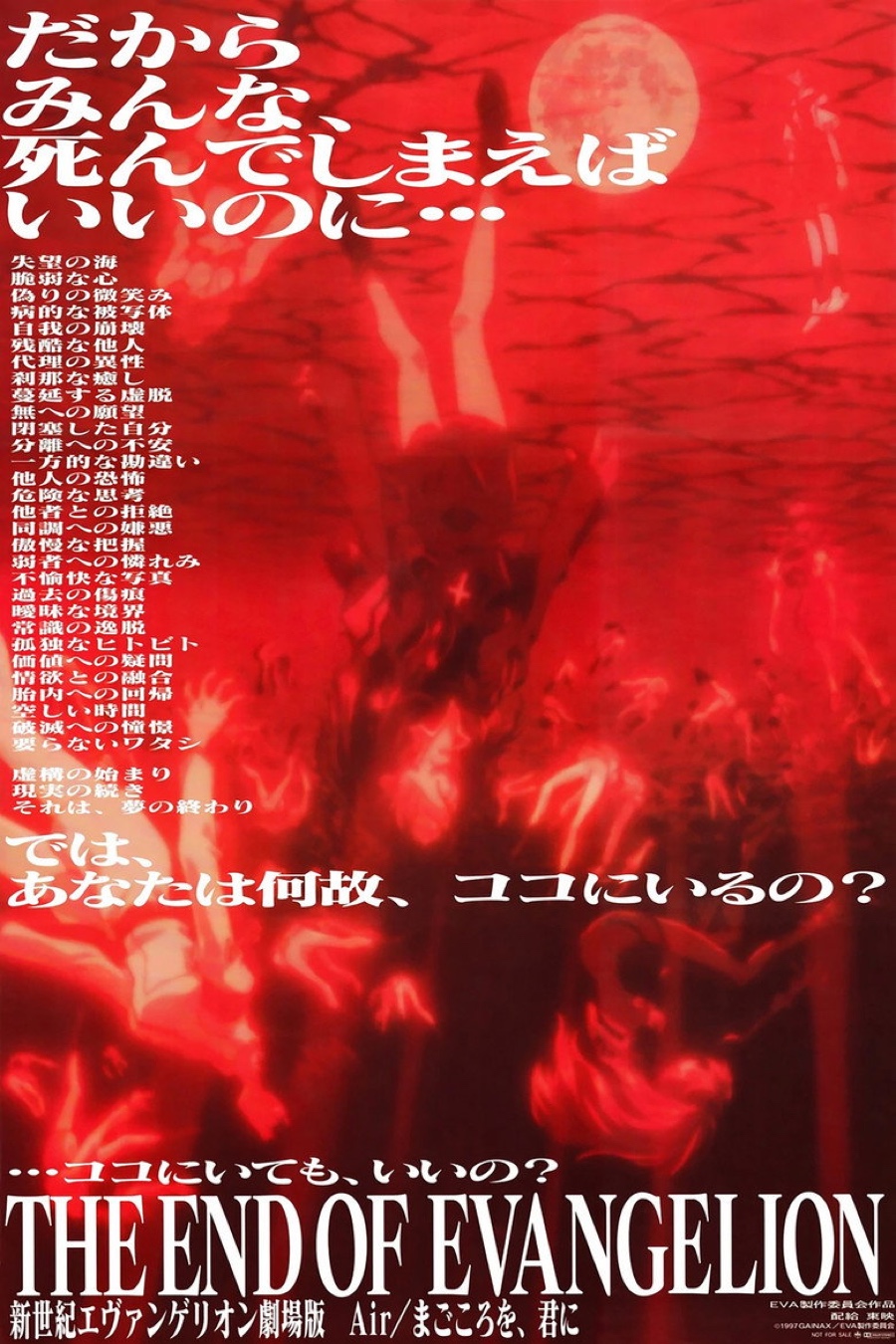
- Title: The End of Evangelion (1997)
- Japanese title: Shin Seiki Evangelion Gekijoban: Air / Magokoro wo, Kimi ni
- What it is: episodes 25 and 26 of the 1995 series, remade for cinemas
- Released: July 19, 1997 in Japan, distributed by Toei
- Chief director and screenplay: Hideaki Anno / Studio: GAINAX
- Music: Shiro Sagisu
- Runtime: 87 minutes
- US rights: GKIDS since 2020. On Netflix since June 21, 2019
- Source: TMDB
📖 Synopsis – No Spoilers
The war against the Angels is over. What comes through the doors of NERV headquarters next is an armed force sent by other human beings, tasked with seizing the organisation and the Evangelions inside it. The pilots are on the list as well. Asuka is lying in a hospital bed with her mind in pieces. Shinji has stopped moving at all. Gunfire is working its way inward through the building, and Misato is trying to get both of those teenagers onto their feet inside a structure that is coming apart around them.
Underneath all that, a plan the organisation has spent decades preparing reaches its final stage: remove whatever it is that separates one person from another, and fold the species into a single thing. One faction wants it executed as written. Another wants it redirected to a private purpose. Standing between them is a fourteen-year-old boy who was never asked. Nothing in this film goes the way anybody planned it.
✨ What Makes It Special
Why It’s Exceptional
- Hand-drawn in 1997, and a 2026 pair of eyes still cannot keep up with it
- Bach playing over the worst thing on screen, at full volume, on purpose
- A director’s feeling that went in without being tidied first
- Eighty-seven minutes carrying two episodes’ worth of unfinished business
Drawn by hand in 1997, and still faster than your eyes
The stretch I return to is Asuka opening her eyes and starting to fight. Unit-02 moves with a level of detail that borders on the perverse. An arm extends. A foot digs into the ground. A weapon changes hands. Every one of those actions has real drawings behind it rather than a held pose and a camera move, and the sequence refuses to stop moving for its entire length. Put it beside anything animated this year and it does not come off worse. I am aware of how that reads coming from the man who announced at the top of the page that this is his favourite part of the film, so treat it as a claim you can check for yourself the moment the fight starts.
Her opponents are nine mass-production Evangelions, and their design is where the film shows its teeth. White. Elongated. Mouths fixed in something that reads as a grin. What happens on screen stops looking like machines colliding and starts looking like animals running down another animal. I read the revulsion as deliberate, though I have never found a production statement that says so outright, so take it as my reading rather than as documented intent. What is beyond argument is the division of labour: one side of the frame is carrying everything cool about giant robots, the other side is carrying everything upsetting about bodies.
All of this predates the point where computers could supply mass and motion cheaply. People drew it, one frame at a time, and arrived at that density anyway. There is a version of this recommendation that has nothing to do with liking anime: if you want to know how far Japanese animation had travelled by 1997, these twenty minutes are the exhibit. I would send a live-action crowd to them before I sent an anime crowd.
The catastrophe and the elation arrive on the same track
Over the cruellest passage in the film, the score puts on the brightest music it owns. Bach’s Air on the G String plays across the battle, and heard on its own that piece is placid to the point of being furniture: the sort of thing Japanese schools pipe through the corridors at going-home time. Underneath it the picture is doing something that cannot be walked back. You lose track of whether you are elated or sick, which is the intended condition.
Getting ruin and exhilaration to occupy one moment at equal strength is close to impossible in live action. An actor’s face has to commit, and the instant it commits the other half of the effect turns into a lie. Drawings and sound have no such obligation. Nobody’s expression has to choose. This film spends its final act living in that gap, and it is the clearest argument I can give a sceptic for why the medium exists.
The maker’s feeling went in unprocessed
I am not going to sell this as a well-made object. Hideaki Anno’s own state of mind is on the screen with the rough edges left on. There is material here that has plainly not been resolved into anything, and you can feel exactly where it sits. Normally that is what the final pass is for. Here the final pass left it alone and the film went out.
Which is why what I carried out of it was not really an opinion about the plot. It was a question about the person who made it, and what he was holding at the time. Films with a maker’s feeling inside them undiluted are rare, and rarer still at this scale. Set the question of craft aside and there is nothing else quite occupying these eighty-seven minutes.
Deeper Themes
Being near other people costs something. Being alone costs more. This film takes a person who has seized up between those two prices and stages the problem at the scale of the end of the world. We learn our own outline by bumping into other people. So if every boundary dissolves and everyone becomes one thing, is there a self left in there to be saved? The film declines to answer and hands the question over the counter to you on the way out.
🎭 Memorable Scenes
Asuka against the nine, again, because it is the summit of the thing. Excitement and despair share the same minutes and neither one wins. I am not going to say how it resolves. Come for those twenty minutes alone and you will not be short-changed.
Then there is Misato putting Shinji out the door and into the fight. By that point in the film there is almost nothing left that an adult can actually do for a child in her position. She gets him moving anyway, and she does it without a speech, promising him the rest of the conversation for when he comes back. It runs for a couple of minutes and it contains every limit the grown-ups in this story are up against.
And then the film ends on a single line of dialogue. Three decades on, that line is still functioning as a password among people who have seen it: say it and you have identified yourself. Who you decide it is aimed at changes what the whole film was. A character? The people who made it, about themselves? The audience in the seats? I am leaving the words out of this page on purpose. Look it up afterwards and you will find the arguments still running.
💭 How It Made Me Feel
The runtime says eighty-seven minutes. What you feel at the end is closer to what a two-and-a-half-hour epic does to you. I do not think that is a matter of information density. It is the concentration of the negative feeling, which the film almost never dilutes; there is no scene built as a place to put your breath back.
Coming to it after all four Rebuild films makes the fall steeper still. Those leave the lights on all the way to the exit. This one will not even tell you which wall the exit is in. There is a choice Shinji makes at the very end that gives something back, and it is the reason I am glad I sat through the rest. Look, I have been talking this up for several paragraphs, so let me put the other half plainly: taken as a whole the film gives no quarter. Pick a night that is not followed by a working morning.
😅 Where It Falls Short
It promises a conclusion and hands over no answers
This film exists to settle what the television series walked away from, and in one respect it delivers: the events the broadcast never showed you do get shown. Come out the other side, though, and your list of open questions has grown rather than shrunk. Far more is put on the table than is ever taken off it.
Some people call that trusting the audience. Others call it walking off the job. The split dates from opening week in 1997 and has never closed, and there is a real case on both sides. Finishing what you started is part of the work, and that criticism still lands when you read it today. My own reading is that nothing was abandoned here. What is missing is the space left over after everything that could be drawn had been drawn.
With no prior knowledge you will receive almost nothing
The film makes no allowance whatsoever for a first-time viewer. What the organisation is for, what the boy is sitting inside, what is buried underneath the building: none of it is explained, because the film opens at episode twenty-five of something you were supposed to have watched. Start cold and following the plot will consume everything you have.
That is a design decision rather than a defect, so whether it belongs in a list of complaints is arguable. What is not arguable is that streaming has made the accident far easier to have. A thumbnail on a service does not tell you it is the second half of a finale. Watch the series first. This is the one piece of advice on the page I would call non-negotiable.
The negative charge never drops
Here is the thing that decides it for most people. The emotional weather of this film is uniformly foul: self-disgust, rejection, resignation, people taking it out on whoever is nearest. It does not thin out at any point in the eighty-seven minutes. You could call that the series being fully itself, and I would agree; no other Evangelion title concentrates the temperament this hard.
On top of that, bodies come apart on screen and there is sexual content early on. Both are strong enough to lose people on their own. Do not put this on in a room where family are drifting in and out, and I would say that to anyone regardless of what they can personally stomach.
The Downsides
- Interpreting the ending is handed over to you almost in full
- No entrance exists for anyone who has not seen the television series
- Bodily destruction plus sexual content. The intensity is real
Who Should Watch This?
- Anyone who finished all four Rebuild films and wants to know what they were rebuilt from
- People who want to see what hand-drawn animation reached in the nineties, as film history
- Viewers who would rather do the interpreting themselves than be told (this one especially)
Who Might Not Enjoy This?
- Viewers who need to feel clean when the credits roll
- Viewers who cannot sit with blood or with bodies being broken
- Anybody planning to have this on with children in the house
📺 Streaming Guide by Service
Netflix or Criterion, and what changes between them
Until September 1 the answer is Netflix by default, because it is the only subscription in the country with the film on it at all. After that there is a real choice, and it comes down to which English voices you want. Netflix carries the 2019 recording commissioned when the series arrived there. The Criterion Channel is bringing the classic dub back to streaming for the first time since ADV Films closed in 2009, and it is doing so for the series and both 1997 films together. Subtitle readers can flip a coin. Anyone attached to the older English track now has exactly one place to go.
👉 The full account of what the 2019 Netflix version changed, including the line everybody argues about, is in the series review: Neon Genesis Evangelion, and what the Netflix version changes.
Where to Watch
- Netflix: streaming now, subtitles or the 2019 English recording
- The Criterion Channel: from September 1, classic dub attached
- The 1995 series: on the same subscription. Watch all twenty-six episodes first
- Amazon Video: digital purchase if you would rather own it outright
📀 On Disc
GKIDS has never sold this film on an American disc of its own. Every edition it announced in 2021 bundles the same three titles together: the twenty-six episodes, Death (True)², and this. So if you want the film on a shelf the route is Neon Genesis Evangelion: The Complete Series, which is the correct purchase regardless, since the series is the prerequisite. One point of difference worth checking before you order: the Collector’s Edition is the tier that carries the classic dubbed versions of the series and the films as well as the new ones.
Soundtrack
The film has its own album, THE END OF EVANGELION, separate from the series releases. Go there if you want to identify what was playing over the final act.
- Spotify: the album in full
- Apple Music: listings shift from one country’s store to the next, so search it out
🎬 If You Loved The End of Evangelion, Watch These 3 Next
Space Runaway Ideon
Yoshiyuki Tomino’s 1980 television series, cancelled before it could finish, with its real ending delivered two years later in a feature called Be Invoked. Humanity is wiped out and what survives is carried onward without bodies. Anno has named it among the works that shaped his own show. Watch the 1982 film and that stops reading as trivia: the structure the last act of Evangelion stands on was already built seventeen years earlier. Two practical notes before you go looking. No English dub of it was ever recorded, so subtitles are the only way in, and the trailer above sits on Sunrise’s official channel in Japanese because an English one does not exist. On availability, no US subscription turns up for it in the usual listings. HIDIVE ran it as an exclusive when it first reached the country, so start there; failing that, the Maiden Japan Blu-ray set holds all thirty-nine episodes plus both 1982 films.
2001: A Space Odyssey
Kubrick, 1968. In its closing stretch the film abandons explanation almost entirely and uses picture and sound alone to show the next thing our species turns into. The posture is identical to the 1997 film: hand the interpretation to the audience and stop. Temperature is where they part company. Kubrick does it in silence and at a crawl; Anno does it screaming. Run them back to back and you have the same manoeuvre performed by two people with opposite temperaments. Streaming on HBO Max in the US, and every storefront rents it.
Haibane Renmei
A 2002 television series working with the identical raw material, guilt and self-rejection, at a completely different temperature. Nobody raises their voice. Nobody comes apart. In a quiet walled town the question of whether a person can be forgiven advances a little at a time across thirteen episodes. For recovering from the eighty-seven minutes above, I know of nothing better suited. Same question, approached from the opposite side, by someone who wanted you to be all right afterwards. The official trailers that exist for it are region-locked from where I am sitting, so there is no video on this one, and no US subscription carries the show either.
👉 Haibane Renmei Review: No US Subscription Carries It, and It Is Still Worth Buying
👉 Why are the pilots 14? Why does an Eva bleed? Why does the story have two endings? The questions that run across the whole series are answered in Why Are Evangelion Pilots 14? The Answer Everyone Repeats Has No Source.
📝 Final Thoughts
Read Japanese write-ups of this film today and one sentiment keeps surfacing: thank goodness the 2021 film exists. People who first met the 1997 ending with nothing standing after it are re-watching it now from a position where the story eventually arrives somewhere, and they say openly that this is the only reason they can bear it. Reception histories rarely run backwards like that, and it happens to be the single most useful piece of context I can offer an American reader working out what order to do this in. The despair here was designed for people who had no idea anything else was coming.
So: the ending of the 1995 series exists in one place and this is it, and anyone who has done the twenty-six episodes should go and get it. The film will not settle your questions and it was never going to. What it does instead is refuse to look away from the thing it started, which the television finale could not manage, and that alone earns it the runtime. Come to it having finished the series, and the eighty-seven minutes are worth every part of the damage. Come to it cold and it is an hour and a half of noise you have no way of reading.
⭐ Series at a Glance
| Category | Rating |
|---|---|
| Animation | ★★★★★ |
| Music | ★★★★★ |
| Story clarity | ★★☆☆☆ |
| Newcomer accessibility | ★☆☆☆☆ |
| How you feel afterwards | ★★☆☆☆ |
| Makes you want to talk about it | ★★★★★ |
Usagi’s Recommendation Score
⭐⭐⭐⭐⭐⭐⭐⭐☆☆
7.9 / 10
A conditional 7.9. The continuation of the series lives only here, and it is not a film to open cold

