*This page contains affiliate links. We may earn a commission if you make a purchase through these links.
It was not final.
Bayside Shakedown: The Final opened here in September 2012 on posters that promised the last case for Detective Aoshima, and the country took the word at face value. Fifteen years of a television series and three previous films were being closed on purpose. Then a two-part spin-off about Muroi arrived in October and November 2024, and on September 18, 2026 a brand new Bayside Shakedown film opens in Japanese cinemas. The goodbye did not hold, which is now the strangest thing about a movie whose entire pitch was that it was the end.
I followed this from the television run, and I took it at the time as the ending. That colours what follows, so I will put the useful part first. The complaints about this film are real and there are a lot of them, but they have a very narrow address. Nearly all of them live in the stretch after the truth comes out. Up to that point the film is tight. It is the landing that goes.
📺 Where to Watch Bayside Shakedown: The Final (August 2026)
| Service | Status | Notes |
|---|---|---|
| Netflix (US) | Not available | Netflix Japan carries the whole franchise |
| Amazon Prime Video (US) | Not available | Nothing to stream, nothing to rent, nothing to buy |
| Hulu, HBO Max, Apple TV | Not available | No American pickup of any kind |
| Import DVD, Hong Kong | English subtitles | Region 3, Vicol Entertainment, 2013. Out of print |
| Japanese services | Widely available | Netflix, Prime Video, U-NEXT, FOD |
As of August 31, 2026, no service in the United States streams, rents or sells this film. I checked the provider data for the American region on the day of writing and it comes back empty. That is not a surprise for this franchise, and the first two films are in the same position.
There is one difference here that is worth knowing, because it changes the answer from no to expensive. A Hong Kong DVD of this film exists with English subtitles, released by Vicol Entertainment in June 2013, Japanese audio with English and Chinese subtitle tracks. It is a Region 3 disc, so you need a region-free player, and the specialist shops that stocked it are showing it sold out at around fifty dollars. It is a real route rather than a good one. Importing is the only route this franchise has ever had: Panorama released English-subtitled Hong Kong Blu-rays of the first three films, and this one got a DVD and nothing since.
The reason I would not chase it yet: this is the fourth of the main films and the least sensible place to start. Begin with the 1998 original, which has the franchise background and the viewing order in it.
🎬 Trailer
Japanese only. Nobody ever cut an English campaign for any film in this series, which tells you most of what you need to know about how far it travelled. Watch it for the tone rather than the plot: a police film that keeps stopping to be a comedy, and a cast the domestic audience had known for fifteen years by then.
Work Info
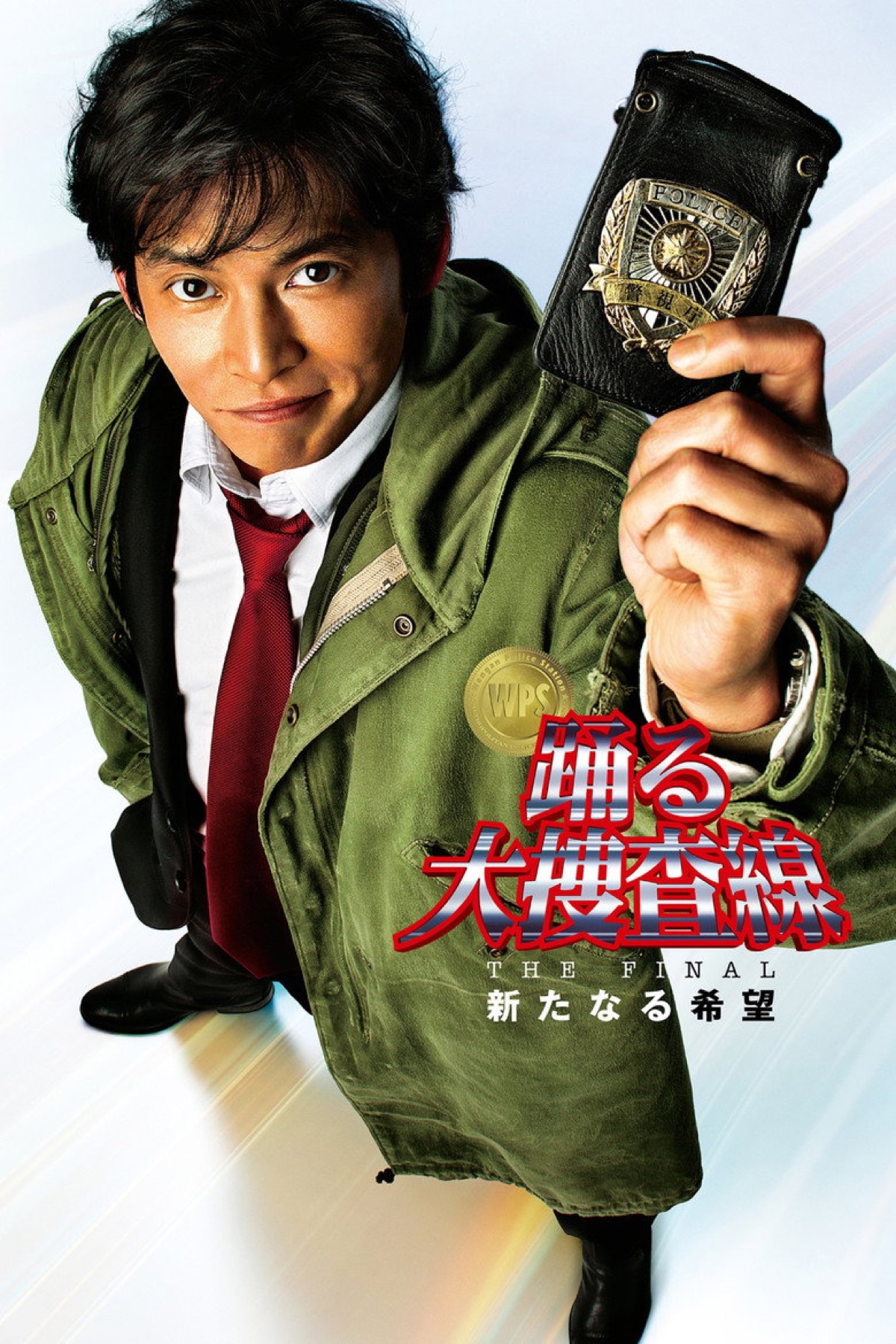
- Title: Bayside Shakedown: The Final, subtitled The New Hope
- Released: September 7, 2012. 126 minutes
- Director: Katsuyuki Motohiro. Screenplay: Ryoichi Kimizuka
- Starring: Yuji Oda, Toshiro Yanagiba, Eri Fukatsu, Yusuke Santamaria, Miki Mizuno
- Music: Yugo Kanno, with Akihiko Matsumoto’s series themes
- Theme song: Love Somebody, performed by Yuji Oda
- Box office: 5.97 billion yen, 4.6 million admissions
- Fourth of the main theatrical films. A fifth opens September 18, 2026
- Source: TMDB
📖 Synopsis – No Spoilers
An international summit is being held inside Wangan precinct’s jurisdiction, and the station has been buried under security duty for it. In the middle of that, somebody is abducted. Hours later the victim is found shot. The weapon is a handgun the police themselves seized and were supposed to be holding.
Headquarters does not want that fact leaving the building. Every piece of information travels upward and none of it comes back down, while the local officers are told repeatedly how much the top floor values them. Aoshima notices that the investigation room is behaving strangely long before he can say why. For its first half the film runs on a simple, effective shape: the problem is not the person who fired the gun, it is the people standing next to you.
✨ What Makes It Special
Why It’s Exceptional
- The best title sequence anybody made for this franchise
- It uses a city that physically changed during the show’s lifetime
- A stakeout scene before the plot starts that you would happily watch for an hour
- It narrows back to the two men the series was originally about
The opening, and a skyline doing the work of a caption
People who dislike this film will still defend the first two minutes of it. I have almost never seen an exception.
The title sequence throws fifteen years at you at speed: words attached to the series, fragments of the earlier films, all of it cut to the show’s main theme. If you came in from the television series it functions like walking into a room full of people you used to work with. Whatever you were doing with your hands, you stop doing it. It is a reunion staged before a single line of dialogue, and it buys the film an enormous amount of goodwill that the second half then spends.
What sits underneath that, and what I think is the smartest thing in the film, is the city. There is a conversation about a case from six years earlier where somebody remembers that you could see Tokyo Tower from the window back then, and gets the reply that these days it would be the Skytree. That exchange is impossible in 1997, when the television series began. Tokyo Skytree had opened on May 22, 2012, three and a half months before this film reached cinemas, and it had already rearranged how the eastern half of the city looks from a window.
Nothing clever is being done. The production simply photographed the Tokyo that existed and let people who had been standing in it for fifteen years talk about it. The elapsed time walks in by itself. This is the one thing a very long-running series can do that a first film cannot, and it is the reason a viewer here feels the weight of the send-off in a way I do not think translates. If you have never watched that tower go up over a skyline you grew up with, it is a building. If you have, it is a date stamp.
The sound does the same job from the other direction. When Yuji Oda’s Love Somebody starts over the ending, the film has already handed you the feeling of a thing concluding, whatever you thought of the two hours before it. He has been singing that song at the door of these films since 1998, and he plays the detective. Complaints about this movie are easy to find. Complaints about how it sounds are not.
The best few minutes are the ones before anything happens
The film proper opens with Aoshima and Sumire undercover, running a fried chicken stall as a married couple. They are not phoning it in. They explain the seasoning to customers with completely straight faces, work the queue, and keep an eye on the target in the gaps.
No case has arrived yet, and none is needed. Two performers who had been playing these people for fifteen years hold several minutes on nothing but the shape of the relationship underneath. You would let them keep frying chicken. I have seen a lot of Japanese viewers write some version of that sentence, and the reason it recurs is that the temperature of the scene never comes back. The moment the abduction lands, that register is gone from the film for good.
Two men, instead of everybody
The previous film ran multiple cases at once and put every recurring face on screen, and it came apart from the sheer width of it. This one pulls back to Aoshima and Muroi. Precinct against headquarters, the ground against the org chart, which is the argument the series was built on. Familiar faces still turn up, but they are visitors rather than subplots. That was the right call and I would defend it against the third film any day of the week.
Deeper Themes
The subject this film finally picks up is the police organization covering for itself. Defenders read that as the series arriving where it was always heading, since the whole franchise has looked at the institution from the ground floor since the line in the 1998 film about where incidents actually happen. Critics read it as a theme bolted on at the last minute for weight. I want to be careful about one thing, because it gets overstated in both directions: the 2005 spin-off Suspect: Muroi Shinji had already gone near this material. What is new here is the main series doing it, in the film that was sold as the last one. The same scenes support both readings, and I cannot get myself onto one side of it.
There is a timing problem underneath the argument as well. In 1997 a Japanese police drama about the field versus the hierarchy was a genuinely new proposition. By 2012 Aibou, the Tokyo detective series that began its full run in 2002 and is still going, had spent a decade making tightly written procedurals ordinary television here, and this franchise’s variety-show reflexes read as looser than they used to. The film did not get worse. The shelf around it filled up.
🎭 Memorable Scenes
We have complete confidence in the officers of this precinct.
The title sequence is the obvious answer, so here is the second one. Headquarters spends the middle of the film thanking Wangan for its cooperation and praising its people, in language that could not be more courteous, while releasing precisely nothing to them. Nobody raises their voice. It is a worse thing to sit through than being shouted at, and it is the most refined version of a humiliation this series has been staging for fifteen years. Watch how the local officers keep answering politely.
The other one is a few seconds long and I will not spoil it. At a critical point, an instruction goes out over the radio to every officer in the operation, and the instruction is a piece of fruit. That is the whole thing. Japanese audiences have been arguing about those seconds since 2012, split roughly evenly between finding it inspired and finding it embarrassing, and nobody has forgotten it. If you only ever see one clip from this movie it will be that one.
💭 How It Made Me Feel
I was not angry. I was just sad.
It is not broken enough to argue with and not sharp enough to applaud. It finishes and you think, oh, that was it. Having given the thing fifteen years, that particular landing is the hardest one to file. There is no complaint to make and nothing to celebrate, and what is left is wanting to thank the cast for the shift.
Then the honest postscript, which is that the sadness has nowhere to sit any more. The series kept going. I saw someone off and they came back, so the feeling I spent in 2012 has been left holding nothing. That is not a criticism of the film. It is just the condition under which anybody watches it now, and it did not exist for the first twelve years of the movie’s life.
😅 Where It Falls Short
Now the part I have been walking towards. The criticism of this film looks scattered until you plot it, and then it turns out to be sitting almost entirely in one place. It is nearly all in the back half.
It has a long way to go after it has stopped being interesting
Getting to the reveal is fine. The institution using its own people is a solid engine, and Aoshima picking at the wrongness of the investigation room is well handled. The problem starts immediately afterwards.
Once the truth is visible the film still has a substantial amount of running time to fill, and it fills it. Having spent that long setting up an argument about the organization, it then resolves at a speed that blurs the edges of everything it built. The setup holds and the payoff does not, which is the shape almost every complaint about this movie takes once you strip the adjectives off it.
The culprit is stupid, and so is the investigation
I will not dress this up. The culprit is stupid. The plan is full of holes and does not look like the work of a person capable of causing this much trouble. Since the stated motive is heavy and the execution of it is childish, the film gets lighter the closer it comes to the end, which is the reverse of what a finale needs.
The people chasing him are not much better. At one point the investigation advances not by reasoning but by imagining how the criminal feels. In a police procedural that is a shortcut you are not allowed, and it is where a lot of viewers check out. A film holding up institutional rot as its subject should not be unlocking it with intuition.
The same applies to how the climax is entered. It is a big piece of staging. As a method of detaining one man it looked excessive to me, and I could not tell whether I was supposed to be laughing. Those are the minutes that sort this film’s audience into two rooms.
Sumire is given a story and then not given an ending
Sumire is handed a significant development about her career in this film. It runs alongside the main plot without ever meshing with it, and where it actually lands is something Japanese viewers still read differently from each other.
She has stood next to Aoshima since the television series, and this was the film with the word Final on the poster. Leaving her thread ambiguous is a decision I still cannot defend. The fried chicken stall is the best scene in the movie and it is hers as much as his, which makes the drop steeper.
The Downsides
- Everything after the reveal is hurried, and there is a lot of it
- The culprit’s plan is careless, and the motive is far heavier than the behaviour
- The investigation advances on instinct where it needs to advance on evidence
- Sumire’s career story is never resolved on screen
- Some sequences let you see the sponsors through them
Who Should Watch This?
- Anyone who watched the television series and never finished the films
- Viewers filling in the franchise before the new film arrives
- People who stopped after the third film and are willing to look once more
- Anybody who only wants to know how Aoshima and Muroi are left
Who Might Not Enjoy This?
- Anyone hoping for the carnival energy of the first two films
- Viewers who need a finale to hold its footing all the way to the credits
- Newcomers trying to enter the franchise here
🤔 About That “Worst in the Series” Reputation
Type the Japanese title into a search box and the suggestions will offer you the word for boring. That has been true for fourteen years. It is worth saying what the reputation is actually made of, because the shape of it is unusual.
Read what people here write about this film at length and two things sit in the same paragraph over and over. The complaints are narrow and specific and they are all about the last stretch. The affection is broad and unspecific and it is about fifteen years. The same person who calls it the weakest entry will thank it four sentences later, and neither statement is insincere.
What I think is happening is that this film is being graded twice at once, and only one grade gets written down. One assessment is of the work: a strong first half, a resolution that does not hold up, a culprit nobody can defend. The other is of a farewell: fifteen years, the same faces, the theme playing one last time. People are dissatisfied and they decline to mark it all the way down, because you do not do that to something you are seeing off. So the loud verdict says worst in the series and the considered one refuses to go that low, and both of those are the same phenomenon looked at from different sides. It does not mean the film is quietly good. It means the verdict was never only about the film.
One number that has nothing to do with feelings: this was the third highest-grossing domestic release in Japan in 2012, at 5.97 billion yen and 4.6 million admissions. Whatever the internet settled on afterwards, the country went.
📺 Streaming Guide by Service
Where to Stream
The honest answer for an American reader is that you cannot stream this, and I have no workaround that does not involve buying a region-free player. What exists is the imported Hong Kong disc described at the top, which does carry English subtitles and is out of print. For a franchise this size that is a thin result, and it is the single strangest fact about Bayside Shakedown.
Order, since that is the other question people ask: watch the films in release order and this one is fourth. Ideally start with the eleven-episode television series, but beginning at the 1998 film works. Both spin-offs sit after the entries they belong to.
The Available Routes
- Import disc listings: the Hong Kong edition has English subtitles, Region 3, stock is scarce
- Japanese streaming services, if you are here or hold an account here
- Our first Bayside Shakedown piece has the viewing order and the franchise background
- Our Bayside Shakedown 2 review covers the entry that broke the box office record
Soundtrack
Yugo Kanno scored this one, working around Akihiko Matsumoto’s series themes rather than replacing them, and the handover is smooth enough that most viewers here never noticed a new composer had arrived. The series music is on both major streaming platforms.
The one to know is Love Somebody. Yuji Oda released it as a single in 1997, a cinema version went over the end credits of the 1998 film, and it has returned for every theatrical entry since, arriving here in a fourth arrangement. An actor singing his own character out of the building for fourteen years is not a normal arrangement, and it is a large part of why the ending of this film registers as an ending even for people who disliked the two hours in front of it.
📀 The Series Did Not End
Everything after this film is worth knowing about, because it changes what this one is. A two-part spin-off following Muroi opened in Japanese cinemas on October 11 and November 15, 2024. A brand new entry, Bayside Shakedown N.E.W., opens on September 18, 2026. Fuji Television has been broadcasting the back catalogue free-to-air across consecutive weekends to set it up, and this film is scheduled for the night of September 19, the evening after the new one reaches cinemas.
None of it has an English-language home release. A boutique label picking up a late-nineties Japanese television and film package is the only realistic route by which this ever becomes properly watchable abroad.
🎬 If You Loved Bayside Shakedown: The Final, Watch These 3 Next
Bakuman Season 3
The exact inversion of this film’s weakness. Three seasons of open threads, and the final run closes every one of them without dropping a single character on the way out. If the back half here left you unsatisfied, watching a long story land properly makes the difference legible in a way no review can. It is also the answer to the question this film raises and does not answer, which is what a finale owes the people who stayed.
👉 Read our review of Bakuman Season 3
Attack on Titan: The Final Chapters
The other famous case of a decade-long series delivering its goodbye and watching its own audience split over it. Different medium, different scale, identical problem: how do you end something people have been living alongside for years, when part of what they want is simply for it not to end? Reachable in the United States, which this film is not.
👉 Read our Attack on Titan: The Final Chapters guide
Sonatine
The same subject at absolute zero. Takeshi Kitano also makes a film about people used up by an organization that decides things above their heads, and he declines every comfort this franchise reaches for. No jokes, no camaraderie, no send-off. Orders come down, men move, nothing changes. Watching it after this one is a cold shower, and it shows you exactly how much of Bayside Shakedown is padding around the same idea.
If the police procedural is what brought you here, the Japanese original of the form is worth the detour. High & Low sits in ten Akira Kurosawa films I sorted by where you can stream them in the US, and every Japanese cop film since has been borrowing from it.
📝 Final Thoughts
As a fan movie, this passes. It collects fifteen years in the title sequence, puts the story back on Aoshima and Muroi, brings the old faces through, and plays the song at the door. The things a farewell is supposed to provide are mostly provided. It is also full of holes, and there is a great deal in it that bothered me. Both of those are true, and describing it without one of them would be a lie.
So the recommendation is narrow. If you have followed the series, finish it. If you have not, do not start here, and honestly you cannot start here anyway. And remember what I opened with: the film that called itself the last one is now the fourth of five. Whatever the send-off was worth in 2012, it has been overtaken by a franchise that turned out not to want to stop. That is a peculiar fate for a movie, and it is the reason I would still tell somebody to watch it. Nothing else in this series is a document of a goodbye that got taken back.
Japanese television has moved a long way from the network era this series came out of. Ten Japanese drama series from the streaming decade are sorted separately, with where to watch each one in the US.
⭐ Film at a Glance
| Category | Rating | Comment |
|---|---|---|
| Title sequence | ★★★★★ | Fifteen years in two minutes, best in the series |
| Music | ★★★★★ | The theme, and Oda’s own song at the door |
| Aoshima and Muroi | ★★★★☆ | Back at the centre, where the show began |
| As a send-off | ★★★☆☆ | Does the required things. A pass, not a triumph |
| Case and resolution | ★★☆☆☆ | Holds until the reveal, then hurries |
| As a mystery | ★☆☆☆☆ | Partly solved by guessing at feelings |
Usagi’s Recommendation Score
⭐⭐⭐⭐⭐⭐☆☆☆☆
6.0 / 10
It did what a last film should do. It just stopped being the last film.

