*This page contains affiliate links. We may earn a commission if you make a purchase through these links.
Fourteen years pass between the second Rebuild film and this one. Nobody on screen will tell Shinji Ikari what happened in them. Nobody tells you either, and the film never once behaves as though that were a problem it ought to fix.
I came to this one holding every advantage a viewer can hold. The 1995 series, The End of Evangelion, both Rebuild films in front of it. It shook me off anyway, thoroughly, in the first ten minutes. What took me years to work out is that being shaken off is the design. The boy at the centre is handed nothing, you are handed nothing, and the two of you go through the same 95 minutes in the same condition. “I did not understand it” is not a failed reading of this film. It is the reading.
📺 Where to Watch Evangelion: 3.33 (August 2026)
| Service | Status | Notes |
|---|---|---|
| Blu-ray / DVD (US) | The only option | The 2016 US disc, English dub included |
| Amazon Prime Video | Streaming | Back on Prime Video as of September 2026, after the 2021 licence lapsed on August 13 |
| Digital storefronts | Not listed | GKIDS covers 1.11, 2.22, the finale. Not this film |
| Crunchyroll | Not available | Never carried the Rebuild films |
| Netflix | Not available | Netflix US has the 1995 television series, not these four |
| Hulu | Not available | Not carried in the US |
As of August 28, 2026, nothing in the United States streams this film, rents it, or sells it as a download. Every Rebuild title had sat behind a single Prime Video subscription internationally since August 13, 2021. That deal ran exactly five years, expired on August 13, 2026, and took the whole quartet off the service on the same day. GKIDS holds North American rights to 1.11, 2.22 and the finale, which is why those three are still one click away on the usual storefronts. This one is the hole in that list. The disc is what is left.
Rights move without warning, and a title with nobody currently holding it is exactly the kind that reappears somewhere in six months. Check the storefronts yourself before you treat any of the above as permanent. If it does come back, it will most likely come back with the other three attached.
👉 Do not start here. This film is built on the assumption that you felt the temperature of the previous one, and if you did not, the thing it does to you cannot happen: Evangelion: 2.22 You Can (Not) Advance.
🎬 Trailer
Work Info
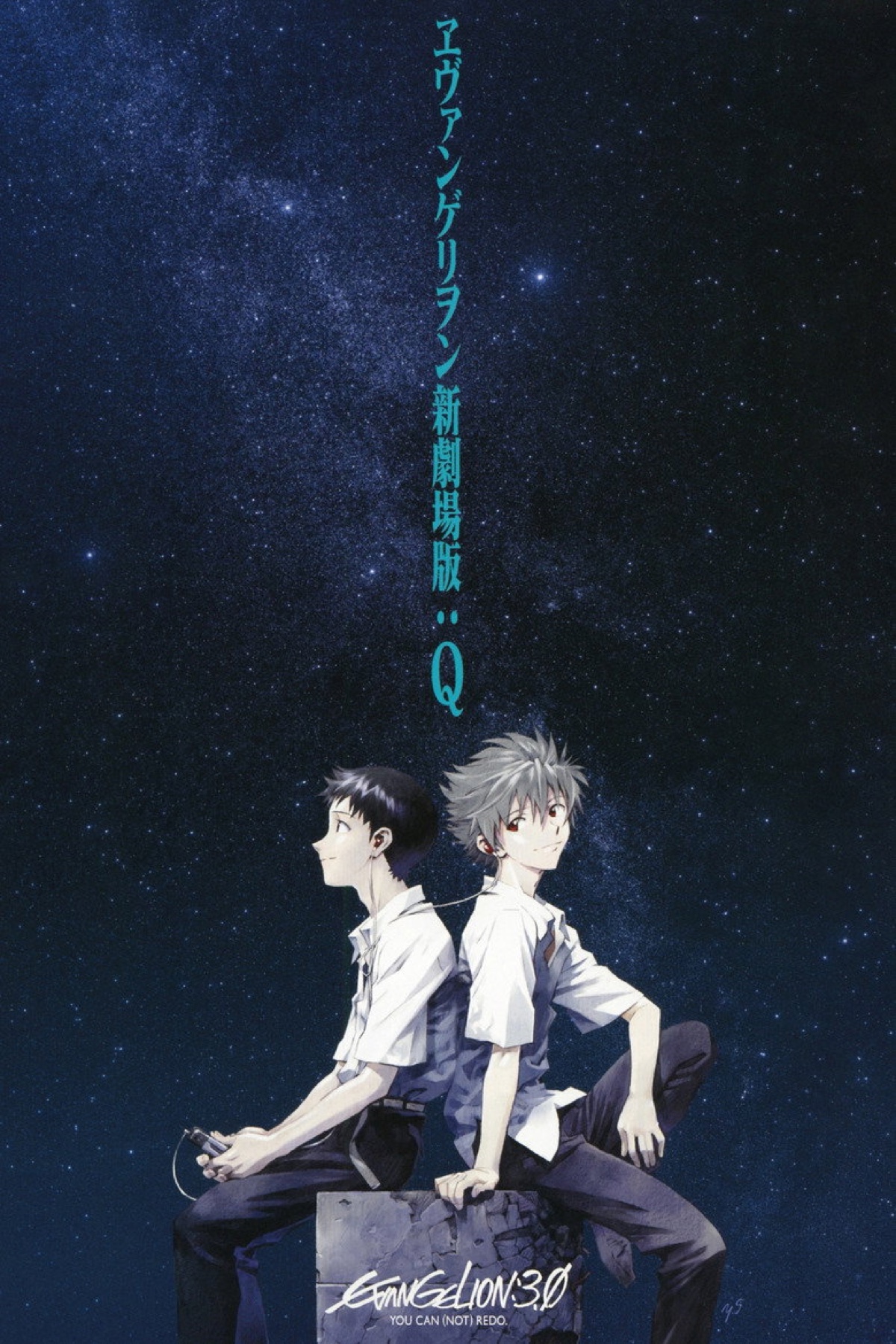
- Title: Evangelion: 3.0 You Can (Not) Redo (2012). The home video cut is titled 3.33
- Japanese title: Evangelion Shin Gekijoban: Q. In Japan the film is called Q, never 3.0
- Chief Director: Hideaki Anno
- Directors: Masayuki, Mahiro Maeda, Kazuya Tsurumaki
- Music: Shiro Sagisu / Theme song: Sakura Nagashi by Hikaru Utada
- Runtime: 95 minutes, the shortest film in the series
- Studio: Khara
- Released: November 17, 2012 in Japan. Funimation put it on US disc on February 2, 2016
- Japanese box office: about 5.3 billion yen by the end of 2012
- Sources: Japanese theatrical records, US home video listings
📖 Synopsis – No Spoilers
Shinji wakes up. The first thing anyone tells him is that fourteen years have gone by, and that he has not aged through any of them. The adults he knew are now staffing an organisation called Wille, which regards him as a hazard and fits a collar around his neck to prove the point. NERV headquarters is quiet in the way a building is quiet after everybody has left it. What happened in the missing years, and what part he had in it, is information nobody volunteers.
The camera stays roughly inside his line of sight for the whole picture, which means his ignorance is your ignorance, minute for minute. Sit down expecting the sequel to a film about three teenagers reaching for each other and the floor comes out from under you before the ten-minute mark. The story only begins to move when a boy named Kaworu Nagisa walks up to him and starts talking.
✨ What Makes It Special
Why It’s Exceptional
- Withholds from the audience exactly what it withholds from its lead, for the full length
- Deletes ordinary life from the frame, then fills the gap with density
- One piano duet, which is the only soft thing anywhere in it
- The only Rebuild film that offers no rescue, which is what makes it the closest to 1995
You are left behind because you were meant to be
Shinji asks questions in this film almost constantly. What happened. Why is he being treated like this. Where did she go. Track them and you notice something: every one of his questions is the question you are holding at that exact moment. He is not being written as a passive lead. He is being written as your proxy in the room, asking on your behalf, in your order.
Then nobody answers him. Misato Katsuragi goes silent. Ritsuko Akagi processes him like paperwork. Asuka throws her irritation at him without ever once explaining what it is about. Question, silence, question, silence, and somewhere in that loop your own irritation climbs until it is running at the same temperature as his. The explanation is missing so that you have to feel the irritation instead of watching it. A film that told you what happened in those fourteen years would be a film in which you watch a boy be lost. This is one where you are lost with him.
Whether you file that as contempt for the audience or as the most committed thing in the series is the fault line the whole reception runs along, in Japan as much as anywhere. I land on the second side. My reason is plain enough: if the film explains itself, the specific loneliness of where the boy is standing never reaches you, and that loneliness is the entire picture. A supplementary episode filling in the gap would have been the kinder choice. The version of this film you watch afterwards is a weaker one.
But here is where I have to be honest. Everything I just wrote is available to me on the second pass, not the first. The first time through I was as lost as anybody, in a bad mood about it, and reading it as a filmmaker losing the thread. Getting angry on your first viewing is the correct response to this film. The only thing I would push back on is stopping there.
Ordinary life is deleted from the frame
The first two films had classrooms. A kitchen. A convenience store, a swimming pool, a bedroom with a wall somebody had to paint. The fantasy sat on top of that ordinary furniture, which is what gave it weight and what made the losses hurt. This film throws the furniture out. What is on screen is a ship’s interior, red waste, installations that stopped being used a long time ago. Almost nobody in this picture lives anywhere.
What replaces it is density. The opening operation around the Wunder runs for over ten minutes while you understand essentially none of it, and it is impossible to look away from. Line weight, the amount of information moving per second, the sheer stubbornness of the compositions: none of it belongs in the same series as the 2007 film. Getting overwhelmed by the image while the plot stays out of reach is a specific pleasure, and there are not many films built to deliver it.
The palette does the same job by subtraction. Everything is red, rust, grey metal, and the film keeps the range that narrow for the full 95 minutes, so the eye has nothing to rest on either. Emptying out the world is the largest formal choice in the picture, and the reason the few moments of warmth carry as much as they do is that the film spent an hour making warmth impossible.
The piano duet is the only soft thing in it
Exactly once, two people in this film get near each other. Kaworu sits Shinji down at a piano and teaches him to play. It goes badly. They fall out of time, stop, restart, fall out again, and gradually the two hands begin to agree. Getting your timing to match another person’s was ordinary in the first two films. Here it registers as an event.
Kaworu never blames him for anything. He answers questions, at his own pace, which by this point in the film feels close to extravagant. In 95 minutes of cold people, this one boy is placed there as the exception, and what the exception is for does not become clear until very late.
It is also the only sequence in the film with no plot inside it. Nothing advances. Two people sit at an instrument and are bad at it together, and the picture just lets that happen for a while. Coming after an hour of organisations glaring at each other, the effect of a scene with no agenda in it is close to physical relief.
The one film in the series with no rescue in it
“This does not feel like Evangelion” is the complaint this film collected more than any other. It only holds if the Rebuild films are your yardstick. Measure against the 1995 series instead, or against The End of Evangelion, and the arrow flips. Hope was the departure. The first two Rebuild films are the ones doing something new; this one goes back. Viewers who came up through the television series tend to arrive at that reading on their own.
Four films, and this is the only one that declines to hand anybody a way out. The first closes on a boy who managed something. The second closes on a boy who chose something. The finale, arriving nine years after this one, has somewhere further to go. This is the film that closes on the bill. A series needs exactly one entry willing to do that, and putting it third, with the audience already committed, is the most expensive place to put it.
Deeper Themes
Look at the English subtitle again. YOU CAN (NOT) REDO. Two contradictory readings sharing one line, with a bracket deciding which of them you get. Can what the boy chose at the end of the previous film be taken back? The film spends 95 minutes on that question without once making it easier to answer, and the bracket is the honest form of the answer.
There is also the board. Some way into the picture, Kozo Fuyutsuki sits Shinji down over a game of shogi and tells him he is thirty-one moves from checkmate. Roughly thirty-one minutes of screen time later, the thing he announced happens. Viewers have sat with stopwatches to confirm it. Whether Anno built that or it fell out of the edit is argued about, and I would not bet on either side. It is a good reason to watch the second time with a clock running.
🎭 Memorable Scenes
The woman who told him to go, in the last film, will not look at him in this one. She tells him, in substance, that there is nothing further he is to do. No reason is offered, then or later.
Misato, in the first minutes. That single exchange carries the whole fourteen years without describing any of it. You do not learn what she went through. You learn what it turned her into, which is more information than a flashback would have given you, delivered in about fifteen seconds.
The duet. They keep losing the beat. Somebody laughs. It is very close to the only point in the film where a face relaxes, and looking back afterwards, the scene seems to have been lit at a different colour temperature from everything around it.
Walking into the red. Nothing is resolved. They start moving anyway, and Hikaru Utada’s Sakura Nagashi comes in over them. That is the moment the film got me. Ninety-five minutes of held breath, let out over a piano.
💭 How It Made Me Feel
The first viewing leaves you holding confusion where the satisfaction was supposed to go. You cannot say what you were just shown. The useful part is that the confusion has a completely different texture from boredom: it does not settle, it rolls around your head for days making more questions out of itself.
Then you go back, and again, and the shape starts assembling in pieces. Taking a story you could not receive in one sitting and receiving it over years is what “I have seen Evangelion” actually means. That the series could travel this far from where it started, land somewhere completely separate from the 1995 version, and still have this much floor left under it is something I feel plainly lucky about. Not many things you loved at fourteen are still capable of that.
I suspect this hits differently if you were in Japan for it. The film opened in November 2012 and the next one arrived in March 2021. Nine years, sitting inside this ending, with no way to skip forward. Whatever your relationship with this film is, ours got built over almost a decade of not being allowed to know.
Who Should Watch This?
- Anyone who stopped after the second film, unsure whether to keep going
- Anyone running all four films through in one stretch (the best way to meet this one)
- Anyone who saw it back in 2012, hated it, has been carrying that ever since
- Viewers who enjoy being overwhelmed by an image they cannot yet explain
😅 Where It Falls Short
There is nothing left to protect
If you want one reason the first two films worked, it is that the thing being defended was visible. A city, the people in it, the pilot in the next machine over. Climbing into an Evangelion meant something you could share from your seat.
None of that survives into this film. Organisations circle each other, Evangelions fight Evangelions, nobody is moving on anybody’s behalf. Shinji goes from room to room and is unwelcome in all of them, including the ones holding people he thought were his. Before the plot is difficult, there is nowhere to put your feeling, and that discomfort has nothing to do with how hard the film is to follow.
Ninety-five minutes with no place to rest
I called the deletion of ordinary life a strength further up, so let me pay for that. It is also a loss. Those small domestic scenes were what kept an absurd premise anchored, and with them gone, every abstract conversation lands with nothing under it to absorb the impact. There is no room in the picture to put your weight down.
The practical consequence: 95 minutes of unbroken tension is a real ask, and starting this at the end of a long day is a mistake. Pick your evening for it.
The adults not explaining does not hold as behaviour
I have spent this whole article defending a film for refusing to explain itself. Here is the part I cannot defend. Wille’s people withhold everything from Shinji, and as an organisational decision it does not stand up. If you believe the boy is dangerous, the fastest route to keeping him still is telling him what is going on. As a device for disorienting the audience it works. As something these particular adults would do, it does not.
What follows from it is that Shinji walks straight into the worst available outcome. I still cannot bring myself to blame him. Put a fourteen-year-old somewhere nobody will tell him anything, hold out the one thing that looks like hope, then ask him not to reach for it. That genuinely bothered me. I still think this is one of the best things in the series.
The Downsides
- Nobody fights for anybody, so there is nowhere to put your feeling
- Ordinary life is gone from the frame, leaving 95 minutes with no slack in them
- The adults’ refusal to explain works as a device, not as behaviour
Who Might Not Enjoy This?
- Viewers expecting the warmth of the previous film to continue
- Viewers who want a film to finish its own story inside its own running time
- Viewers with no appetite for reading up afterwards
📺 Streaming Guide by Service
The odd one out on the American shelf
For five years the American answer to this question was one word long. Everything lived in the same place, under one monthly charge, with nothing else to weigh it against. Then the paperwork ran out this August, the entire set disappeared in a day, and the easiest major anime title in the country to locate turned into one of the hardest.
The other three landed on their feet. GKIDS handles 1.11, 2.22 and Thrice Upon a Time in North America, so those are buyable or rentable today from the storefront of your choice. The third film is the one GKIDS does not carry, which leaves it with no US digital home at all right now. If somebody tells you they cannot find it, they are not looking wrong.
Where to Watch
- Disc (Amazon US): the only way in right now, English dub plus subtitles
- Amazon Prime Video: gone since August 13, 2026, along with the other three films
- Crunchyroll / Netflix / Hulu: not available in the US
Soundtrack
- Spotify: available
- Apple Music: available
Shiro Sagisu’s score keeps the choral pieces at the same wrongness they have in the film, which is the point of them. The end theme sits outside the album, on its own, so here is the piece of context that changes how it sounds. Hikaru Utada had been on an announced indefinite hiatus from music since the end of 2010. Sakura Nagashi, released on the film’s opening day, was her first new song in two years, made because the production staff asked and because of what the series meant to her, with no promotion attached to it whatsoever. Japanese listeners knew all of that going in. It is not a tie-in single. It is somebody stepping out of a silence once, for this.
📀 On Disc
A film that has just vanished from every service in the country is the clearest argument for physical media anybody could construct. Funimation released it in the US on February 2, 2016, with the English dub plus subtitles, at 95 minutes.
One thing to know before you buy. Japan has a further revision, 3.333, which went into Japanese cinemas on January 8, 2021 and onto 4K UHD that August. Anno had the whole film recaptured, adjusted the lighting, the colour, a number of small objects, and replaced the next-film preview with real footage from the finale. The US disc is the 2016 cut, not that one, and no English-language release of 3.333 has been announced.
🎬 If You Loved Evangelion: 3.33, Watch These 3 Next
Cure
Kiyoshi Kurosawa is not holding his answers back for later. He has no answers on the premises. His 1997 film keeps the audience standing on the same bad footing as its detective for two hours, and the way not-knowing accumulates into dread is the identical mechanism to the one running here. Where this film does it at volume, Cure does it in near silence, which turns out to be worse.
Millennium Actress
Satoshi Kon ends his film without ever saying the one thing the audience came to find out. The answer stays off-screen, deliberately, in a picture that is otherwise completely sealed. Handing you an empty space as an empty space takes the same nerve Anno is running on, and Kon does it in 87 minutes, which your head can manage on the same evening as this one.
👉 Read the Millennium Actress review
Ghost in the Shell 2: Innocence
Mamoru Oshii made zero concessions to comprehension in 2004. The dialogue is assembled out of quotations you will not catch on a first pass, the plot is barely holding your hand, and the density of the image carries you through regardless. If being hit with pictures while the story stays out of reach is the sensation you are chasing, this is the deep end of it. Anybody who got a strange kick out of the first ten minutes here will be at home.
👉 Why are the pilots 14? Why does an Eva bleed? Why does the story have two endings? The questions that run across the whole series are answered in Why Are Evangelion Pilots 14? The Answer Everyone Repeats Has No Source.
📝 Final Thoughts
This is not a film that can be graded on its own. People who saw it in 2012 were left in this exact condition for nine years, and the wait was part of what the film was. You do not have to do that. Being able to start the next one while still confused changes the whole reading, and a lot of what the cinema audience could not collect at the time is collectable now, in one sitting, in order.
Be as annoyed as you like about not being told anything. Remember what I said at the start about being shaken off on purpose: the annoyance is the correct response, Shinji is standing in the same place, and neither of you is supposed to be comfortable. Just do not stop while you are still annoyed. Eight out of ten, and it is a strange eight. Two points off for a film that is deliberately hard to sit through, awarded by somebody who thinks the hardness is the best thing about it. The deepest hole the Rebuild films ever dug is right here, and the fact that they got this far from 1995 without losing any depth is the reason I keep coming back.
⭐ Series at a Glance
| Category | Rating | Note |
|---|---|---|
| Story | ★★★☆☆ | Opens a hole. Closes nothing |
| Characters | ★★★★☆ | One boy at a piano carries the human weight |
| Music | ★★★★★ | Sagisu’s choral wrongness, then Utada at the door |
| Visuals | ★★★★★ | Denser than anything else in the series |
| Clarity on a first viewing | ★★☆☆☆ | Low by design, not by accident |
| Rewatch value | ★★★★★ | The second pass is where it starts working |
Usagi’s Recommendation Score
⭐⭐⭐⭐⭐⭐⭐⭐☆☆
8.0 / 10
You are not meant to get it in one pass. The second one is the real screening.

