*This page contains affiliate links. We may earn a commission if you make a purchase through these links.
Before anything else: this is not a bad film. Since 1995 the series has circled one idea, which is that a toy gets outgrown eventually, and the fourth one walks further into that idea than any of the three in front of it. Forky is the most inventive thing anybody has put in a Toy Story movie. Gabby Gabby is the part of this film I like most. And I cannot bring myself to like the film.
It comes down to one thing. The conclusion Woody arrives at in the closing stretch makes you ask what the previous three films were for. Coming from Buzz, I could have taken it. Coming from Woody, it reads as 24 years of history getting one line rewritten at the very end. That is emphatically not the general verdict. The film sits at 96% on Rotten Tomatoes, it won Best Animated Feature at the 92nd Academy Awards, and here in Japan it cleared ¥10 billion at the box office on 7.78 million admissions. So take everything below as a specific complaint from somebody who came through 1, 2 and 3 in order, because that is the only place this complaint exists.
📺 Where to Watch Toy Story 4 (October 2026)
| Service | Status | Notes |
|---|---|---|
| Disney+ | Streaming | All four films behind one subscription |
| Amazon Video | Rent / Buy | A Prime membership does not include it |
| Apple TV | Rent / Buy | Same on YouTube, Google Play, Fandango at Home |
| Hulu | Not available | Hulu stops at the first two films |
| Netflix | Not available | Disney keeps its own features at home |
| Crunchyroll | Not available | Not an anime service title |
Disney+ is the only US subscription carrying Toy Story 4, and every other route is a per-title rental. Hulu has the first two films in the series but not this one or Toy Story 3, so a Hulu-only household finds the run breaking off at the halfway mark.
👉 Whether this film costs you anything depends entirely on what Toy Story 3 left you holding. If that ending has gone soft in your memory, start there instead.
🧸 What Is Toy Story 4 Rated, and Is It Too Much for Young Kids?
Toy Story 4 is rated G and runs 100 minutes. The G is accurate. There is no language to speak of, nobody gets hurt in a way the film dwells on, and the danger is the cartoon kind that resolves within the scene.
If anything gives a small child pause, it is the antique store. Gabby Gabby’s helpers are a set of ventriloquist dummies who move without a word, and the store is shot at night with the lights down. It is the spookiest stretch the series has staged since Sid’s bedroom in the first film, and the film gets out of it fairly quickly.
The weight in this one falls on the grown-ups. A child meeting Woody for the first time has nothing riding on the final scenes. Whoever brought them, especially anyone who came through films one to three in order, may walk out quieter than the kids do, which is the argument the rest of this review keeps having with itself.
🎬 Trailer
Work Info
- Title: Toy Story 4 (2019)
- Director: Josh Cooley, directing his first feature after two Pixar shorts
- Screenplay: Andrew Stanton, Stephany Folsom
- Music: Randy Newman, who has scored all four films
- Runtime: 100 minutes
- Studio: Pixar Animation Studios / Distributed by Disney
- Released: June 21, 2019 in the US, July 12, 2019 in Japan
- Awards: Best Animated Feature at the 92nd Academy Awards
- Source: TMDB
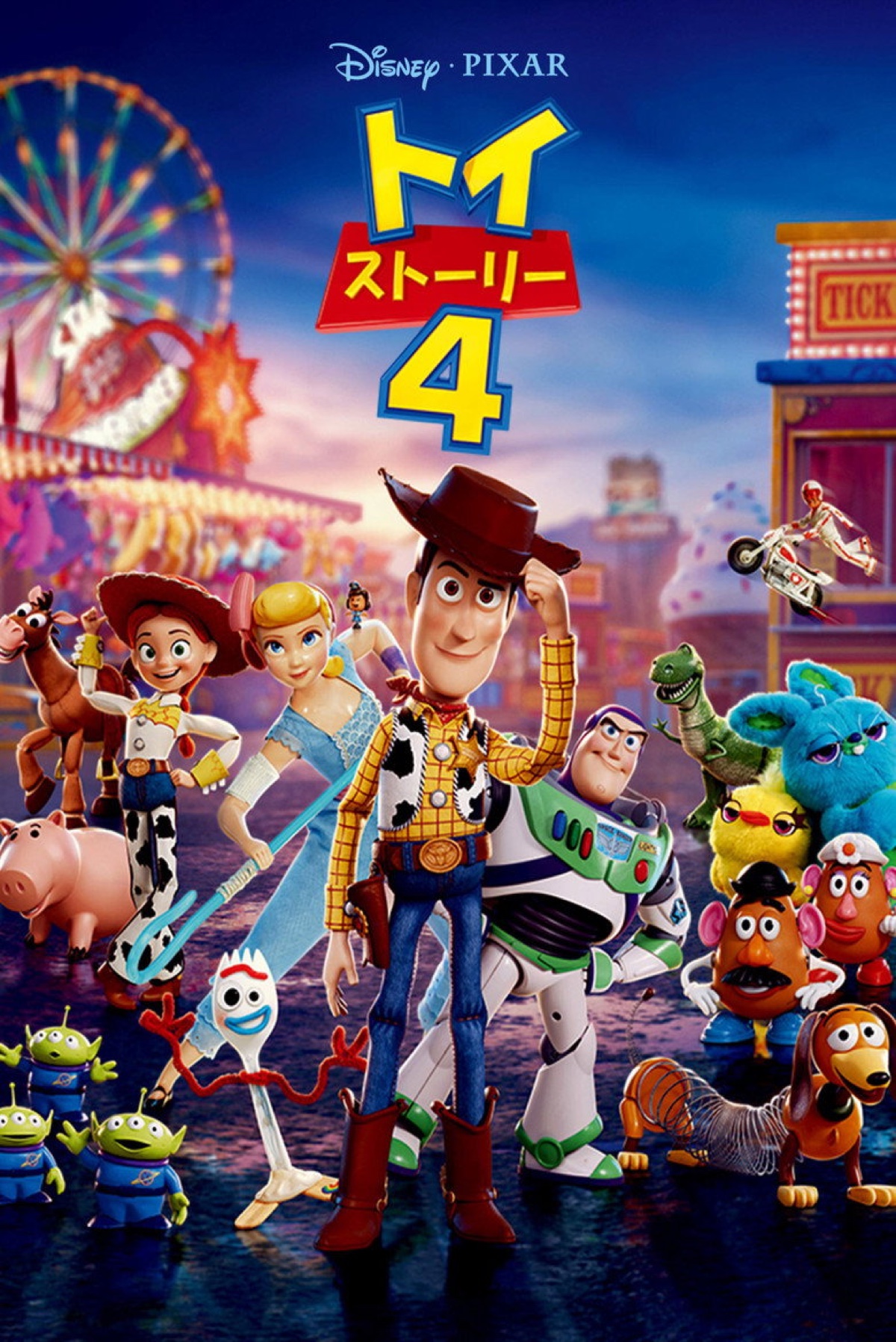
📖 Synopsis – No Spoilers
Woody does not belong to Andy any more. Bonnie has the room now, and Woody spends most of playtime shut in the closet. On her kindergarten orientation day Bonnie is frightened enough that Woody stows away in her backpack. When a classmate knocks her craft supplies into the bin, Woody dives in after them, and what he dumps back on her table includes a used plastic spork. Bonnie builds it into a toy with pipe cleaner arms, popsicle stick feet, googly eyes. She writes her name on his feet. She calls him Forky.
Forky has other views. He has concluded that he is trash, and he keeps making a run for the nearest bin. Woody appoints himself the one who fetches him back, over and over. Then the family takes an RV trip, Forky goes out of a window, and Woody follows him into a strange town at night. Passing an antique store, he sees a lamp in the window that he last saw nine years ago. Bo Peep was the porcelain figure attached to it.
✨ What Makes It Special
Why It’s Exceptional
- The series finally films the moment a toy wakes up, using a spork out of a bin
- Gabby Gabby wants exactly one thing, and it is not power
- Rain, run-off water, wet plastic: the opening is the technical peak of the series
- Four new characters inside 100 minutes, all four with a job to do
Forky is the series filming the moment a toy wakes up
The boldest thing in this film is that the camera stays on the birth. Bonnie sits at the table and works: the eyes go on, the pipe cleaner gets twisted, a name goes onto the feet. Next cut, the thing is standing up under its own power. Three films kept that moment off screen for 24 years. The fourth one shoots it in daylight in a classroom.
Better still, the newborn does not accept the job. “I’m not a toy! I’m a spork! I was made for soup, salad, maybe chili, and then the trash.” He is not being modest about it, he is being accurate. For a disposable utensil, getting thrown out after use is not a tragedy, it is the end of a completed assignment. Read the running gag that way and it inverts. Forky sprinting for the bin is not despair. He is trying to finish the work he was made for, and Woody keeps dragging him off the job.
One local footnote, because the object is not neutral where I live. In Japan a spork has its own name, sakiware supun, the split-tip spoon, and for a couple of generations it was the standard utensil in school lunches rather than a picnic accessory, which makes it a childhood object here. It also got itself thrown out. Campaigners blamed it for inugui, literally eating like a dog, the habit of dropping your face to the tray instead of lifting the bowl, and cities began removing it: Kawaguchi took it out of its public elementary schools in 1992. The item Pixar chose to stand for worthless garbage is, over here, the thing a Japanese adult of a certain age associates with being seven years old. Watching Forky insist on the bin plays a little differently when the utensil itself was expelled from the country’s schools for encouraging bad posture.
There is a second wrinkle from this side of the ocean. Japan already had a rule for objects coming to life. In the old telling, a tool that survives a hundred years picks up a spirit and becomes a tsukumogami, and the qualification is time served. Forky clears the bar in roughly thirty seconds with no service history whatsoever, and the film treats his claim on existence as no weaker than Woody’s decades of it. That is a larger argument than it looks.
This is the film’s opening move. Forky puts his whole body behind the proposition that being useful is happiness. The second half then sets about dismantling that proposition from the inside. As design work it is excellent, and whatever else I am about to say, refusing to leave Forky as a cute mascot was the right call.
Gabby Gabby wants one thing, and it is not power
The doll on the antique store shelf is my favorite thing here. No world domination, no revenge, no scheme beyond the immediate. She wants a child to choose her, once. She wants nothing more than that.
Worth correcting a thing people misremember about her: she is not mute. Her voice box came out of the factory faulty, so the recording plays back warped. Her own line on it is that the record works just fine, it is the voice box that is broken. She speaks perfectly well in every scene she is in. One defective component, fitted before she ever reached a shelf, is what kept her unbought for decades.
Which is why her methods are ugly, why her first appearance is shot almost as horror, and why the urge to blame her drains out of you as the film goes. When a villain’s only motive is wanting to be loved, at some point it stops being a villain’s story. Lotso stood in the same spot in the third film, but Gabby has less room to move, because her loneliness is a manufacturing defect she carries around in her chest. Reading through Japanese reviews of the film afterwards, the same sentence keeps surfacing in different wording: nobody expected the doll to be the one that got them.
What happens to her at the carnival stays out of this review. I will say that as a landing for an antagonist it is the cleanest thing the series has managed.
The storm in the first five minutes ends the CG argument
It opens nine years earlier, on a night of heavy rain: falling water, a storm drain running over, light sitting on wet plastic. Shown that stretch cold, a fair number of people would call it live action. Set it against 1995, when the entire pitch of the first film was that a computer could do this at all, and 24 years looks like a very long distance.
The use of it is smarter than the showing off. Bo Peep is a porcelain figure off a bedside lamp, and in this film she carries most of the physical action. However far she jumps, the body never stops reading as ceramic, so every landing arrives with a half second of bracing for the crack.
I should flag what is coming, because I have now spent a while admiring a film I am about to turn on. Both positions are held sincerely, at once, and the second half of this piece is me failing to reconcile them.
Deeper Themes
The film builds a premise and then knocks it down itself. Forky demonstrates, physically, that fulfilling the role you were handed is happiness. Bo Peep is placed on the other side of the room as living proof that you can walk away from having a role at all. What the first half asserts, the second half retires. Set against three films running on a single conviction, which is that a toy belongs beside a child, that is a large turn of the wheel. Read generously, the series graduated out of fantasy into human drama, and there are people who read it exactly that way. Whether the characters standing on the other side of that graduation are still the ones you knew is a different question, and this film does not answer it.
🎭 Memorable Scenes
I’m sure she’ll pick you next time.
1. The hat shop
Bonnie throws the closet open and hands out parts. Mayor, banker, ice cream man, hat shop owner, mail man. Then she picks Woody up, pulls the sheriff badge off his shirt, drops him back on the floor, and shuts the doors. Through the slats he watches Jessie wearing his badge. The toys left in the closet beside him are the ones Bonnie outgrew a while ago, and one of them asks when they last got to play hat shop. Opening a film there, before anything else happens, decides everything that follows.
2. Fetching Forky, again
The mirror of it. Forky bolts for the bin, Woody runs him down, dusts him off, carries him home. It is built as comedy and it plays as comedy. It is also the same wound: the reason Woody will do this indefinitely is that somebody who needs looking after is a job, and he has just been made redundant from the only other one he had. Randy Newman scores the sequence with a song titled I Can’t Let You Throw Yourself Away, which is doing double duty and knows it.
3. The line
Late on, the signature line of the series comes back around. Who says it, and who it is aimed at, stays out of this review. Those words have been in every one of these films since 1995. Here they mean something they have never meant before.
💭 How It Made Me Feel
Two verdicts sat side by side for the whole runtime and neither one would move. The head signs off. The feeling never turns up. I would not have guessed those two could hold position against each other for 100 minutes without one of them collapsing.
What lingers is not really about this film. It is the question of whether the last scene of Toy Story 3 can still be watched the way it used to be watched. I am not confident that it can, which is a strange thing for a sequel to do to the film it is extending. Plenty of good films sit awkwardly beside their own series. Very few of them reach backwards.
(I am aware that taking a toy’s career decision this personally means the film has already taken something off me.)
👉 It streams on Disney+ in the US, sitting alongside the other three.
Who Should Watch This?
- Anyone who has seen films 1 through 3 and has been putting this one off for years
- Anyone who came out of it uneasy and wants the unease put into words
- Anyone curious about where Pixar’s rendering actually got to (strongly recommended)
😅 Where It Falls Short
Time to be straight about the shape of what follows. Not one of the three complaints below is that the film is badly made. That is precisely what makes them impossible to put down.
It writes over the landing Toy Story 3 had already made
The third film shut the series in about as clean a shape as anybody could ask for, and that ending stood as finished for nine years. The fourth lays a different ending on top of the residue of it.
The awkward part is that you cannot unsee it. Go back to the third film now and its final scene only reaches you through the fourth. Whatever you make of this movie, that overwrite happens on contact. When people call a sequel unnecessary they usually mean it added nothing. This one is more specific than that: something you already owned got edited.
The one pulling the lever is Woody. What he chooses is not going in here. It does not sit easily on top of what the character built across the first three films. Bonnie had already drifted, and I understand that. He wants to be near Bo, and I understand that. A life with no owner is a coherent position, and I understand that too. What I could not put down was whether it had to be Woody.
Had it been Buzz, this would be a different conversation. Buzz had his entire sense of himself rebuilt once already, in public, in 1995. Taking the character who spent 24 years refusing to bend and having him set the conviction down in the last stretch is where the accumulation came apart for me.
The old crew is barely in the film
Jessie, Rex, Hamm, Mr. Potato Head, the Aliens. The third film found something for every one of them. At the incinerator it was Jessie and the others who took each other’s hands, while the Aliens were somewhere else entirely, working the industrial claw that hauled everyone out. Here, Jessie apart, they are furniture. Even Buzz spends most of the runtime on his own, and the Woody and Buzz double act is thinner than you would ever guess from the poster.
To be fair to Jessie, she does get one decisive move, involving a nail and an RV tire. That counts for something, though it is also roughly the size of what the entire group gets between them.
The reasoning is obvious enough: this is Woody’s film. But a real share of what this series is worth was always just those characters being in a room together. If this turns out to be the last one, handing them that little time is a poor allocation.
The toys start putting their hands on the humans
The series runs on a rule: toys must not move in front of people. It mattered in 1995 that Woody broke it outright, in front of Sid, as a deliberate one-off act of terror. In this film, toys steer human behavior repeatedly, and it is treated as ordinary.
The plot needs it, and I can follow the need. It still felt like the physics of the world coming loose. A restriction kept expensive for 24 years stops being a restriction the moment it becomes a tool, and the whole history of having kept it gets cheaper retroactively. A film that took the birth of Forky seriously as a birth should not be this casual inside the same 100 minutes.
The Downsides
- What the third film left you gets rewritten the moment you watch this one
- Woody’s final decision does not sit on top of three films of groundwork
- Jessie, Rex, the Aliens and the rest are close to absent
- The no-moving-in-front-of-humans rule gets demoted to a plot device
Who Might Not Enjoy This?
- Anyone holding the ending of the third film as a finished thing
- Anyone with a particularly strong attachment to Woody as a character
- Anyone here for the noise of the whole gang being together
📺 Streaming Guide by Service
Which service is the right one for Toy Story 4?
One shelf, one subscription. Disney+ carries it and nothing else in the US does on subscription, Hulu included, even though Hulu has the first two films. So the split is simple. Renting is the cheaper answer for a single viewing. If you plan on working through all four, the subscription pays for itself on the second film.
Running the set is rather the point. This film is close to meaningless on its own, because it is built entirely on what you carry in from the other three. Watch it cold and you get a competent road movie about a spork. Watch it fourth and it becomes an argument about a character you have known since 1995.
Where to Stream
- Disney+: Streaming, as are the first three
- Amazon Prime Video: rent or buy, a Prime membership does not cover it
- Apple TV: rent or buy, at the same price on YouTube, Google Play, Fandango at Home
- Hulu / Netflix: not available in the US
Soundtrack
- Spotify: available
- Apple Music: available
Randy Newman has scored every film in the series. The song written for this one, I Can’t Let You Throw Yourself Away, plays over the stretch where Forky keeps heading for the bin. It was nominated for Best Original Song at the same ceremony that handed the film Best Animated Feature, and Newman performed it live on the night. Elton John took the award.
📀 On Disc
The storm in the opening, plus the glaze on Bo Peep, are exactly the places where streaming compression shows itself. The disc landed in the US on October 8, 2019, a 4K UHD edition bundled with the Blu-ray, which is the version to own if you intend to rewatch the series on picture quality alone.
🎬 If You Loved Toy Story 4, Watch These 3 Next
Weathering with You
The same experience, transplanted to Tokyo. Makoto Shinkai hands his lead a decision in the last act that a good share of the audience cannot follow him into, and you carry it out of the theater with you. What makes it useful next to this film is that nothing is wrong with the movie. The friction is entirely with what the protagonist decides, which is the exact machinery running here.
👉 Read the Weathering with You review
Frieren: Beyond Journey’s End
A continuation that begins after the ending, and here is the part that matters: it never once reaches back to edit that ending. The hero’s party won, the quest closed, everybody went home, and the series opens on an elf working out what to do with the rest of an extremely long life. It is asking the Toy Story 4 question, which is what you are for once your role is finished, without unwriting a single thing the closed chapter established. Put next to the fourth film it works as the counter-model.
👉 Read the Frieren: Beyond Journey’s End review
WALL-E
Pixar’s other film about an object still performing its assigned job centuries after the job stopped meaning anything. WALL-E compacts trash on an abandoned planet because that is what he was built for, and the film is about what grows on top of that. Stand him beside Forky, who is fighting to get back into the bin because the bin is his job description, and the two of them turn out to be the same argument from opposite ends. Same studio, same shelf on Disney+.
📝 Final Thoughts
Taken apart, every piece works. Forky, Gabby Gabby, the texture of the rain. Fitting four new characters inside 100 minutes and giving all four something real to do is the kind of thing that explains why Pixar is Pixar. The reason a portion of the people who came through 1, 2 and 3 will not accept it has next to nothing to do with quality. The film puts a loyalty test in front of you, and the test is not about the film.
The test is the answer Woody reaches at the end. Read it as growth and this is the summit of the series. Read it the other way and it is the film where somebody you thought you had known for 24 years turns into a stranger in the last reel. I read it the other way, which is why the number below is what it is. It is a strange 6.5, because not one point of it is a complaint about the craft. Which side of that line you come down on is not knowable in advance, either. If you have the three films behind you, it is worth finding out.
⭐ Series at a Glance
| Category | Rating | Note |
|---|---|---|
| Story | ★★★☆☆ | The new characters land cleanly, the ending splits the room |
| Characters | ★★★★☆ | Forky plus Gabby are triumphs, the old crew is wallpaper |
| Themes | ★★★★☆ | Walks straight into what happens once your role is over |
| Visuals | ★★★★★ | The opening storm is the high-water mark of the series |
| Aftertaste | ★★☆☆☆ | Writes over what the third film left you holding |
Usagi’s Recommendation Score
⭐⭐⭐⭐⭐⭐☆☆☆☆
6.5 / 10
Beautifully built. Which is exactly why some of us cannot forgive it.

