*This page contains affiliate links. We may earn a commission if you make a purchase through these links.
I read the manga long before this film existed, so I walked into a Japanese cinema already knowing who lived, who did not, and roughly what order it happened in. The ticket was still worth it. What I cannot do is watch it again tonight, because when Crunchyroll put the film up worldwide on July 28, 2026, the announcement came with a footnote: everywhere except Japan and mainland China. You can stream this film right now. I live in the country that made it, and I cannot.
So this review has an odd shape for a Japanese blog. Normally the useful thing I can tell an American reader is where to find something that never left Japan. Here the traffic runs the other way, and the only interesting thing about my location is that it is the one place in the world with no legal way to press play. Fine. Let me spend the space on the part almost nobody writes about instead. Yes, it is a shonen battle film. No, the fights are not decided by shouting.
📺 Where to Watch Demon Slayer: Infinity Castle (October 2026)
| Service | Status | Notes |
|---|---|---|
| Crunchyroll | Streaming | Since July 28, 2026. Japanese audio with subtitles, plus the English dub that ran in US cinemas |
| Netflix | Streaming | Since September 28, 2026, the ad-supported plan included |
| Hulu | Streaming | Since September 28, 2026, and inside the Disney+ app for Hulu bundle subscribers |
| Amazon Prime Video | Rent / Buy | The purchase is certain. Prime Video also lists it as included, so check whether your account shows it that way before paying |
| Apple TV | Rent / Buy | Rents and sells it |
| Fandango At Home / Google Play / YouTube | Rent / Buy | Digital purchase only. Identical file, so pick whichever library you already keep films in |
In the US this film streams on three subscriptions, Crunchyroll, Netflix and Hulu, plus a Prime Video listing. Crunchyroll had it alone from July 28 until Netflix and Hulu both added it on September 28. Apple TV rents and sells it. So the practical advice has flipped: before you spend anything, open the app you already pay for. Checked October 2.
👉 One thing to settle before you press play. This film begins seconds after the last television season ended, and it explains none of that. If the names Gyomei, Shinobu or Akaza mean nothing to you yet, our Hashira Training Arc review covers the eight episodes that put every character exactly where this film finds them.
❓ Can You Watch Infinity Castle on Crunchyroll, and Is the Dub There?
Yes to both. Crunchyroll has streamed Infinity Castle in the US since July 28, 2026, with the Japanese track plus English subtitles and with the English dub. It is filed as its own title rather than as an episode of the series, so search for the film by name if it does not turn up under the Demon Slayer show page. Crunchyroll announced it as a worldwide release with two exceptions, Japan and mainland China.
The dub question has a short history. The English dub is the track that played in American theaters, not a second recording made later for streaming, and it arrived on Crunchyroll on the same day as the subtitled version. Where I cannot vouch for you is Netflix and Hulu. Their September 28 releases were announced without a list of audio tracks, so if you have a strong preference, check the audio menu before you settle in for 155 minutes.
As for what comes after: Infinity Castle II has been confirmed as in production, with no release date or even a window announced yet. If the ending leaves you desperate, the manga section further down tells you exactly which volume to open.
🎬 Trailer
This is the trailer Sony cut for the North American theatrical run. Watch what it keeps returning to. Not a character, not a technique, but the building: rooms rotating, floors dropping away, the camera unable to settle on which surface is the ground. The marketing understood the product. What a two-minute cut cannot give you is the sheer accumulation of it across 155 minutes.
Work Info
- Title: Demon Slayer: Kimetsu no Yaiba, The Movie: Infinity Castle. Chapter one of a planned trilogy
- Released: July 18, 2025 in Japan. September 12, 2025 in the United States through Crunchyroll
- Running time: 155 minutes
- Rating: R in the United States for bloody violence throughout. PG12 in Japan, which is an advisory rather than a restriction
- Director: Haruo Sotozaki
- Animation production: ufotable
- Music: Yuki Kajiura and Go Shiina
- Theme songs: A World Where the Sun Never Rises by Aimer, Shine in the Cruel Night by LiSA
- Original manga: Koyoharu Gotouge. Volume 16 chapter 140 through the middle of volume 18
- English release: Crunchyroll, subtitled plus dubbed. Manga from VIZ Media
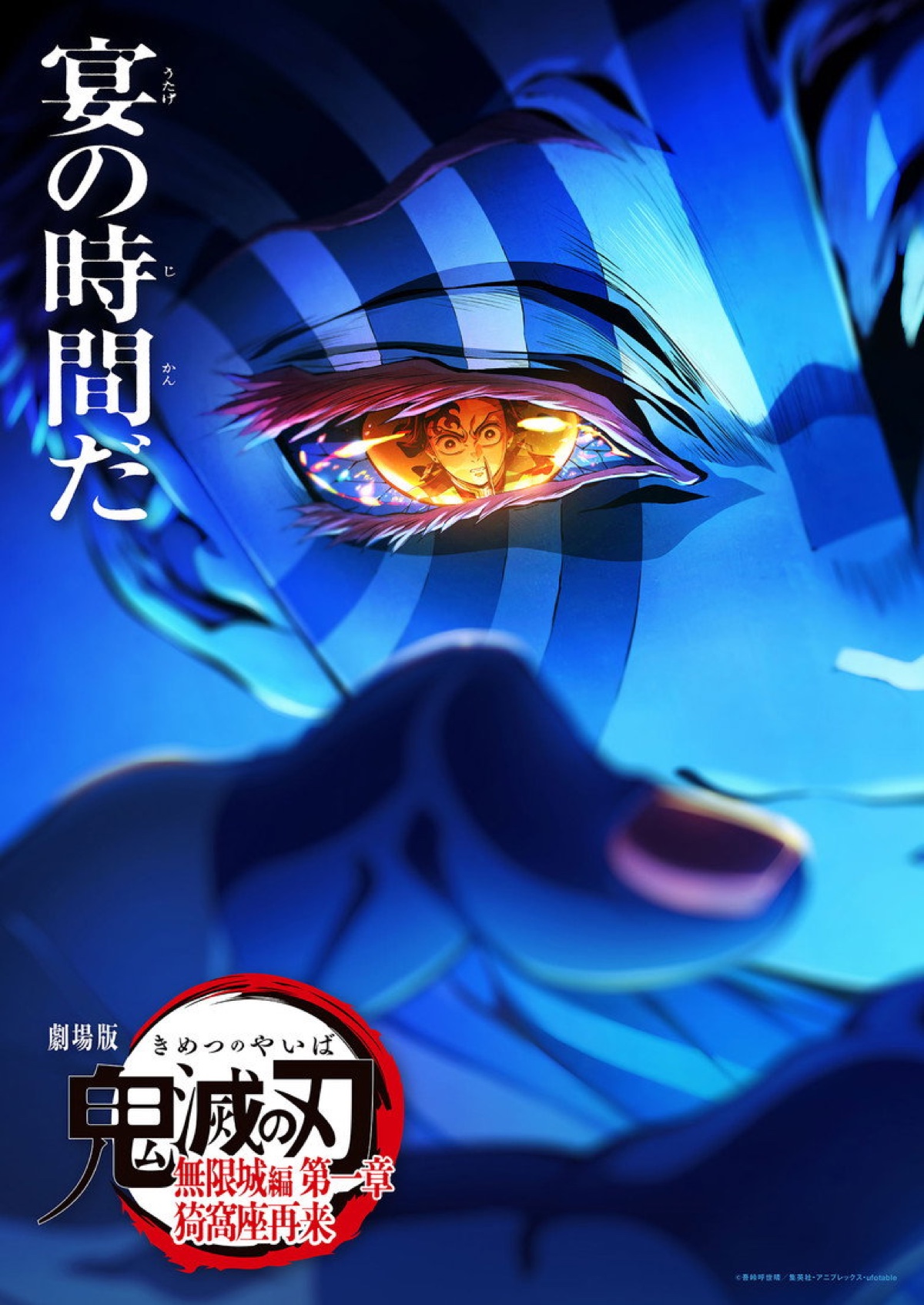
📖 Synopsis, No Spoilers
The film opens quietly. Gyomei Himejima walks through the Demon Slayer Corps graveyard, and for a short while nothing happens at all. Then the picture drops into the Infinity Castle, the demon king’s stronghold, where the events at the close of the previous season have just deposited the Hashira and Tanjiro Kamado. Inside the castle there is no fixed up or down. Rooms slide, floors open, and the swordsmen are scattered so that each of them ends up facing an Upper Rank demon with nobody beside them.
Three fights make up the body of the film. Shinobu Kocho, the Insect Hashira, against Doma of Upper Rank Two. Zenitsu Agatsuma against Kaigaku of Upper Rank Six, a man who trained beside him under the same master before choosing to become a demon. And Giyu Tomioka, the Water Hashira, standing with Tanjiro against Akaza of Upper Rank Three, the one who took Rengoku from them on the Mugen Train. On paper that is volume 16 chapter 140 through the middle of volume 18, compressed into 155 minutes.
✨ What Makes It Special
Why It’s Exceptional
- The castle is a condition of every fight rather than scenery behind one
- Three battles run in parallel, no two of them staged the same way
- Every win and every loss arrives with a stated reason. Nothing is settled by willpower alone
- The eight episodes of training that nobody enjoyed turn out to have been the setup for this
The Castle Refuses to Stand Still Behind Anyone
Most anime settings hold their position. They sit behind the characters, take the light, and wait for the scene to finish. The Infinity Castle does not wait. A paper door slides open and the floor beyond it is gone. What was a ceiling ten seconds ago is now a wall somebody is running along. Two people fighting will have their spatial relationship rewritten three or four times inside a single exchange. Sword fights that happen entirely while falling work here for a very simple reason: there was never any ground to fall from.
What I want to give ufotable credit for is refusing every escape route. This premise has cheap solutions built into it. Shoot everything tight so you never have to draw the far wall. Drop the lights and let silhouettes carry it. Move the camera fast enough that nobody can check the details. The studio takes none of those. It keeps pulling back to show you the whole castle, over and over, at a density that costs real money every single time. Nobody in the film ever tells you how big the place is. They just keep drawing it, in absurd quantity, until you stop asking.
For the first act, this is not really a battle movie. It is an architecture film with swords in it. That is the thing I would push hardest if you are deciding what to watch it on. Find the largest screen in your life and use that one. A phone is actively the wrong tool, and even a normal television costs you something real, because the whole effect depends on your eye reaching the edges of the frame and failing to find a floor there.
Here is a detail from this side of the Pacific that I found telling. The Japanese reactions I kept running into did not reach for other battle anime when describing the castle. They reached for science fiction, the sort of film where a person gets dropped into a space with no orientation and has to make a decision anyway. Once the reference pool for your background art is coming from a different genre entirely, the background has stopped being background.
Every Win and Every Loss Gets Said Out Loud
This is the part almost nobody writes about, and it is the reason the film holds together. An Upper Rank demon regenerates from decapitation. The blade that could stop that cannot reach. Played straight, none of these fights is winnable. And yet the Demon Slayer Corps turns up to every one of them holding an actual method: how to close a difference in size, how to outrun a healing rate, how to land a strike that by definition cannot land. There is a plan, there is an attempt to execute it, and only then does a result arrive.
Because of that, defeats land as cleanly as victories. Nobody grits their teeth hard enough to win. Nobody unlocks a convenient new power at the exact moment the plot needs one. What people do is bring the thing they prepared and find out whether it was enough. Those eight dull episodes of the Hashira Training Arc are not a delay. They are the deposit, and this is where it gets spent. If you skipped that season on the advice of the internet, this film is where you find out what the advice cost you. Which is awkward for me, since I gave that season the lowest score of any Demon Slayer arc on this site. It was still the right investment.
Saying a film is easy to watch does not sound like praise. In battle fiction it is close to the hardest thing there is. The standard shortcut for making a villain feel unbeatable is to make the heroes briefly stupid: someone charges in alone, someone ignores an obvious warning, someone stops thinking so the antagonist can look terrifying for a scene. I went looking for that moment across 155 minutes and did not find it. Not once. In a genre that leans on it constantly, that absence is an achievement worth naming.
Shinobu Kocho Counts Her Own Body as Ammunition
Of the three fights, hers is the one that got to me. Shinobu is the only Hashira who cannot cut a demon’s head off. She is small, she does not have the arm strength, and she holds the highest rank in the organisation while failing its basic physical requirement. Poison is how she covers that gap, and the series has said so before. What this film adds is the harder question underneath it: how do you get the poison into a target that is faster, larger, and healing continuously?
The answer involves treating her own body as part of the delivery system, and I had read it years ago on paper. Animated, timed, and spoken aloud by an actor, it was not the same information. That is the strange thing about adapting a manga you already know by heart. The facts do not change. The weight of them does.
Deeper Themes
Demon Slayer has almost no interest in explaining how its own powers work. The breathing forms are numbered and then barely described, and no character ever sits down to lay out a system the way a modern fantasy series is expected to. All of that page space goes somewhere else: into the person holding the sword. And the story spends exactly as much of it on the demon, which is why the thing being killed always gets a case of its own. Building a battle series on emotional heat instead of mechanics is a blunt approach for 2025, close to old-fashioned. What this film demonstrates is that blunt still works if the drawing is strong enough to carry the weight you put on it.
🎭 Memorable Scenes
The first is short and contains no fighting whatsoever. Seven Hashira running through the castle, together, in the same direction. That is the entire scene. Plenty of Japanese viewers have written about welling up right there, before a single blade came out, and I understand why. Every one of those faces was built across a different arc of television, at a different point in the last several years, and this is the first frame that has ever held all of them at once. It turns out that is enough.
The second is the one the Japanese subtitle names outright: Giyu and Tanjiro against Akaza. The Mugen Train film has been sitting in the audience’s memory for five years, and now the two water users walk up to the demon who ended it. Flame, then water. The temperature in the room is already high before anybody moves.
The third is the very last moment of Akaza’s history, and I am not going to describe it. A man who spent his whole existence trying to become strong is met, at the end, in the state he was in before any of that started. I complained about the length of that flashback and I will complain about it again in a few paragraphs. The case for the length is those final seconds, and it is a real case even though I still think the section is too long.
💭 How It Made Me Feel
Comfortable, which is a strange word for a film with this much dismemberment in it. What I mean is that the outcome never annoyed me. Wins were earned, losses were explained, and at no point did I sit there arguing with the screen about why someone had done something obviously foolish. Over 155 minutes that is genuinely rare.
The flashback cools it, though, and the drop is noticeable. Both halves are still exactly the same size in my memory: an enormous castle I would pay to see again on something bigger, and a twenty-minute stretch where the film stopped and I noticed the stopping. Neither one has shrunk to make room for the other.
😅 Where It Falls Short
Enough of the credit column. Three entries sit on the other side of the ledger, and the first of them comes up in almost every conversation I have had about this film.
Akaza’s Past Arrives at the Wrong Temperature
A demon gets cornered and the story reaches back into its human life. That has been the Demon Slayer move since the first season, and complaining about it now would be like complaining that a musical has songs in it. The problem is placement and scale. This one lands late, runs long, and drains the tension out of a fight that had spent an hour building it. The film had been holding a note for a very long time, and then it puts the instrument down.
There is a second thing underneath that, which is harder to say without sounding cold. The shape of these histories has become visible. A childhood taken away, a reason the cruelty was inevitable, a small mercy offered at the very end. Individually they are well made, and this one is among the better ones. But once you can see the template through the episode, some of the effect leaks out, and I felt it leaking.
I will grant the counterargument. Three fights back to back with no change of air would have its own problem, and something had to break the rhythm. Unbroken combat is not actually good pacing. I just never got to the point of believing it had to be that section, at that length, in that spot.
It Is Chapter One, and Chapter Two Has No Date
Obvious, given it says chapter one on the poster, but worth stating plainly because the consequences are worse than they look. Threads are left hanging on purpose, and there is still no announced release date for the second film. Not a month, not a season. Ufotable’s own promotional reel, released in February 2026, gave its 2026 cinema slot to a different film entirely and filed the second Infinity Castle under future projects without attaching a year to it. So 2027 is the earliest realistic window, and that is me reading a slide rather than anyone announcing anything.
A television season guarantees you next week. A film trilogy guarantees you nothing, and you are asked to hold the emotional thread for a length of time nobody will name. Some viewers took the ending as a clean stopping point and were satisfied, and I understand that reading, since the film does not simply cut off mid-swing. If you value a story that closes inside its own running time, this is where your score comes down.
Zenitsu Against Kaigaku Loses on Placement
Nothing is wrong with the fight itself. A man who could only ever perform the first form finally produces something else, and as a piece of storytelling it is one of the better beats in the film. The trouble is where it sits. It follows Shinobu, and Akaza is waiting on the other side of it, so it plays like something you pass through on the way somewhere. Kaigaku also gets noticeably less excavation than the other two demons, which leaves the emotional argument of the fight thinner than it should be. Same scene, moved somewhere else in the running order, would land considerably harder.
The Downsides
- A long flashback late in the film drops the tension the fight had built
- The template behind these demon histories has become visible
- The story stops partway with no announced date for the second film
- The Zenitsu fight becomes a corridor between the two bigger ones
Who Should Watch This?
- Anyone who bounces off battle anime because the fights feel decided by shouting. This one shows its working every time
- Manga readers who already know the ending. The castle in motion is not something the page could give you
- Anyone who stopped after Mugen Train and has been meaning to catch up. This is the payoff the series was saving
Who Might Not Enjoy This?
- Anyone who needs a film to finish inside its own running time. This is chapter one of three, with no date for chapter two
- Viewers who lose patience when a fight pauses for someone’s childhood
- Newcomers. It starts moments after the previous season ended and explains nothing
- Families with younger kids. The American rating is R, and it earns it
📺 Streaming Guide by Service
The One Country That Cannot Watch It
Crunchyroll’s release on July 28, 2026 was worldwide with two holes cut in it, Japan and mainland China. So the situation in my apartment is that the highest-grossing Japanese film ever made is playing in living rooms all over America while the country that produced it has no subscription carrying it, no rental, and no digital purchase. The disc came out here on July 29, 2026, one day after your stream went live. That is the whole legal route in Japan: buy the Blu-ray. Meanwhile the United States has the streaming copy, with no disc release announced there so far. We each got exactly the half the other one wanted.
On the sub versus dub question, Crunchyroll carries both, and the dub is the same track that played in American cinemas rather than something assembled afterwards for streaming. I saw it in Japanese in a Japanese cinema, so I have no useful comparison to hand you and will not invent one. What I will say is that the sound design here does a large amount of the spatial work, so whichever track you choose, this is not a film to run through laptop speakers.
The ratings gap is the practical difference between our two countries, and it may be the most useful line in this article if you are choosing something for a household. The MPA rated this R for bloody violence throughout. Japan’s board passed it PG12. In Japanese practice PG12 is advice to parents and nothing more, so a twelve-year-old can buy a ticket unaccompanied. In the United States the same film requires an adult for anyone under seventeen. Nothing was cut in either direction. Two countries simply looked at identical footage and disagreed about who should be allowed near it.
For scale, since the numbers explain why the release strategy looked the way it did. In Japan the film finished its run on 40.2 billion yen across 266 days, with 27.4 million admissions in a country of about 120 million people, which puts it second on the all-time domestic chart behind Mugen Train. Worldwide it took 117.9 billion yen from 98.5 million admissions, the highest figure any Japanese film has ever reached. In North America it opened to 70 million dollars, the largest opening weekend an anime film has recorded there, comfortably past the 31 million that Pokemon: The First Movie took in 1999.
Where to Stream
- Crunchyroll: Streaming since July 28, 2026, subtitled plus the theatrical English dub. Every previous arc is on the same service
- Apple TV: rent or buy
- Amazon Prime Video: Prime Video lists it, but check whether your account shows it as included or as a rental. The digital purchase is there either way
- Fandango At Home, Google Play, YouTube: digital purchase, no rental
- Netflix: Streaming in the US since September 28, 2026
- Hulu: Streaming since September 28, 2026, also reachable through Hulu on Disney+
Soundtrack
The score is Yuki Kajiura working with Go Shiina, the pairing that has handled this franchise since its first television season, and a large part of why the castle reads as enormous rather than merely confusing. There is a catch for anyone wanting the score itself: when I checked in August 2026, no standalone soundtrack album had been released, and the only physical copy is a bonus disc packaged with the Japanese limited edition. What you can stream today are the two theme songs. Aniplex billed them in Japan as a W-shudaika, a double theme song, with neither one designated as an opening or an ending. That is a deliberate piece of casting rather than a coincidence: LiSA carried the first television season and the Mugen Train film, Aimer carried the Entertainment District Arc, and the studio put both of them on this one at equal billing.
- A World Where the Sun Never Rises: Aimer, one of the film’s two theme songs
- Shine in the Cruel Night: LiSA, the other half of the pair
📚 Read the Manga
Gotouge’s original finished in 2020 at 23 volumes, all of them available in English from VIZ Media. Given that chapter two has no release date, this is the one guaranteed way to find out what happens next rather than waiting an unspecified number of years. The film covers chapter 140 in volume 16 and stops partway through volume 18, so volume 18 is the one to pick up. Roughly the first two thirds of it is what you just watched, and the pages after that are where the story keeps going.
- Demon Slayer, Vol. 18: Assaulted by Memories: the volume the film stops inside
- Infinity Castle on digital: for keeping a copy that no license expiry can remove
🎬 If You Loved Infinity Castle, Watch These 3 Next
The other Demon Slayer arcs are not on this list, because you are going to watch those anyway and you do not need me for it. These three are drawn from the specific things this film does, including the thing it does badly, and none of them is where a Demon Slayer fan would normally end up. If what you want is simply more of that cinema-crowd adrenaline, our most hype anime list is built for exactly that mood.
Made in Abyss
Start with this one. It takes the idea that made the castle work and builds a whole series out of it. A pit goes down into the earth further than anyone has mapped, and the deeper you descend the worse the penalty for climbing back out becomes. The setting is not where the danger happens. The setting is the danger. Every decision the characters make is shaped by a rule the landscape imposes, exactly as every swing in the Infinity Castle is shaped by a floor that may not be there next second.
Fair warning: it is much crueller than it looks, and the gap between the art style and the content is the whole trap. If Demon Slayer’s R rating surprised you, this one will surprise you more.
👉 Read the Made in Abyss review
PLUTO
This one comes straight out of my complaint. Infinity Castle stops a fight to explain why the monster became a monster, and I found the interruption expensive. PLUTO asks what happens if you refuse to interrupt anything, because working out why the killer is a killer is not a pause in the story, it is the entire story, across eight episodes with almost no combat in them at all. Same raw material, completely different job. If the Akaza flashback was the part of the film you loved most rather than least, this is where that appetite actually gets fed. It is on Netflix worldwide, so it costs you nothing extra to try.
Ghost in the Shell 2: Innocence
The opposite of everything I praised. Demon Slayer states its reasons out loud, every time, so you always know why the result went the way it did. Mamoru Oshii explains nothing, ever, and half the dialogue is characters quoting dead philosophers at each other instead of answering the question. What the two films share is the thing you actually came for: a sequence in the middle, a festival procession, that advances the plot not one inch and is simply several minutes of the densest animation Japan has produced. If the castle made you want the biggest screen you could find, this is the other film that demands it.
👉 Read the Ghost in the Shell 2: Innocence review
📝 Final Thoughts
Infinity Castle moves this series up a level, and it does it with a single piece of set design. The castle is the argument, and 155 minutes of it is a lot of argument. Underneath the spectacle, though, the thing holding it together is quieter and more old fashioned than the marketing suggests: three fights in which every person involved has thought about the problem in advance. The loud part is the drawing. The structure is close to arithmetic.
Set against that, the long flashback really does cost the film something, and finishing without a date for the next one is a genuine wound rather than a quibble. I am giving this a 7.7, and it is an awkward 7.7, because the ceiling here is far higher than that number and so is the floor. Remember the opening of this review, where I said I could not legally rewatch this from inside Japan? The reason that annoys me as much as it does is that I want another go at the castle on something enormous. If you are in the United States, that option is in an app you probably already pay for. Take it.
⭐ Series at a Glance
| Category | Rating | Note |
|---|---|---|
| Animation | ★★★★★ | The castle is drawn in full, repeatedly, with no shortcuts taken |
| Combat logic | ★★★★★ | Nobody enters a fight without a method. Results follow from it |
| Music plus sound | ★★★★☆ | Kajiura with Shiina again, doing much of the spatial work |
| Story | ★★★☆☆ | Strong beats, one long detour that stalls them |
| Pacing | ★★★☆☆ | 155 minutes, with roughly twenty of them going cold |
| Works on its own | ★★☆☆☆ | Chapter one of three, and chapter two has no date |
Usagi’s Recommendation Score
⭐⭐⭐⭐⭐⭐⭐⭐☆☆
7.7 / 10
155 minutes in which nobody walks in without a plan. Find the biggest screen you can.

)