*This page contains affiliate links. We may earn a commission if you make a purchase through these links.
A samurai film with no battle in it. Not a stylized one, not an implied one. Two hours and a quarter of powerful men in a castle deciding the future of Japan by lobbying each other in corridors, and the closest thing to combat is somebody being seated in the wrong place.
The premise is excellent and the film is less so. What I actually felt walking out was tiredness before enjoyment, and it took several days before the parts I liked surfaced. This is a review of something I cannot quite recommend and have not been able to stop thinking about.
📺 Where to Watch The Kiyosu Conference (October 2026)
| Service | Status | Notes |
|---|---|---|
| Netflix | Not available | Only Netflix Japan has it |
| Crunchyroll | Not available | Live-action period comedy, not carried |
| Amazon Video | Not available | Nothing to rent, nothing to buy |
| Apple TV | Not available | Not in the US store |
| The Criterion Channel | Not available | No US art-house pickup |
| Kanopy / Hoopla | Not available | On neither library platform |
I could not find The Kiyosu Conference on a US service, to stream, rent or buy, and I have not found a disc with English subtitles either. Koki Mitani is a household name in Japan.
His films are dialogue, in Japanese, about Japanese social behavior, with casts of actors nobody outside the country can sell tickets on. This one adds four hundred years of political history that the domestic audience absorbed at school. Exporting it would require a distributor willing to trust subtitles completely, and I found no sign of a US release.
In Japan it is on Netflix, U-NEXT, FOD and Lemino.
🏯 Is The Kiyosu Conference Based on a Real Meeting?
Yes. In 1582, weeks after Oda Nobunaga and his heir Nobutada were killed in the Honnō-ji Incident, the Oda clan’s senior retainers met at Kiyosu Castle to settle who would lead the clan. Four of them sat at the table: Shibata Katsuie, Hashiba Hideyoshi, Niwa Nagahide and Ikeda Tsuneoki. They named Nobutada’s three-year-old son, Sanbōshi, as heir.
What a Japanese audience carries into the theater is the sequel, and that changes how the film plays. We walk in knowing which of these men will be dead within a few years, so the comedy runs on dramatic irony the whole way through. Every confident speech from the losing side lands as a joke the speaker cannot hear. An American viewer without that knowledge is watching a different, flatter film. This table is the school lesson in five rows. If you would rather go in blind, skip the last column.
| Historical figure | Played by | What happened next |
|---|---|---|
| Shibata Katsuie | Koji Yakusho | Beaten by Hideyoshi at Shizugatake in 1583. Died at Kitanoshō Castle |
| Hashiba Hideyoshi | Yo Oizumi | Won that war. Later ruled Japan as Toyotomi Hideyoshi |
| Niwa Nagahide | Fumiyo Kohinata | Backed Hideyoshi. Was given Katsuie’s province of Echizen in 1583 |
| Ikeda Tsuneoki | Koichi Sato | Fought for Hideyoshi. Killed at Nagakute in 1584 |
| Oichi, Nobunaga’s sister | Kyoka Suzuki | Married Katsuie. Died with him at Kitanoshō in 1583 |
Read the last column against Kohinata’s scenes in particular. History rewarded the man the film shows agonizing over which side to take.
🎬 Trailer
In Japanese, because nobody ever cut an English version of this. Watch the faces, not the armor. Nearly every shot in the film is somebody working out what the person opposite them actually wants.
Work Info
- Title: The Kiyosu Conference, or Kiyosu Kaigi
- Released: November 2013, 135 minutes
- Written and directed by: Koki Mitani
- Adapted from Mitani’s own novel
- Starring: Yo Oizumi, Koji Yakusho, Fumiyo Kohinata, Koichi Sato, Kyoka Suzuki
- Music: Kiyoko Ogino. Studio: Toho
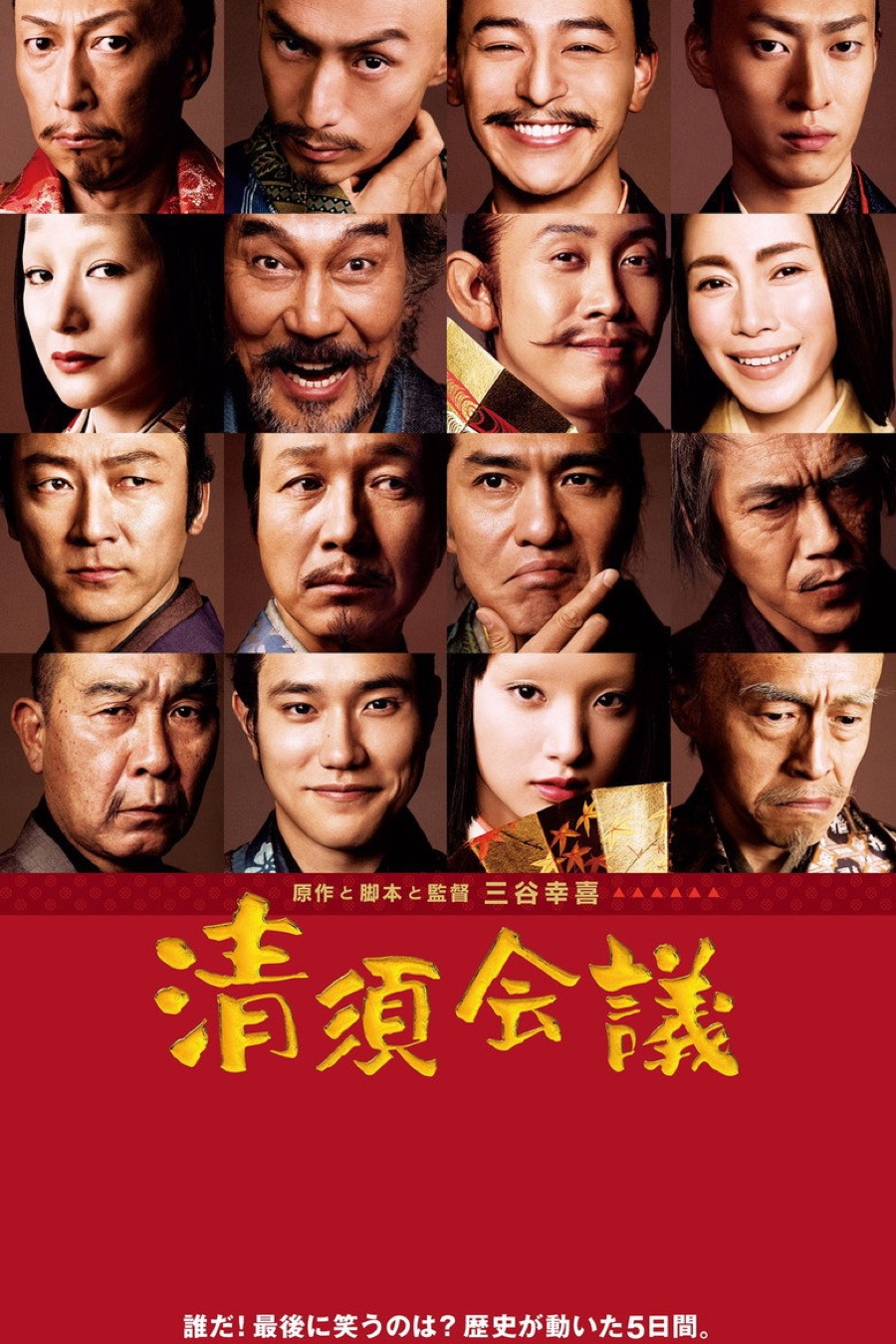
📖 Synopsis, No Spoilers
In 1582 Oda Nobunaga, the warlord who had come closest to unifying Japan, was killed by one of his own generals. He left no settled successor. What happened next is the event this film is named after: his senior retainers assembled at Kiyosu Castle to decide who would inherit, and the decision they reached set the course of the next three decades.
Katsuie Shibata, the ranking general, backs Nobunaga’s third son. Hideyoshi Hashiba, lower in status and considerably quicker, backs the second son. Both spend the days before the meeting collecting allies, calling in favors, and arranging what the room will look like before anybody enters it. Two other men hold the votes that matter, one loyal and conflicted, one entirely for sale, and Nobunaga’s sister has plans of her own.
✨ What Makes It Special
Why It Is Exceptional
- A period film where the weapon is the guest list
- Yo Oizumi playing charm as a form of cruelty
- Four hundred year old office politics that have not changed at all
- A final sound cue that reframes the whole comedy
The word this film is really about
There is a Japanese business term that explains this entire movie, and if you have worked in a Japanese company you already flinched. Nemawashi literally means digging around the roots, as you would before transplanting a tree. In practice it means securing everybody’s agreement privately, one conversation at a time, before the meeting where the decision is formally made.
The consequence is that in Japan the meeting is frequently theater. Real decisions are made in corridors, over drinks, in small rooms, by people establishing obligations. By the time everybody sits down, the outcome has usually been settled and the meeting exists to ratify it. Foreign staff at Japanese firms typically discover this the hard way, after arguing brilliantly in a meeting and losing anyway.
Mitani’s insight is that the Kiyosu conference of 1582 was exactly this, and that the practice has not changed in four hundred years. The film spends most of its length on the corridors and only a fraction on the table. Once you have the word, the structure stops looking like a comedy about samurai and starts looking like a documentary about your employer.
That is also why it travels better than its total absence from Western catalogs suggests. The specific history is local. The mechanism is not. Anybody who has watched a decision get made before the meeting will recognize every move in this film.
Two actors, one of them terrifying
The reason to watch is the pairing at the center. Yo Oizumi plays Hideyoshi as a man whose approachability is a weapon. He is funny, warm, endlessly accommodating, and about four moves ahead of everybody, and roughly twice a scene the warmth drops out of his eyes for half a second. The traditional Japanese portrayal of Hideyoshi is a cheerful commoner who rose by charm. This one has the charm and adds something considerably colder underneath it.
Against him, Koji Yakusho as Katsuie: blunt, honorable, hopeless at maneuver, and reduced to a wreck by the presence of a woman he admires. Readers who have followed this site will have met Yakusho as a ballroom student, a corrupt detective, and a man losing his mind. Here he is a soldier who believes that being right is sufficient, which the film treats as both admirable and a fatal professional weakness.
But I have to register the problem, because it undercuts the whole design. The gap between the two men is obvious from their first scene and never narrows. Hideyoshi is simply better at this, always, and Katsuie loses in a way you can see coming from the opening act. A contest of wits needs the wits to be comparable. This one is a demonstration rather than a duel, and the ending lands softer as a result.
The joke the last thirty seconds tells
Mitani is one of Japan’s most successful writers of comedy for stage and screen, and his native form is the chamber piece: a fixed location, a group of people, and an argument. One of his best-known plays is a version of Twelve Angry Men relocated to a Japanese jury room, and this is that instinct applied to national history.
Which makes the final gesture worth staying for. Over the closing credits you hear the sounds of a battle. Japanese audiences know immediately which one: the fight that settled, by force, what this conference tried to settle by procedure, and which ended very badly for one of the two men you have been watching. A comedy that spends two hours proving talk can decide anything, closing on the noise of the argument being reopened with swords.
Deeper Themes
The film sets two theories of power against each other without adjudicating. Katsuie believes a correct argument will prevail because it is correct. Hideyoshi believes that whoever has placed the most people under obligation has already won. The film does not say which is right, only which one works.
What keeps that from being cynical is the third position, held by the retainer caught between friendship and the direction of history. He knows what the honorable choice is, he knows what it will cost him, and the film gives him more sympathy than either of the men competing for the room.
🎭 Memorable Scenes
Whoever holds the child holds the clan.
The moment that stayed with me belongs to Fumiyo Kohinata as Nagahide Niwa, Katsuie’s ally, watching the direction of things and understanding that loyalty is about to become expensive. Kohinata plays it with an expression somewhere between apology and nausea, and it silences the comedy for about a minute. In a film built on people performing confidence, one man visibly failing to is the most human thing in it.
Then the parting at the end. Hideyoshi smiles and sees Katsuie off with every appearance of goodwill. Katsuie, who by now understands exactly what has been done to him, declines to give him the satisfaction of noticing. Two men being perfectly polite while both of them know what happens next.
And the flag-taking sequence in the middle, which I bring up because it is the film’s clearest misjudgment. It is a broad comic set piece, it goes on for a long time, and it belongs to a different and lighter movie.
💭 How It Made Me Feel
Tired, honestly, and that is the first thing I owe you. Two and a quarter hours of conversation with no action to break it up is a real physical ask, and by the last half hour I was aware of the seat.
What surprised me is what surfaced afterwards. Days later the things I kept returning to were Katsuie’s clumsy decency and the specific coldness behind Hideyoshi’s smile. I cannot dislike this film and I cannot recommend it without a paragraph of conditions. That is an unusual place to end up and I have decided to report it and leave it unresolved.
Who Should Watch This?
- Anybody who has lost an argument that was decided before the meeting
- Readers interested in how Japanese organizations actually reach decisions
- Viewers who want a period film built on talk rather than swords
- Anyone following Koji Yakusho through the widest range in Japanese acting
😅 Where It Falls Short
Three complaints, and they are not small
The running time is the first and largest. A conversation piece with no action does not support two and a quarter hours, and the middle stretch sags badly. Cut to a hundred minutes this would be considerably sharper, and the comic detours that pad it out actively work against the tension the rest of the film is building.
Second, and this is the one that will affect readers here most: it assumes you know the history. Who Katsuie is, why Nobunaga’s death matters, what the succession implies, all of it arrives unexplained. Japanese audiences absorbed this at school. Everybody else is going to spend the first act working out who these people are, and Mitani, whose whole reputation rests on being accessible, has written something for insiders here.
Third, the imbalance I mentioned. Katsuie is written closer to comic relief than to a credible opponent, which drains the manoeuvring of suspense. Give him one successful counter-move, or let Hideyoshi’s scheme fail once, and the ending would ache instead of simply arriving. This is the difference between a good film and a film with a good idea.
The Weak Points
- Far too long for a film with no action in it
- Assumes Japanese school-level knowledge of 1582
- One side of the contest is never a real contender
Who Might Not Enjoy This?
- Newcomers to the Sengoku period with no reference points
- Anyone expecting a period film to contain a fight
- Viewers with limited patience for two hours of talk
📺 Streaming Guide by Service
Homework first, if you ever get the chance
In place of a link, what I can offer is preparation, on the assumption that a repertory screening or a late licensing deal eventually happens.
Spend fifteen minutes on the Honnoji Incident before you start. You need four facts: Nobunaga was killed by his own general in 1582, he had several sons and no designated heir, Katsuie was his most senior soldier, and Hideyoshi was a commoner who had risen further than anybody expected. With that in hand the film is perfectly followable. Without it the first forty minutes are a fog of names.
And if you only want one Japanese film about a decision being made in a room, take the Shin Godzilla recommendation below instead. It is the same subject, it is available to you today, and it is frankly the better film.
The Available Routes
- Japanese streaming services, if you are here or hold an account here
- Import disc listings: Japanese release, no English subtitles
- Reachable instead: our Shin Godzilla piece, on the same subject
Soundtrack
Kiyoko Ogino has scored most of Mitani’s films and writes in a register that is closer to stage comedy than to period drama: light, propulsive, slightly mischievous. It keeps the film moving through stretches where nothing is happening except negotiation.
It is on Apple Music and absent from Spotify, which is a common pattern for Japanese film scores of this vintage. Worth hearing for how deliberately un-solemn it is about a national turning point.
📚 The Source
Mitani wrote the novel first and then adapted it himself, which is unusual and explains a good deal about the film’s problems. Prose can carry a long negotiation and hold a dozen named retainers in play. A hundred and thirty-five minutes of screen time struggles with both.
There is no English translation and I would not expect one. His novels sell on his name, and outside Japan that name means nothing at all, which remains the strangest gap in the export record of Japanese popular culture.
🎬 If You Loved The Kiyosu Conference, Watch These 3 Next
Shin Godzilla
The same film with a monster attached and a much better sense of pace. Hideaki Anno spends most of his running time on committees, jurisdiction, and who is authorized to sign what, and the result is the most exciting procedural Japan has produced this century. It streams on HBO Max in the US.
👉 Read our review of Shin Godzilla
Bayside Shakedown
The modern version of the same complaint, from a police precinct instead of a castle. Its famous line is a shout that the real work happens outside the meeting room. The Kiyosu Conference is the film arguing, politely, that the meeting room wins anyway.
👉 Read our review of Bayside Shakedown
Zatoichi
The period film as pure entertainment, and the exact opposite approach. Takeshi Kitano keeps the talking to a minimum and settles everything with a sword, in a film that is free with ads on YouTube in the US. Put it on afterwards as a corrective.
📝 Final Thoughts
The Kiyosu Conference has one excellent idea, which is that the most consequential meeting in sixteenth century Japan worked exactly like a modern Japanese company. Two very good actors execute that idea. Then it runs half an hour past its natural length, assumes a history lesson you have not had, and lets one side of the contest be hopeless from the start.
If you take one thing from it, take the word: nemawashi. Once you know it, you will start seeing it at work, and you will lose fewer arguments that were already over. And if what you came for was a Japanese comedy, Ozu’s Good Morning is also about adults talking past each other, only with children and a television set, and you will find it with its US status in our Japanese comedy roundup.
⭐ Film at a Glance
| Category | Rating | Comment |
|---|---|---|
| Premise | ★★★★★ | A period film where the weapon is the guest list |
| Performances | ★★★★★ | Oizumi’s charm as a form of cruelty |
| Writing | ★★☆☆☆ | One-sided contest, thirty minutes too long |
| Accessibility | ★★☆☆☆ | Assumes the history you were not taught |
| Music | ★★★☆☆ | Light, propulsive, deliberately un-solemn |
| Ending | ★★★★☆ | The final sound cue reframes everything |
Usagi’s Recommendation Score
⭐⭐⭐⭐⭐✨☆☆☆☆
5.2 / 10
A great idea at half an hour too long. Learn the word nemawashi and keep it.

