*This page contains affiliate links. We may earn a commission if you make a purchase through these links.
In 1998 this was the highest-grossing Japanese film of the year, took about ten billion yen, and put seven million people in cinemas. It spawned eight more films, a set of catchphrases that Japanese office workers still say out loud in meetings, and eventually a real police station. You have almost certainly never heard of it, and there is no legal way to watch it where you live.
I saw it in a cinema that autumn, after following every episode of the television series it continues. That is the correct way to see it and it is also the problem, which I am going to be straight about, because the honest description of this film is that it is episode twelve of a show you have not seen.
📺 Where to Watch Bayside Shakedown (August 2026)
| Service | Status | Notes |
|---|---|---|
| Netflix (US) | Not available | Netflix Japan has the whole series |
| Amazon Video (US) | Not available | Nothing to rent, nothing to buy |
| Criterion Channel | Not available | Never picked up for art house |
| Hoopla / Kanopy | Not available | Absent from both library platforms |
| Japanese services | Widely available | Netflix, Prime Video, U-NEXT, FOD |
As of August 18, 2026, nothing in the United States carries this film. I checked streaming, rental, and both major library platforms. A commercial phenomenon this size with no Western footprint at all is unusual even by Japanese cinema standards.
Here it is on four services simultaneously, and this month Fuji Television is broadcasting all nine films in order on consecutive weekends. That is groundwork for a brand new entry arriving in cinemas in September, twenty-eight years after the first one. The franchise is not a nostalgia object here. It is still running.
🎬 Trailer
Japanese only, since there was never an English campaign. It sells the film as a thriller, which is misleading. Listen to the music instead. That riff is one of the most recognizable pieces of screen music in the country.
Work Info
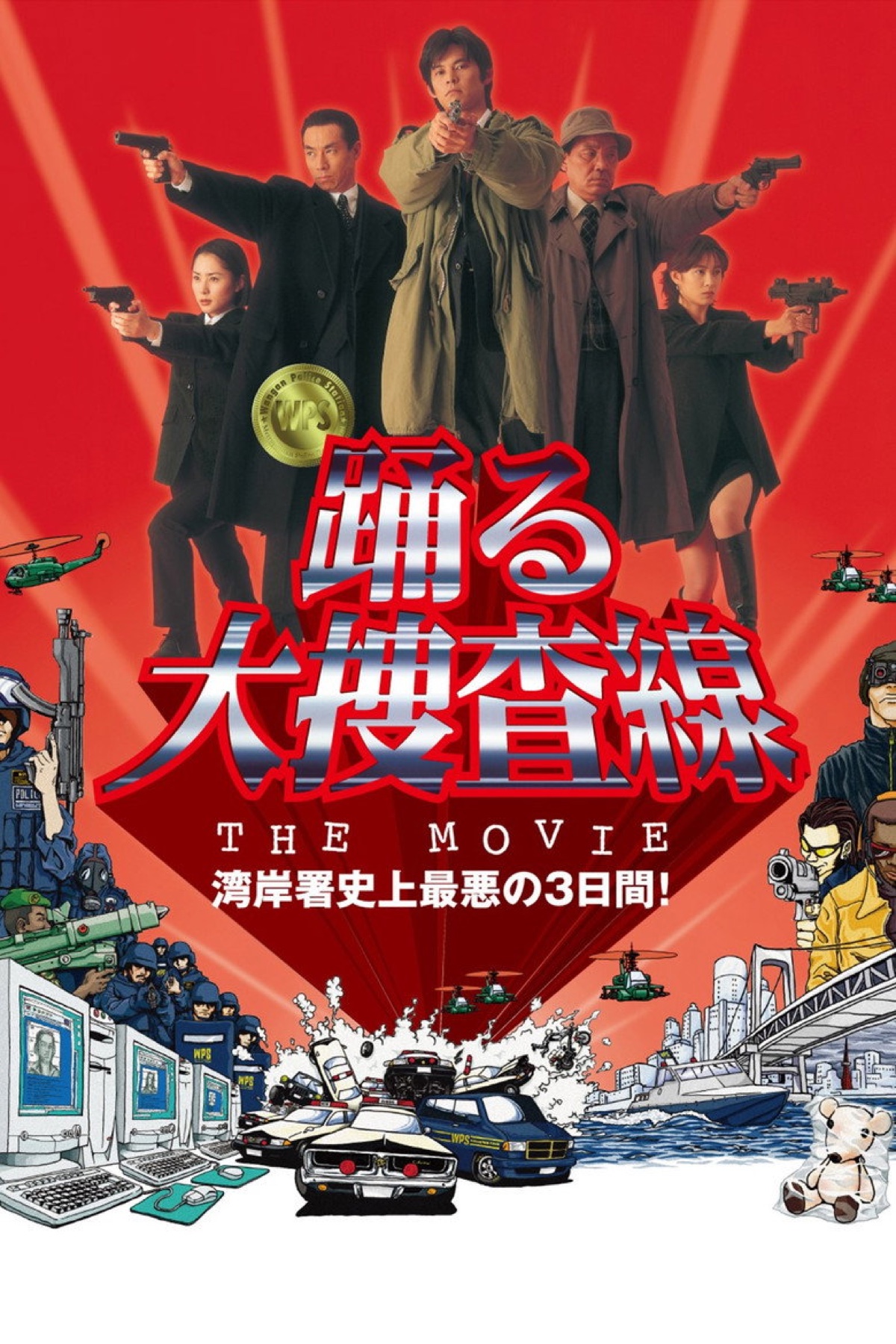
- Title: Bayside Shakedown (Odoru Daisosasen: The Movie)
- Released: October 1998, 119 minutes
- Director: Katsuyuki Motohiro. Screenplay: Ryoichi Kimizuka
- Starring: Yuji Oda, Toshiro Yanagiba, Eri Fukatsu, Chosuke Ikariya
- Music: Akihiko Matsumoto
- Box office: 10.1 billion yen, the top Japanese film of 1998
- Japan Academy Prize for Best Supporting Actor, Chosuke Ikariya
📖 Synopsis, No Spoilers
Shunsaku Aoshima left a corporate job to become a detective, which everybody around him treats as evidence of poor judgement. He works at Wangan, a precinct on the Tokyo waterfront, at the bottom of a chain of command he finds ridiculous.
Three things happen at once. A body surfaces in the canal with a stuffed bear in its stomach. Somebody inside the station is stealing receipts and small change from detectives’ desks. And a deputy commissioner of the Tokyo Metropolitan Police is abducted outside his own house, inside Wangan’s jurisdiction. Headquarters sets up an incident room in the building and then tells the local officers nothing, on the grounds that the case is confidential. Aoshima, locked out of the important one, keeps working the body in the water.
✨ What Makes It Special
Why It Is Exceptional
- A police procedural that is actually about internal politics
- Lines that entered the Japanese workplace and never left
- The central promise repeated a generation earlier, with the answer attached
- Three cases running at once, converging late
A cop film about org charts
What this film is actually about is not the crimes. It is about who has authority, who carries blame, and who gets used. Most of the running time goes on the relationship between headquarters and the local precinct, and the film is unusually specific about the mechanics.
One piece of structure needs spelling out for anyone outside Japan, since the film simply assumes it. The Japanese police divide into two tracks. Officers who pass the national civil service examination enter as career-track administrators and rise fast regardless of ability. Everybody else spends a working life in local precincts and will never command anything. The film goes further and shows the hierarchy inside the career track, where which university you attended still determines how you are spoken to at forty. Nobody in this system is being evaluated on whether they are any good at police work.
Muroi, the career-track inspector caught between orders from above and responsibility below, is the middle manager every viewer here recognizes. He is the reason the film is not simply an anti-authority cartoon. The organization is grinding him too.
The neat irony is that the key to the case turns out to be inside the building rather than out on the street. A film whose most famous line is a shout about the crime happening outdoors quietly declines to prove itself right. Later entries in the series lost that double-mindedness. This first one still has it.
The same promise, one generation apart
The spine of the film is an agreement between Aoshima, who stays on the street, and Muroi, who is climbing. One day I will be senior enough to do the right thing, and when that happens, trust the people on the ground. That relationship carries over from the television series.
What the film adds is the same pair, thirty years earlier. The abducted deputy commissioner and Waku, the veteran detective at Wangan, made that agreement when they were young men. One of them went all the way to the top of the organization and changed nothing. You are being shown Aoshima and Muroi’s future before either of them has arrived at it, and once you notice, the last act reads completely differently.
Waku is the best thing in the film, and there is a piece of Japanese context that makes the performance land harder here than it can abroad. He is played by Chosuke Ikariya, who spent decades as a member of The Drifters, the sketch comedy group that dominated Japanese television in the seventies and eighties. Every adult in the audience in 1998 knew that face as a clown. Watching him deliver the moral centre of a police drama, and win the Japan Academy Prize for Best Supporting Actor doing it, was a genuine shock at the time.
The line that outlived the film
Two sentences from this film are still in circulation in Japan, and the second one is close to a national idiom. Roughly: the incident is not happening in the meeting room, it is happening out here. Salaried workers have been saying that to each other in offices for twenty-seven years, usually with no idea it came from a police film.
The other, from Waku, is the better line. If you want to do the right thing, get promoted. As a student I would have heard that as cynicism. After a decade of employment it reads as a description of how organizations work, and the film has the honesty to complete the thought, which is that authority does not preserve anybody’s principles either.
Deeper Themes
People at the bottom of an organization tend to treat anybody who climbs as a traitor. This film refuses that, and spends real time on how powerless the people at the top also are. Muroi is handed command and still cannot act. The deputy commissioner reached the summit and never delivered on the promise he made at twenty-five.
The premise that seniority buys you the ability to do right is exactly what the film puts in doubt. That it ends with the promise being made again anyway, by two men who have just watched the previous version of it fail, is where the warmth is.
🎭 Memorable Scenes
If you want to do the right thing, get promoted.
The salute near the end is the scene most people here would name first. Almost no dialogue, a few dozen seconds, and everything the film has built delivered through posture alone. Then a joke lands immediately afterwards, which is exactly the series’ instinct: never leave the audience crying for longer than it can stand.
My own favourite is smaller and involves a stolen coin purse. The station’s pathetic internal theft case, treated as a joke for most of the film, is the thread that turns out to matter. A film that spends two hours shouting about the importance of fieldwork solves itself with paperwork, and never draws attention to the contradiction.
One postscript that is almost too neat. Wangan Police Station is invented. In 2008 the Tokyo Metropolitan Police opened a real Tokyo Bay station, denied any connection to the film, and received a congratulatory telegram at the opening ceremony signed by Yuji Oda in character as Detective Sergeant Aoshima.
💭 How It Made Me Feel
Twenty-seven years on it has acquired a value nobody planned. Cigarettes indoors at the station. Everybody still at their desk at midnight. A whole room moving because one man raised his voice. The 1998 Japanese workplace is preserved here like documentary footage, and it was captured entirely by accident.
Then there is what has not changed. People who get promoted forgetting what the ground floor is like. Nobody moving until a decision comes down. Responsibility going vague the moment it enters a meeting room. I have changed employers twice since I first saw this and I keep running into the same scene, which is why the jokes still are not funny.
Who Should Watch This?
- Anybody who has been the person doing the work while others decide
- Viewers curious about the biggest Japanese franchise nobody exported
- People who liked Shin Godzilla for the bureaucracy rather than the monster
- Anyone who wants to see a 1998 Japanese office preserved intact
😅 Where It Falls Short
Seen from outside the fandom
Look, I have been fond so far, and now I want to stand where a first-time viewer stands, because from there this film gets considerably worse. The three cases all resolve into very little. Motives are thin, the culprits get no interior life, and anyone watching for a mystery will be short-changed. Every ounce of care went into the organizational material and almost none went to the crimes.
The killer, played by a pop star of the era, is staged with the framing of The Silence of the Lambs, restraints and all, and is genuinely arresting the moment she appears. She then has almost nothing to do with the plot. A striking image, spent, and not connected to anything.
The real problem is the one I opened with. The promise between Aoshima and Muroi, the weight of Waku’s advice, the salute at the end, all of it draws on eleven episodes of television you have not watched. Without that, the cases are thin, the relationships arrive from nowhere, and the famous lines sit on the surface. I have tried to imagine watching this as a foreign viewer with no context, and I cannot make the result come out well.
The Weak Points
- All three cases resolve weakly. This is not a mystery
- The most striking villain barely touches the plot
- Without the television series, half the emotional weight is missing
Who Might Not Enjoy This?
- Mystery readers who want a real puzzle
- Anybody starting cold with no series background
- People who dislike comedy and drama alternating every few minutes
📺 Streaming Guide by Service
What order, and what is realistically possible
Order first, since it is the thing people ask. Watch the nine films in release order, starting here. The two spin-offs about the negotiator and about Muroi both sit after the main entries they belong to, and the broadcast schedule Fuji Television is running this month follows exactly that sequence. Ideally you would begin with the eleven-episode television series, though starting from this film still works.
Now the awkward part. None of that is available to you outside Japan, and no service has picked it up. The Japanese discs carry no English subtitles, and a dialogue-driven comedy about civil service hierarchy is not watchable without them. There is one route, and it takes patience: Panorama released an English-subtitled Hong Kong Blu-ray, and YesAsia still lists it. Stock and region coding both move around on these, so check the listing before you order.
If you want the same subject in a film you can actually reach, the recommendations below are doing real work rather than filling space. The first one in particular is this film’s direct descendant.
The Available Routes
- Japanese streaming services, if you are here or hold an account here
- Hong Kong Blu-ray (Panorama): English subtitles, stock varies
- Import disc listings: Japanese editions, no English subtitles
- Read our Shin Godzilla piece for the same subject in a reachable film
Soundtrack
Akihiko Matsumoto’s main theme, titled Rhythm and Police, is one of a very small number of Japanese screen cues that any adult here can name within about three seconds of the introduction. It is on both major streaming platforms.
The moment it enters, as Aoshima works out how the cases connect, still produces a physical reaction in me. Whether it does anything for a listener with no attachment to the series is a fair question, and probably the answer is no.
📀 The Franchise
Nine films exist, plus the original television series and several specials. A brand new entry opens in Japanese cinemas in September 2026, which makes this one of the longest-running live-action franchises the country has produced.
None of it has an English-language home release. If you ever see a boutique label announce a Japanese television and film package from the late nineties, this is the property to hope for, and I would buy it the day it was listed.
🎬 If You Loved Bayside Shakedown, Watch These 3 Next
Shin Godzilla
The direct descendant, and available to you, which this film is not. Hideaki Anno takes the meeting room against the field and makes the organization itself the protagonist, with the same interest in who is authorized to act. It is also the version where the crisis gets as much attention as the paperwork.
👉 Read our review of Shin Godzilla
The Blood of Wolves
The same structure at a completely different temperature. A local precinct squeezed between headquarters and the street, except the street is 1988 Hiroshima and the officers are worse than the criminals. Wangan handles that pressure with jokes. Kurehara does not.
👉 Read our review of The Blood of Wolves
Cure
Released the year before, and the exact opposite film. Kiyoshi Kurosawa takes a Japanese detective and dismantles him from the inside, with no jokes, no colleagues worth the name, and no organization capable of helping. Watch it if the 1998 Japanese workplace interests you more than the comedy did.
The 2003 sequel outgrossed almost every live-action Japanese film that came before it, which makes what does not work in it more interesting. 👉 Read the Bayside Shakedown 2 review
📝 Final Thoughts
Bayside Shakedown is a very good sequel to a television series and a fairly ordinary film, and both of those are true at once. As a continuation for people who watched the show it is close to ideal. As a self-contained two hours it has three weak cases, a wasted villain, and relationships that arrive already loaded with meaning you were not present for.
The reason to know about it anyway is the size of the hole in the record. A film that took ten billion yen, defined how a generation of Japanese people talk about their employers, and ran to nine sequels has no Western presence at all. Something on that scale should not be invisible, and if a label ever fixes it, you will want to have heard the name.
⭐ Film at a Glance
| Category | Rating | Comment |
|---|---|---|
| Organizational drama | ★★★★★ | Specific, two-sided, still accurate |
| Mystery plotting | ★★☆☆☆ | Three cases, three weak resolutions |
| Performances | ★★★★☆ | Ikariya turns a comic into a moral centre |
| Music | ★★★★★ | Three seconds of intro, instantly placed |
| As a sequel | ★★★★★ | Exactly what the audience turned up for |
| As a standalone | ★★☆☆☆ | Half the weight is in episodes you missed |
Usagi’s Recommendation Score
⭐⭐⭐⭐⭐⭐⭐☆☆☆
7.0 / 10
Japan’s biggest unexported franchise. Great as episode twelve, ordinary as a film.

