*This page contains affiliate links. We may earn a commission if you make a purchase through these links.
You can watch this film free, legally, in the United States, this evening. I cannot watch it in Japan at all. Not on any subscription service, not as a rental, not for money. The country that made it has lost it, and the country that imported it lets anybody watch it free on YouTube.
Which is a shame, because this is the Takeshi Kitano film to hand to somebody who has been told his work is difficult. It is not difficult. It is a blond swordsman, a village under a protection racket, some of the fastest violence ever cut into a Japanese film, and a tap dance at the end. I have complicated feelings about that tap dance, and I will get to them.
📺 Where to Watch Zatoichi (October 2026)
| Service | Status | Notes |
|---|---|---|
| YouTube | Streaming | Free with ads, HD, Japanese audio |
| Amazon Video | Rent / Buy | Google Play and YouTube rent it too |
| Kanopy | Not available | No longer in its US catalog |
| The Criterion Channel | Not available | Has the 1962 original, not this one |
| Netflix | Not available | Not in the US catalog |
| Crunchyroll | Not available | Not a title it carries |
| Any Japanese service | Not available | Gone from every service in Japan |
The free route in the US is YouTube’s ad-supported tier, in HD with the original Japanese audio, no subscription needed. Kanopy, the library service I pointed to in August, no longer lists it. Amazon, Google Play and YouTube also rent it, if ads in the middle of a sword fight are a dealbreaker.
The Japanese side of that sentence still surprises me. Kitano’s rights situation is famously tangled, his films appear and vanish from domestic services on no schedule anybody can predict, and right now this one is gone from every service here. A Venice prize winner that made nearly three billion yen at the domestic box office, and the way to see it in its own country is a disc.
🗡️ Is Kitano’s Zatoichi Connected to the Shintaro Katsu Films?
Not by story. Kitano’s 2003 film is a standalone that borrows the character and none of the plot, so you can start here without having seen anything else. Zatoichi began as a minor figure in a 1948 piece by the novelist Kan Shimozawa, and Shintaro Katsu went on to play him in 26 films between 1962 and 1989, the last of which Katsu wrote and directed himself. Kitano kept the blind masseur, the cane sword and the gambling, and built his own town and his own villains around them.
He also kept one of the old series’ favorite tricks. In the Katsu films Ichi often cuts the candles and finishes a fight in the dark, where nobody else can see either, and Kitano stages his gambling-den scene on exactly that idea. It is a small nod, and it is the clearest sign that the blond hair is a joke made by somebody who knows the originals well. One more thing the English title hides: Zatō is not part of his name. It was the lowest rank in the old guild for blind men, so the character is simply Ichi.
If this sends you back to the source, begin at the beginning. The Tale of Zatoichi (1962), the first Katsu film, streams on the Criterion Channel in the US and rents on Amazon and Apple TV. It is black-and-white and in no hurry, and it makes Kitano’s version, at under two hours, look even faster than it already is.
🎬 Trailer
Cut by Imprint Films for their restoration release. Note how little actual swordplay it contains. That is honest advertising, and it is the first thing worth understanding about the film.
Work Info
- Title: Zatoichi, sometimes The Blind Swordsman in the US
- Released: 2003, 116 minutes
- Written, directed, edited by: Takeshi Kitano
- Starring: Takeshi Kitano, Tadanobu Asano, Yui Natsukawa, Ittoku Kishibe
- Music: Keiichi Suzuki
- Based on: Kan Shimozawa’s Zatoichi stories
- Awards: Silver Lion for Best Director, Venice 2003
📖 Synopsis, No Spoilers
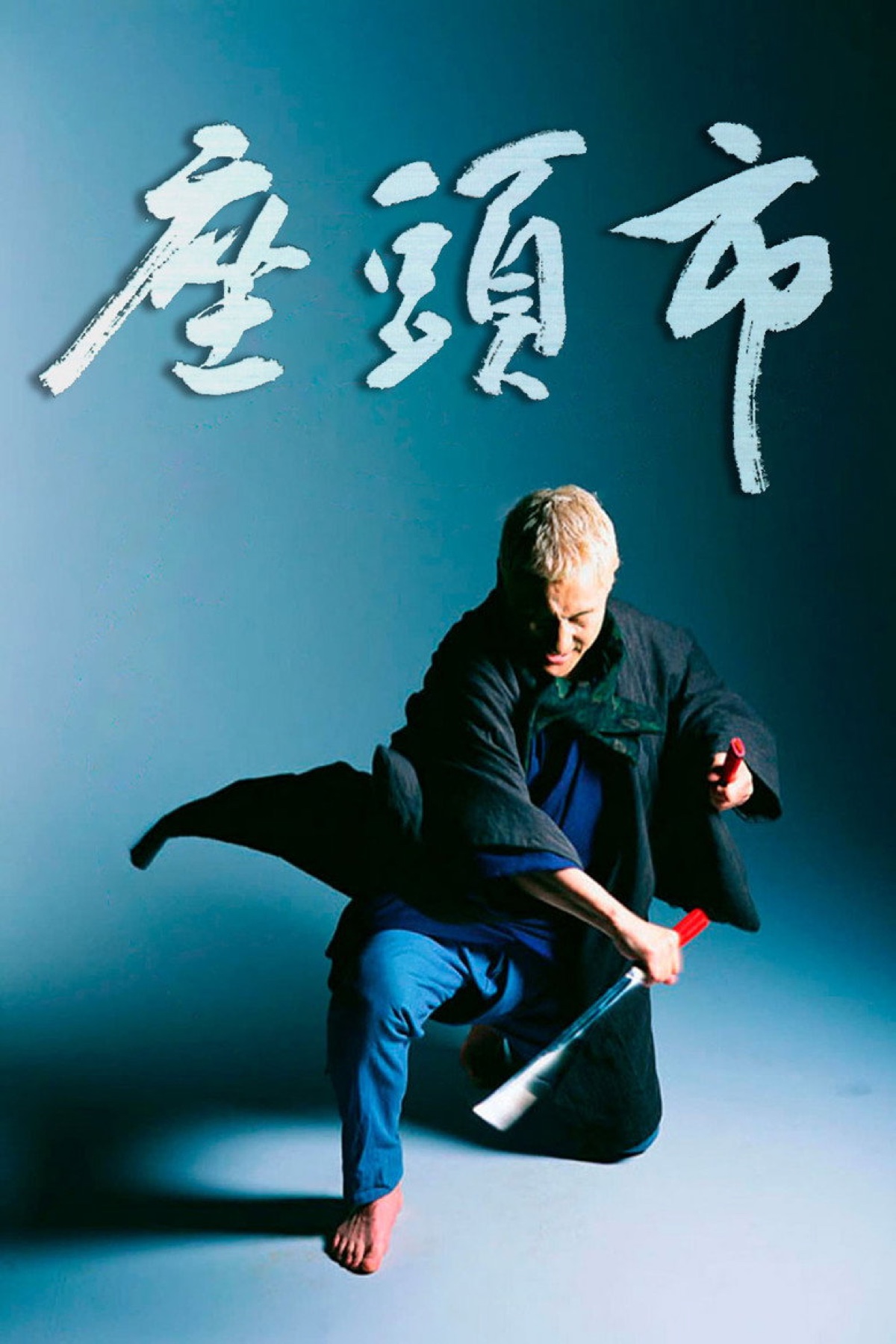
A blind masseur walks into a post town carrying a red-lacquered cane. He gambles by ear, he is treated as beneath everybody’s notice, and the cane has a sword inside it. Kitano plays him with bleached blond hair, which is the first signal that this is not going to be a reverent adaptation of anything.
The town is being squeezed by a gang and the merchant house financing it, and the farmers are paying whatever they are told to pay. Two other sets of outsiders arrive at the same time. A masterless samurai has taken work as the gang’s enforcer because his wife is ill and medicine is expensive. A pair of traveling entertainers are looking for the men who killed their parents. All three threads run into the same gang, and eventually the cane comes apart.
✨ What Makes It Special
Why It Is Exceptional
- Sword fights that skip the fighting and let the bodies explain
- Kitano the comedian showing up inside Kitano the auteur
- Desaturated images so that blood is the only saturated thing on screen
- Farm labor turning into percussion, and then into a musical number
Fights with the fight removed
Forget everything a period drama has taught you about duelling. There are no extended exchanges here. Ichi’s sword leaves the cane and the opposition is already on the ground. The stroke itself is frequently not on screen at all.
This is deliberate and it is more sophisticated than it sounds. Removing the cut forces you to reconstruct it, and the film gives you everything you need to do the reconstruction: where the bodies have landed, the arc the blood took, the order in which people fell. Every shot is built backwards from a result, and the result is more articulate than a choreographed sequence would be. Kitano the editor is the person doing the most work in this film.
The gambling den sequence is the one to watch for. Ichi takes out the candles with the sword and then works in total darkness, which is the only environment where a blind man holds the advantage. Everyone else is suddenly operating under his conditions. It is stylish and it is also the single clearest statement of what the character actually is.
I should be honest about the load-bearing assumption here. This technique works on you partly because Kitano spent fifteen years establishing that his violence arrives without warning and finishes instantly. Anyone who has seen Violent Cop or Sonatine fills in the missing frames automatically. Come to this cold and the fights may simply read as abrupt, and I would not argue with that reaction.
The comedian in the director’s chair
Most Kitano films decline to meet the audience. They withhold explanation, flatten emotion, and let silence carry the load, and that austerity is what festivals abroad rewarded him for. This film puts all of it away.
What replaces it is a clean revenge structure, broad comic interludes performed by members of his own television troupe, a large climactic action set piece, and a dance number over the credits. It is an addition film by a director whose entire reputation was built on subtraction.
Context worth knowing: outside Japan, Kitano is a serious film director who occasionally acts. Inside Japan he is, first and overwhelmingly, a television comedian, one of the most famous people in the country, who came up through Asakusa strip theatres doing stand-up between acts. Those two versions of him have coexisted uneasily for forty years. This is the film where the Asakusa comedian gets the keys. Purists here call it a minor work. It also took the Silver Lion at Venice and sold a great many tickets, which is its own kind of argument.
Gray images, red blood, and work as rhythm
The color is pulled down almost everywhere, using a bleach bypass process that leaves the image silvery and low contrast. The consequence is that blood is the only fully saturated thing you ever see. The effect is not beauty. It is discomfort, which is the correct response and a harder one to engineer.
Keiichi Suzuki’s score answers that design. Farmers hoeing a field fall into a pattern, carpenters planing wood join it, and the sound of labor becomes a beat and then becomes music without ever announcing the transition. Dancer in the Dark did something adjacent three years earlier and made it heavy. Kitano keeps it dry and light, and that lightness is what holds the whole film’s tone together.
Deeper Themes
Ichi occupies the lowest rung available in Edo period society: blind, itinerant, a masseur, outside every register that mattered. The original stories ran on that irony, and Kitano keeps it. The most dangerous person in any room is the one nobody in the room considers a person.
The samurai enforcer is the film’s real moral problem, and it declines to solve him. He is competent, decent, and killing people for money because his wife needs medicine she cannot otherwise have. Kitano offers no judgement on this whatsoever, which is the one place where the austere director is still clearly in the building.
🎭 Memorable Scenes
You can open your eyes as wide as you like. It will not help you see what is not there.
The best moment in the film is not a fight, it is the second before one. Tadanobu Asano’s ronin runs the coming duel in his head first, and Kitano shows us the simulation in slow motion. In it, he wins. There is the faintest movement at the corner of his mouth. Then, in the real world, Ichi shifts his grip on the cane, and the entire simulation is void. Two rooms full of people, one on each side of the screen, stop breathing simultaneously.
Against that, the flashback belonging to the two entertainers, which is where the film briefly stops being fun. A child sells himself to keep the pair of them alive and hands over the money, and his sister holds him and cries. Nothing about the scene is played for effect. In a picture built to be a good time, this is Kitano’s other face surfacing for ninety seconds: cold about the world, tender about the people trapped in it.
And then the ending, in which the entire cast performs a tap routine on a festival stage in wooden sandals. It has no business being there. It is a curtain call rather than a scene, and it violates the period, the genre, and the tone. It also works completely, and arguing about why is one of the small pleasures of talking about this film.
💭 How It Made Me Feel
Cheerful, which is a strange word to use about Kitano. His films usually leave a residue somewhere between numb and bruised. This one leaves a rhythm stuck in your head and a general sense that things went well.
Would I call it his best film? No. Sonatine is his best film. But when somebody asks me which Kitano to start with, I have never once said Sonatine, and I have said this one every time. It is the door, and I have walked several people through it who then went on to the harder work.
Who Should Watch This?
- Anyone who has been told Kitano is hard work and believed it
- Film fans who assume period drama means slow and dusty
- Anyone who wants an action film that is properly satisfying
- Editors, because the cutting here is the whole argument
😅 Where It Falls Short
The ledger, honestly kept
Look, I have been generous, so now the ledger. The comic interludes performed by Kitano’s television troupe are too long. I understand the intention, which is to release pressure between the violent sequences, and the principle is sound. In practice one extended bit about a man attempting to learn swordsmanship stops the film dead. Comic timing is the one thing Kitano should never get wrong, and here the proportions are off.
Second, the digital blood. Limbs come away and the compositing has not aged well, which is partly a 2003 problem and partly a choice. Kitano’s violence is supposed to hurt. Rendered blood is weightless, and every shot that uses it is a shot where the film stops being frightening and starts looking assembled.
Third, a practical one for anyone watching with subtitles: several performances mumble, in period vocabulary, at low volume. Subtitles will save you, and I mention it because I had to rewind twice with no subtitles at all and I speak the language. Turn them on regardless.
The Weak Points
- Comic interludes that outstay their usefulness
- Digital blood that looks weightless next to the practical work
- Mumbled period dialogue. Subtitles are not optional
Who Might Not Enjoy This?
- People expecting the austere Kitano of the nineties
- Anyone allergic to early digital gore
- Purists who object to comedy inside a period film
📺 Streaming Guide by Service
Free first, and turn the subtitles on
Start with the ad-supported tier on YouTube. It is free, at the price of interruptions in a film whose editing rhythm really does not want them. Rent it if you can spare a few dollars and want it uninterrupted.
There is an English dub in circulation and I would avoid it. Half the comedy in this film is delivery, in a specific working-class Tokyo register that Kitano has been performing since the seventies, and no dub reaches it. Subtitles are also the practical choice given how much of the dialogue is muttered.
One warning about search results. There are twenty-six Zatoichi films with Shintaro Katsu, made between 1962 and 1989, plus a television series, and storefronts mix them together freely. Add the year or Kitano’s name to whatever you type.
Watch It Here
- YouTube: free on the ad-supported tier, no subscription
- Amazon Video: rental or purchase, uninterrupted
Soundtrack
Keiichi Suzuki’s score is on the streaming platforms, and it is worth a listen precisely because it is so odd out of context. Percussion built from farm tools, a tap number, and cues that sound like a Western in places.
Suzuki has spent a long career doing this kind of thing, including a good deal of video game work that a certain generation of Western listeners will recognize the moment they hear it. He is a more interesting composer than his film credits alone suggest.
📀 On Disc
Given how unreliable Kitano’s streaming rights have proven, a disc is the version that will still be there in five years. Boutique labels have kept this title in print with restoration transfers, and the picture rewards it, since the bleach bypass look degrades badly under heavy compression.
The source material is a series of stories by Kan Shimozawa, with no English translation I am aware of. Check current disc listings on Amazon, and confirm the year, because the 1960s series shares the shelf.
🎬 If You Loved Zatoichi, Watch These 3 Next
Sonatine
The Kitano this film is a holiday from, and the one people mean when they call him a great director. Gangsters waiting on a beach, killing time with children’s games, and violence that arrives with no music and no warning. Watch it second and the tap number will look different in retrospect.
Merry Christmas Mr. Lawrence
Kitano twenty years earlier, acting rather than directing, opposite David Bowie in a prisoner of war camp. It is the film that proved a television comedian could carry serious dramatic weight, and Japanese audiences have never entirely recovered from the shock. The last shot of it is one of the great close-ups in Japanese cinema.
👉 Read our review of Merry Christmas Mr. Lawrence
The Blood of Wolves
Where Japanese screen violence went after Kitano. Kazuya Shiraishi’s 1988-set police film is everything this one refuses to be: wet, prolonged, physically unpleasant, and morally unresolved. If the elegance of the sword work left you wanting something that actually hurts, go here.
👉 Read our review of The Blood of Wolves
If you want a modern jidaigeki that behaves more like a war film than a swordplay picture, 11 Rebels arrived in 2024. 👉 Read the 11 Rebels review
📝 Final Thoughts
Zatoichi is a minor Kitano film and an essential one, which is a contradiction I have stopped trying to resolve. His usual work speaks by staying quiet. This one speaks by holding a festival. A blond swordsman cuts through a stone lantern, farmers dance in wooden sandals, and every rule of the genre gets broken on the way to a completely satisfying ending.
The day after I rewatched it I caught the rhythm of that dance running in my head at a bus stop. Kitano films do not normally leave you cheerful. Calling this the entry point to his work is probably heresy to the people who care most about him. I have never found a better one, and being right matters less than the film being good.
⭐ Film at a Glance
| Category | Rating | Comment |
|---|---|---|
| Writing | ★★★☆☆ | Clean revenge structure, few surprises |
| Direction | ★★★★☆ | Bleach bypass images, sound built from labor |
| Action | ★★★★★ | The subtracted sword fight is an invention |
| Music | ★★★★☆ | Suzuki turns work into percussion |
| Cast | ★★★★☆ | Asano’s ronin is the best thing in it |
| Entertainment | ★★★★★ | The most welcoming film Kitano has made |
Usagi’s Recommendation Score
⭐⭐⭐⭐⭐⭐⭐☆☆☆
7.1 / 10
The best door into Takeshi Kitano, and unavailable in his own country.
Zatoichi also appears in our roundup of the ten best Japanese samurai films, alongside the Kurosawa and Kobayashi pictures Kitano was working against.

