*This page contains affiliate links. We may earn a commission if you make a purchase through these links.
How much corruption is acceptable in a police officer, if every corrupt thing he does is aimed at protecting the people you also want protected? The Blood of Wolves puts 126 minutes into that question and then declines, on purpose, to answer it. Two hours later you are still holding the question, which I suspect was always the plan.
I had been avoiding yakuza films. Two hours of shouting and arterial spray is a specific kind of stamina and I was not confident I had it. This one embarrassed me out of that position inside ten minutes, somewhere during an opening scene set in a pig farm that I will describe later only as far as I have to.
📺 Where to Watch The Blood of Wolves (October 2026)
| Service | Status | Notes |
|---|---|---|
| Shudder | Streaming | Yes, the horror service. See below |
| AMC+ | Streaming | Same AMC Networks title |
| Philo | Streaming | Through its AMC channels |
| AMC+ channel on Prime Video | Add-on | Paid add-on to Prime |
| Netflix | Not available | Streams there in Japan only |
| Crunchyroll | Not available | Not carried |
| Rental storefronts | Not available | Not sold digitally in the US |
Every US route to this film still runs through AMC Networks: Shudder, AMC+, Philo, or one of those channels bolted onto Prime Video, Apple TV or Roku. Nobody rents or sells it digitally, which is unusual for a film this decorated.
The Shudder placement deserves a note, because it looks like a filing error. This is a police procedural, not a horror film. Watch the first fifteen minutes and the logic becomes clear enough: Kazuya Shiraishi shoots bodily harm with the patience and framing of a horror director, and the distributor evidently noticed. In Japan the film sits on Netflix, Prime Video, Hulu, and U-NEXT simultaneously, filed under crime, where nobody would think twice about it. It took export to make it a horror title.
🐺 Is There a Sequel to The Blood of Wolves?
Yes. Last of the Wolves (2021), released in Japan as Korō no Chi Level 2, is the direct sequel, with Kazuya Shiraishi directing again. It moves the story into the early 1990s, puts Tori Matsuzaka’s Hioka at the center, and gives him a new problem in Ryohei Suzuki’s Uebayashi, a gangster just released from prison. It runs 139 minutes, thirteen longer than the first.
The catch is that you cannot get it in the US. No American service I checked offers it to subscribe to, to watch free or to rent. In Japan the first film streams on Netflix, Prime Video, Hulu and U-NEXT, among others, and the sequel on most of the same services.
🎬 Trailer
The English-subtitled trailer. It shows you the register accurately, which is rarer than it should be, though it undersells how much of the film is two men in a car arguing about ethics.
Work Info
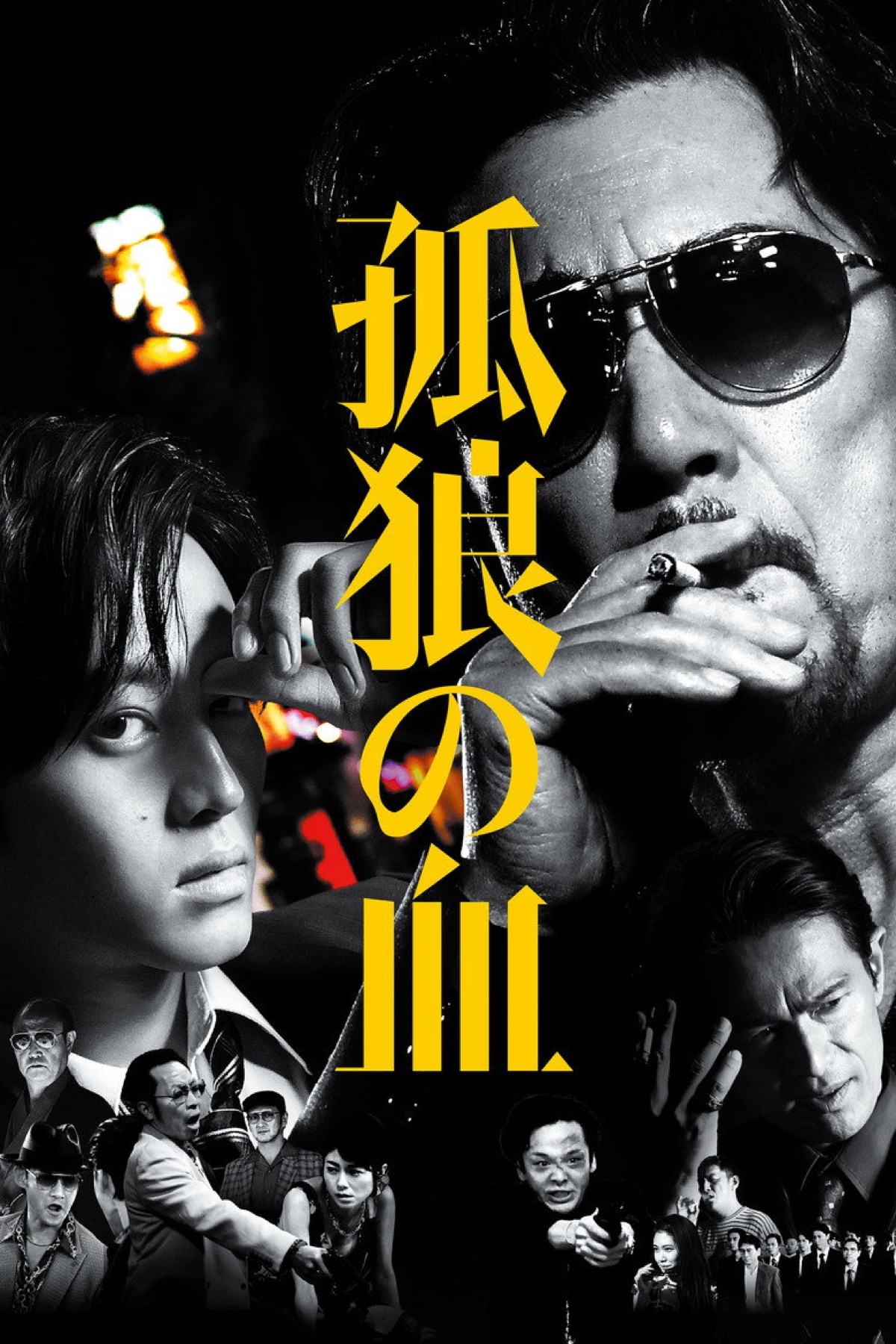
- Title: The Blood of Wolves (Korou no chi)
- Released: 2018, 126 minutes
- Director: Kazuya Shiraishi
- Screenplay: Junya Ikegami
- Starring: Koji Yakusho, Tori Matsuzaka, Yosuke Eguchi, Yoko Maki
- Music: Goro Yasukawa. Studio: Toei
- Source novel: Yuko Yuzuki, first of a trilogy
- Awards: Japan Academy Prizes for Best Actor, Best Supporting Actor, Best Art Direction, Best Sound
📖 Synopsis, No Spoilers
Hiroshima, 1988. In the invented city of Kurehara, a local yakuza family and a much larger Hiroshima syndicate are one incident away from open war. An employee of a finance company connected to the bigger outfit goes missing, which is the incident everybody has been waiting for.
Two detectives take the case. Shogo Ogami is a veteran of the organized crime division who drinks with gangsters, takes their money, and cheerfully commits felonies in the course of his duties. Shuichi Hioka is a university graduate on his first posting, still in possession of a functioning conscience, and he has been sent to gather evidence against his own partner. Neither of these men is being straight with the other, and the film knows exactly how long to let you believe you have worked out which one to trust.
✨ What Makes It Special
Why It Is Exceptional
- A moral inversion that lands because the year is 1988, not 2018
- Koji Yakusho giving one of the great performances of his career
- A mentor story hiding inside a gang war, with the reveal held to the last reel
- Toei rebuilding its own 1970s house style with modern tools
The inversion, and why the year matters
Set this in the present and it collapses into a familiar dirty-cop picture. Set it in 1988 and it becomes an argument about a specific vanished arrangement, which is what elevates it.
The film assumes context that Western viewers mostly will not have. Until the Anti-Boryokudan Act passed in 1991, organized crime in Japan operated more or less in daylight. Syndicates kept offices with signs on the door. Detectives knew the membership by name and drank with them. The relationship was not primarily adversarial, it was regulatory, and both sides understood the rules. Ogami is a product of that world and his method follows from it: keep the gangs alive, keep them visible, keep them fed just enough that they never go underground and become indistinguishable from everybody else.
His corruption is not a personal failing. It is his professional method, and the film builds a coherent case for it. Meanwhile the prefectural headquarters, the people who follow the rules, are shown to be sitting in the syndicate’s pocket for reasons that are entirely selfish. The men who obey the law come out worse than the man who breaks it constantly.
What keeps this from being smug is that Shiraishi never cashes the argument out. He does not tell you Ogami was right. He shows you how the man lived, how he died, and how much he cost the people near him, then leaves you to do the arithmetic yourself. I finished it unsure, and I have stayed unsure, which is a rarer outcome than films of this kind usually manage.
The 1991 law did what laws do. It drove the syndicates out of sight, into fronts and shell companies and the semi-legal gray economy, exactly as Ogami predicted. Whether that counts as a win is still argued in Japan. The film is not neutral about it, but it is careful, and thirty-eight years on it plays less like a period piece than like a report.
Koji Yakusho, the third face
If you have been reading this site you have now met Yakusho three times, and the range is the point. In Shall We Dance? he is a folded, apologetic office worker learning to stand up straight. In Cure he is a detective being quietly disassembled from the inside. Here he is a wall of a man who fills a room before he says anything, and none of the three feel like the same actor doing accents.
Japanese audiences read Ogami through that whole history, which foreign viewers coming to this cold will not get for free. Yakusho has spent forty years being cast as the decent, slightly beleaguered ordinary man. Handing him a character who forces excrement into a suspect’s mouth in the first ten minutes is a piece of casting violence, and the film is using your affection for him against you.
He took Best Actor at the Japan Academy Prizes for it. Tori Matsuzaka took Best Supporting Actor, which undersells what he does, since the film is arguably his. Watch his eyes in the last twenty minutes. The clean young graduate from the opening reel is simply not present any more, and Matsuzaka never signals the change once.
Toei rebuilding its own house
The film opens on grainy footage of waves hitting rock and then the Toei logo, and for a Japanese viewer of a certain age that combination is practically a Pavlovian trigger. It is a direct summons of the studio’s 1970s jitsuroku cycle, the true-account gang pictures headed by Battles Without Honor and Humanity, which were shot fast, loud, and handheld, and which Toei more or less abandoned for decades.
Shiraishi borrows the whole grammar: the hard-cut narration, the block-lettered captions naming each new gangster, the yellowed film stock. What stops it becoming a costume party is that the production design underneath is obsessive and specific. Police stations without air conditioning. Beer cans with pull tabs that come away in your hand. A period is being rebuilt here, not referenced.
Deeper Themes
Underneath the gang war this is a film about inheritance, in the narrow sense of one man handing his working method to another and in the wider sense of a studio handing a form to a younger director. Both transfers are shown to cost something. Nobody receives anything here without also taking on the damage attached to it.
The other thread is the price of the arrangement, paid almost entirely by people with no say in it. The film keeps returning to the civilians at the edges of the frame, bar hostesses and small shopkeepers, whose safety is the stated justification for everything Ogami does. It is careful never to let you forget that the men arguing about how to protect them have not asked them anything.
🎭 Memorable Scenes
I am the police. I can do whatever I like.
Ogami says it in thick Hiroshima dialect, and it functions as two different lines depending on where you are in the film. First time through it is a crooked cop announcing his own impunity. By the end it reads as a statement of what he has decided to carry, given that somebody has to. The words never change. Only your position does.
The one that actually got me is quieter and I did not see it coming. Hioka finds his own notebook, the working notes he has been keeping, marked up in red pen by somebody else. Ogami has been correcting his subordinate’s police work in secret for the entire film, never mentioning it, presumably to avoid the indignity of being caught caring. I did not expect a yakuza picture to do that to me.
Then the ending, which is a man lighting a cigarette. That is the whole shot. The lighter is not his, and everything the film has been building for two hours is in the fact that he now has it, opens it without thinking, and inhales. No dialogue. None needed.
💭 How It Made Me Feel
Wound up, and unable to settle the argument. I spent the rest of the evening turning over whether obeying the law is the same thing as doing right, and got nowhere, which I now think is the correct destination.
The tell came the next day. A police misconduct story turned up in the news, the sort of item I would normally scroll past, and I found myself reading it properly and asking a question the film had installed. That is a lot of work for one movie to do on a person, and I have not entirely forgiven it.
Who Should Watch This?
- Anyone who rates Training Day, Infernal Affairs, or the first two Godfathers
- Viewers who want the modern answer to Battles Without Honor and Humanity
- Anyone who met Koji Yakusho through Perfect Days and wants the other extreme
- People who like a film that refuses to tell them what to think
😅 Where It Falls Short
Three warnings, one of them serious
I have been enthusiastic so far, so now the accounting. The violence is severe and it starts immediately. The opening sequence at a pig farm involves a close-up of an animal’s rear end and then the use of what comes out of it, on a human being. Later there is a finger removal, a drowned body some days along, and a severed head. The Japanese rating was R15, which strikes me as optimistic. If graphic bodily harm is a genuine problem for you, this film will not negotiate.
Second, the first twenty minutes are a wall of proper nouns. Four organizations, a dozen named men, and shifting allegiances between all of them, delivered entirely in Hiroshima dialect that even Japanese viewers from elsewhere find heavy going. I spent the opening act working out who was aligned with whom rather than watching the film. A character chart before you start is not cheating.
Third, and this is minor, the cast is deeper than the script can use. Several well-known faces turn up, make a strong impression in one scene, and then effectively vanish. Yosuke Eguchi gets a late showcase that goes some way to squaring the account. Not everybody does.
The Weak Points
- Graphic violence from the first scene onward, with no easing in
- A dense opening act of factions, names, and heavy regional dialect
- Strong supporting actors given one scene apiece
Who Might Not Enjoy This?
- Anyone with a low tolerance for graphic or degrading imagery
- Viewers who dislike tracking large casts across rival factions
- People who want a clean resolution about who was right
📺 Streaming Guide by Service
One subscription, three doors
Practically speaking there is one decision to make: which door into AMC Networks you prefer. Shudder is the natural pick if horror is already your habit, the AMC+ channel on Amazon is convenient if you already live inside Prime Video, and Philo makes sense if you were considering the wider bundle anyway. Same film behind all three.
No English dub exists, which settles that question. Subtitles are the only route, and for once I would call that a mercy, because the Hiroshima dialect is doing real characterization work that a dub would flatten into generic tough-guy American.
Watch It Here
- Shudder: included with a subscription
- AMC+ on Amazon: an add-on channel inside Prime Video
- Philo: carries it as part of the AMC package
Soundtrack
Goro Yasukawa wrote the score, and it is a deliberate reconstruction of how Toei crime pictures sounded in the seventies: brass stabs, agitated percussion, a main theme that announces trouble a beat before trouble arrives. Both major audio platforms carry it.
Heard on its own it is almost comically emphatic. Heard under the film it does exactly what the images need, which is to keep insisting that this is a genre picture while the script quietly stops being one.
📚 The Source Novel
Yuko Yuzuki wrote the book, and the story runs to three volumes in Japanese. I can find no English edition of any of them, which is a real gap given how well the series sold at home. Do not buy a listing that claims otherwise without checking the language field carefully.
Worth knowing if you get there anyway: the novel handles Ogami’s fate quite differently, and the pig farm structure is an invention of the screenplay. Reading the book after the film is not a recap. Watch the film on Amazon first, then decide how much you want the rest.
🎬 If You Loved The Blood of Wolves, Watch These 3 Next
Sonatine
The opposite temperature, same subject. Takeshi Kitano shoots gangsters as bored men killing time on a beach until violence arrives without warning or music. Where Shiraishi is sweaty and shouting, Kitano is silent and flat. Watch both and you have the two poles of the Japanese yakuza film.
Cure
Yakusho again, also playing a detective, also losing his grip on where he ends and the case begins. Kiyoshi Kurosawa does it with almost no blood and considerably more dread. If the moral vertigo was your favorite part of The Blood of Wolves, this is the pure form of it.
Shall We Dance?
Put this on afterwards, deliberately, as a corrective. The same actor, twenty-two years earlier, playing a timid accountant who takes secret ballroom lessons because his life has gone quiet. Nothing about the two performances suggests one man. It is the best short argument I know for why Japanese audiences treat Yakusho the way they do.
👉 Read our review of Shall We Dance?
If you want the seventy years of Japanese crime cinema this film is arguing with, that list runs from a 1949 Kurosawa procedural to a Miike farce. 👉 10 Best Japanese Crime & Yakuza Movies
📝 Final Thoughts
Toei spent the seventies making gang films faster than anyone could watch them, then spent forty years letting the form go cold. The Blood of Wolves is the studio picking it back up with a director born after the cycle ended, and the surprising result is not nostalgia. It is a working argument about policing, dressed in a jacket it borrowed from 1973.
What stayed with me was not the violence, which is considerable and which I would happily have had less of. It was a cigarette lighter. I do not smoke and I have found myself thinking about the sound of that lid for weeks. Everything the film wants to say about what one man leaves to another is in a piece of metal changing hands, and I would like to watch it again, at night, on my own, once the rest of it has faded a little.
⭐ Film at a Glance
| Category | Rating | Comment |
|---|---|---|
| Writing | ★★★★☆ | The inversion is built, not announced |
| Lead performance | ★★★★★ | Yakusho fills the room before he speaks |
| Visuals | ★★★★☆ | 1988 rebuilt down to the beer cans |
| Music | ★★★★☆ | Yasukawa reconstructs the Toei sound |
| Emotional impact | ★★★★☆ | The red pen, then the lighter |
| Accessibility | ★★☆☆☆ | Severe violence, dense first act |
Usagi’s Recommendation Score
⭐⭐⭐⭐⭐⭐⭐⭐☆☆
7.7 / 10
Brutal, argumentative, and unwilling to tell you who was right. Look up a character chart first.

