*This page contains affiliate links. We may earn a commission if you make a purchase through these links.
If you asked me for the best film ever made about a job, I would not hesitate, and the job in question is forestry.
Shinobu Yaguchi built his career on films about unpromising people learning a discipline, and after synchronized swimming and big band jazz he picked cutting down trees in a mountain village with no phone signal. It should be a public information film. It is instead one of the most purely enjoyable Japanese comedies of the last twenty years, and Americans cannot stream it, which I will deal with immediately because there is a workaround.
📺 Where to Watch Wood Job! (August 2026)
| Service | Status | Notes |
|---|---|---|
| Prime Video (US) | Not available | Streams in Japan, absent from the US catalog |
| Netflix | Not available | In no region |
| Crunchyroll | Not available | Live-action, outside its catalog |
| Hulu (US) | Not available | Never licensed |
| The novel, in English | Available | Translated, in print, same story |
⚠️ Availability as of September 2026. Please verify before subscribing.
Checked on August 18, 2026: the film has no US streaming, rental or disc release. It never picked up Western distribution, which is odd for a director whose earlier work travelled, and TMDB lists no American provider of any kind.
The workaround is unusually good, though. Shion Miura’s novel was translated into English by Juliet Winters Carpenter and published as The Easy Life in Kamusari in 2021, with a sequel following. The film is a faithful adaptation, so the story is fully available to an English reader even though the movie is not. That is not a consolation prize; the book is excellent and it is in print.
From here, the contrast is the usual one. In Japan it sits on Prime Video and U-NEXT, both flat-rate, and it turns up on television regularly. A film that a Japanese viewer can put on tonight for free with an existing subscription is, for you, a book order.
🎬 Trailer
Japanese only, from the distributor’s official channel, because with no English-language release there is no English trailer to offer. You will still get the tone from it, which is roughly ninety percent sunshine. What the trailer cannot convey is how large the trees get later.
Work Info
- Title: Wood Job! In Japanese, Wood Job! The Easy Life in Kamusari
- Released: 2014, 116 minutes
- Director and writer: Shinobu Yaguchi
- Source novel: Shion Miura
- Cast: Shota Sometani, Masami Nagasawa, Hideaki Ito
- Also by the director: Waterboys, Swing Girls
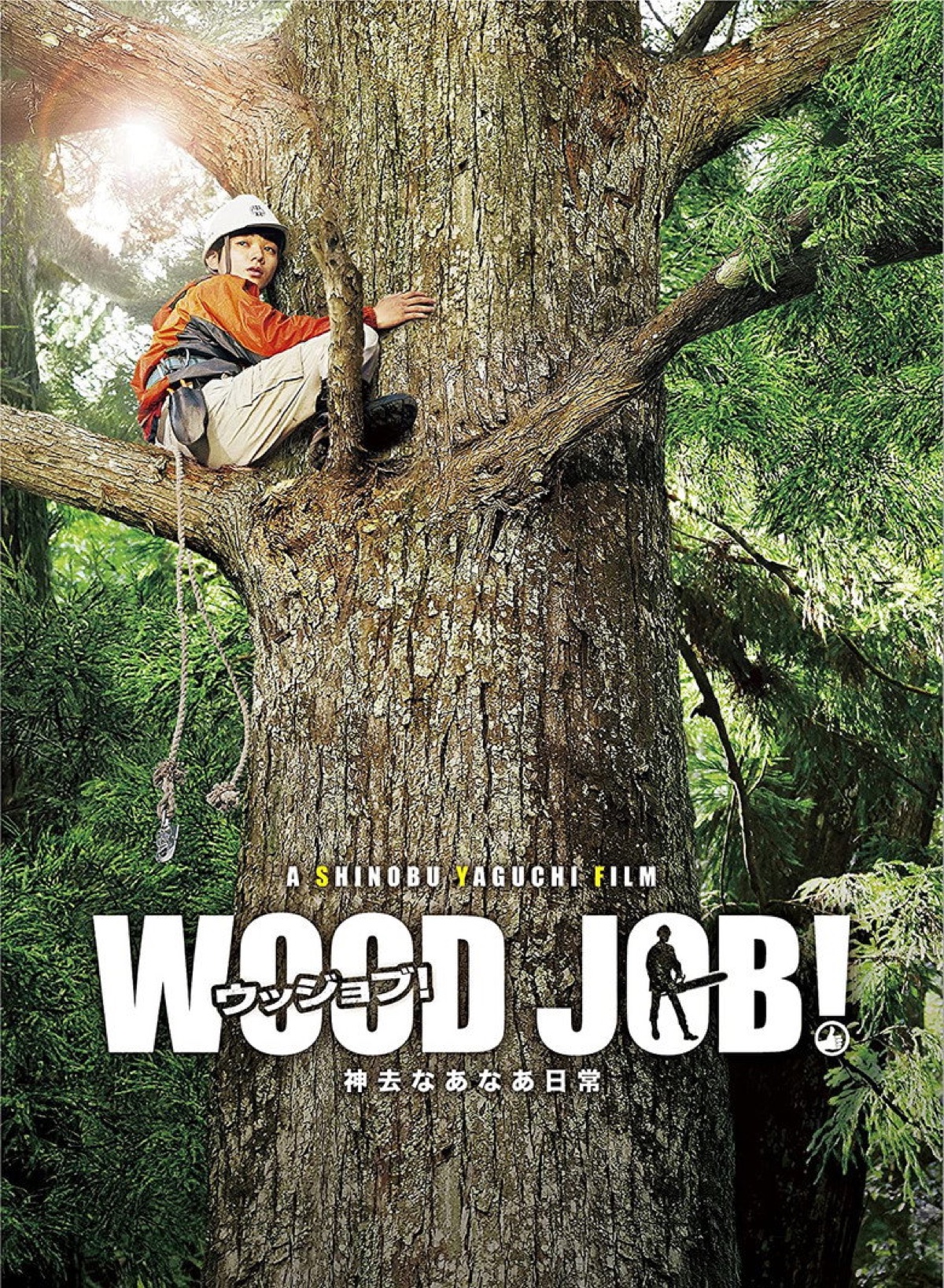
📖 Synopsis, No Spoilers
Yuki Hirano has failed his university entrance exams, been dumped, and has no plan. Flipping through leaflets, he sees a photograph of an attractive woman on the cover of a forestry training brochure and signs up on that basis alone. This is the entire extent of his motivation and the film is honest about it.
The program deposits him in Kamusari, a mountain village with no mobile reception, under the supervision of Yoki, a man who approaches both forestry and teaching as contact sports. There are chainsaws, leeches, and a great deal of physical labor Yuki is unequipped for. He spends the first stretch counting the days until he can leave. The film is about what that count turns into.
✨ What Makes It Special
Why It Is Exceptional
- A countdown that changes owners, and never gets explained out loud
- Real hundred-year trees, shot on location, with no digital assistance
- A comedy about a trade whose results arrive after everyone involved is dead
The countdown changes hands
Early on, Yuki is counting down the days until the training ends and he can escape back to the city. It is the only thing keeping him upright. By the back half, the villagers are counting the same days, in the other direction, because they do not want him to go.
Nobody announces this. There is no scene where a character says that Yuki has become one of them, and no music cue marking the turn. The reversal is built entirely from meals, work, and preparations for a festival, and you notice it has happened some time after it happened. That is a considerably harder trick than the emotional beat it delivers, and it is why the film keeps working on repeat viewings when the jokes are no longer surprising.
By the point where the count flips you are doing it too. I have watched this film several times knowing exactly how it ends and still not wanted the training period to be over.
The trees are real and it shows
There is no digital scenery here. What is on screen is a Japanese mountain forest and cedars over a century old, shot where they stand, and the film gets an enormous amount out of simply pointing a camera up.
It also refuses to make the work look easy or safe. Felling something that size is presented as genuinely dangerous, closer to demolition than to gardening, and the sequences where the crew works at height are shot to make your legs unsteady. The scene of two men eating lunch on a branch a long way up is the one people remember, and the reason it lands is that the height is not a special effect.
Some context you would have no way of knowing from outside. About two thirds of Japan is forest, one of the highest proportions in the developed world, and domestic forestry has spent decades in decline against cheap imported timber. So the village is not simply remote and charming. It is doing skilled work in an industry that largely lost its market, which gives the film’s cheerfulness an undertow the subtitles will not tell you about.
A comedy with a hundred-year horizon
The line that carries the film is Yoki’s, and it is delivered without any ceremony: a farmer eats what he grows, but a forester’s results come in long after he is dead. Everything the villagers do is aimed at people who do not exist yet.
That idea sits underneath a film that is otherwise loose, funny and fast, full of physical comedy and eccentric neighbors and a very silly romance. The philosophy never gets a speech. It is stated once, plainly, and then dropped, and the rest of the film simply behaves as though it is true. I have a weakness for stories that make you enjoy yourself and then hand you something serious on the way out, and this is the cleanest example of it in modern Japanese cinema.
Deeper Themes
The title contains a word that does not survive translation. Kamusari’s local expression is naa-naa, a piece of regional dialect that covers something like take it easy, near enough, let it be. The English edition of the novel renders it as easy life, which is the best available option and still loses the shrug in it.
That word is the film’s actual argument. Not that rural life is superior, and not that the city is corrupt, but that a slower unit of measurement exists and is available to anyone willing to adopt it. Yuki does not learn to love nature. He learns to stop counting in days.
🎭 Memorable Scenes
A farmer gets to eat the vegetables he grows. In forestry the results come in after we are dead.
Translated by me from the Japanese, since there is no English release to quote. It arrives casually, mid-conversation, from a man who is not presenting it as wisdom, and it reframes everything you have watched up to that point.
The other one is the lunch break in the canopy. Yoki and Yuki eat sitting on a branch at a height that should be terrifying, and the aerial photography arranges it so that the fear loses to the view. It is the moment the film stops being about a boy who wants to leave.
💭 How It Made Me Feel
Rinsed out, in the best sense. The film ends and something that had been sitting on your chest is not there any more, which is a strange result from a comedy about manual labor and leeches.
What I take from it every time is the effect on the following morning rather than the film itself. It is a work story that makes you want to go and do your own work, without arguing that your job is meaningful or that you should be grateful. It just shows people doing something difficult with each other and lets that be persuasive.
Who Should Watch This?
- Anyone worn down by city life who wants two hours in a forest
- Viewers who want Japanese cinema that is warm rather than devastating
- People who have lost the thread of why they go to work
- Readers who would happily take the novel instead, since the film is unavailable
😅 Where It Falls Short
The city section is the weak half hour
Being honest about it: everything before Yuki reaches the mountains is the least interesting part of the film. The photography is ordinary, the comedy is broad, and it feels like a runway rather than a first act.
His university friends are the specific problem. They are written as shallow urban types with nothing behind them, and the caricature is thin enough to be irritating on a second viewing. The counterargument, which I half accept, is that the flimsiness of those scenes is what gives Kamusari its weight when it arrives. I would still have taken a lighter touch.
Beyond that, the romance is functional at best and the film is not attempting anything difficult structurally. It is a well-executed crowd-pleaser rather than a formally ambitious one, and it does not pretend otherwise.
The Weak Points
- The opening city stretch is flat next to everything after it
- Yuki’s urban friends are drawn as caricature and grate
- The romance is the least developed thread in the film
Who Might Not Enjoy This?
- Anyone who needs narrative stakes, since almost nothing here is at risk
- Anyone allergic to broad physical comedy
- People who find the countryside-heals-you premise tiresome by default
📺 Streaming Guide by Service
Read the book, and keep an eye out for the film
Since there is no US release, the honest recommendation is the novel. The Easy Life in Kamusari covers the same story, the translation is by Juliet Winters Carpenter, who also brought Miura’s The Great Passage into English, and there is a sequel called Kamusari Tales Told at Night if the first one takes.
The book and the film differ in useful ways. Miura writes Yuki’s account as a first-person record, so you get the interior grumbling that Yaguchi converts into physical comedy, and the village’s practices get more room. If you have read it and then somehow get access to the film, the adaptation will feel unusually faithful.
On the film itself, the only realistic route is a Japanese subscription or an import disc, neither of which comes with English subtitles. This is a title worth checking on again in a year, since Yaguchi’s back catalog has been circulating internationally and there is no obvious reason this one should stay out.
The State of Play
- United States: no streaming, no rental, no subtitled disc
- In English: the novel is translated and in print, and it is the same story
- Japan: Prime Video and U-NEXT, both included with a subscription
Soundtrack
The score is on the major streaming platforms, and it does what the film does: bright, unfussy, and content to stay out of the way of the scenery.
It is a reasonable thing to put on while working, which is not a claim I would make about most of the soundtracks that come up on this site.
📚 The Source Novel
Shion Miura is one of the more reliably translated contemporary Japanese novelists, and this is the rare case on this site where the source material is easier for an English reader to get hold of than the adaptation.
The Easy Life in Kamusari runs about two hundred pages and reads quickly. Start there, and if the village gets you, the sequel is waiting.
🎬 If You Loved Wood Job!, Watch These 3 Next
Sanctuary
The same shape with the warmth removed. A young man with no prospects joins a closed traditional Japanese world for entirely cynical reasons and gets taken apart by it. Sumo instead of forestry, considerably harsher, and available on Netflix in every territory, which is more than can be said for Kamusari.
👉 Read our review of Sanctuary
A Letter to Momo
A city child dropped into a small rural community against her will, and slowly stopping wanting to leave. Animated, aimed younger, and built on exactly the same movement. It also gets the texture of a Japanese village right, down to the way neighbors turn up uninvited.
👉 Read our review of A Letter to Momo
Mushishi
For the forests rather than the jokes. Episodic stories set in a rural Japan where the natural world is enormous, indifferent and not hostile, which is more or less the attitude the villagers of Kamusari take toward their mountain. Quieter and sadder, and the best thing to put on afterwards.
📝 Final Thoughts
This is not a documentary about forestry with a story attached. It is a comedy that happens to be right about work, and the thing it gets right is that meaning does not arrive by being told your job matters. It arrives from doing something hard alongside people who expect you to keep showing up.
The frustration is that I cannot simply point you at a service. What I can point you at is the novel, which is translated, in print, and the same story. Read it, and if the film ever crosses the Pacific, you will already know why the village counts in centuries.
⭐ Film at a Glance
| Category | Rating | Comment |
|---|---|---|
| Writing | ★★★★☆ | The reversal is executed without a word of explanation |
| Visuals | ★★★★★ | Real forest, real height, no digital help |
| Characters | ★★★★☆ | The village is superb, the city friends are not |
| Comedy | ★★★★☆ | Broad, well timed, never smothers the material |
| Themes | ★★★★★ | Stated once, then simply lived out |
| Availability | ★☆☆☆☆ | Nothing in the US. Read the novel instead |
Usagi’s Recommendation Score
⭐⭐⭐⭐⭐⭐⭐⭐☆☆
8.0 / 10
Yaguchi’s best. Easy to watch, and quietly serious about work.

