*This page contains affiliate links. We may earn a commission if you make a purchase through these links.
This is the one I hand over carefully.
Shunji Iwai’s 2001 film about a fourteen-year-old boy, the classmate who used to be his friend, and the imaginary pop star both of them are hiding inside, is the most beautiful thing in Japanese cinema from that decade and among the most punishing. It has spent twenty-five years being passed between people who recognize something in it, usually without much said out loud. Here is where to watch it, what it is doing with all that light, and who should probably not press play.
📺 Where to Watch All About Lily Chou-Chou (August 2026)
| Service | Status | Notes |
|---|---|---|
| Kanopy | Free | With a US library or university card |
| Hoopla | Free | Also through a participating library |
| Cineverse / AsianCrush | Streaming | Subscription, also sold as an Amazon Channel |
| The Roku Channel | Free with ads | Plex carries it on the same terms |
| Amazon Video | Rent or buy | Apple TV, Google Play and YouTube as well |
| Netflix | Not available | Never licensed in the US |
| Crunchyroll | Not available | Live-action, outside its catalog |
As of August 18, 2026, American readers have the best deal on this film anywhere in the world, and most of them do not know it. Kanopy and Hoopla both carry it, which means a US library card gets you a 146-minute art film from 2001 for nothing. Roku and Plex will show it to you free with ads. Cineverse has it behind a subscription, and every major storefront rents it if you would rather just pay four dollars and skip the sign-ups.
Now the view from here. In Japan the only subscription service carrying it is U-NEXT, which costs about 2,200 yen a month, and the alternative is renting it. There is no library-card route, no free tier, no ad-supported option. A Japanese viewer who wants to revisit this film pays for it. An American with a library card does not. That is not the usual arrangement for Japanese cinema and it is worth taking advantage of.
🎬 Trailer
There is no trailer embedded here, and the reason is worth stating. The only official English-language trailer, from the film’s US distributor Film Movement, is age-restricted on YouTube, which means the embedded player is dead for every reader regardless of country. This site’s rule is that an embed has to be checkable before it goes on the page, and a broken box is worse than none. Search for the Film Movement trailer and watch it on YouTube directly if you want a look first.
That is Film Movement, the US distributor. The Debussy on the soundtrack and the noise in the image are the whole film in ninety seconds. If that combination puts a knot in your stomach rather than making you reach for something else, you are the audience.
Work Info
- Title: All About Lily Chou-Chou
- Released: 2001, 146 minutes
- Director and writer: Shunji Iwai
- Cast: Hayato Ichihara, Shugo Oshinari, Ayumi Ito, Yu Aoi
- Music: Takeshi Kobayashi, with Salyu as the voice of Lily Chou-Chou
- Origin: an online novel Iwai wrote on a live message board before shooting
📖 Synopsis, No Spoilers
A provincial town surrounded by rice fields. Yuichi Hasumi is in his second year of junior high, which in Japan means fourteen and locked into one classroom with the same thirty people for the year. Hoshino, who was his friend, now runs that classroom, and Yuichi runs errands for him: the shoplifting, the collections, whatever is asked.
What Yuichi has instead of a life is the singer Lily Chou-Chou. He administers a fan site under the handle Philia, and on that message board he says the things he cannot say anywhere else. Another regular, Blue Cat, writes back, and the two of them build the only honest relationship in the film out of text on a black screen. The distance between who these people are online and who they are at school is the film’s subject, and it closes in a way you will see coming and still not be ready for.
✨ What Makes It Special
Why It Is Exceptional
- Overwhelming natural beauty used as the setting for something ugly
- Message-board text laid over the image, twenty years before anyone called it a format
- A fictional singer with a real discography, and a voice that justifies the devotion
The prettiest film about the worst year of someone’s life
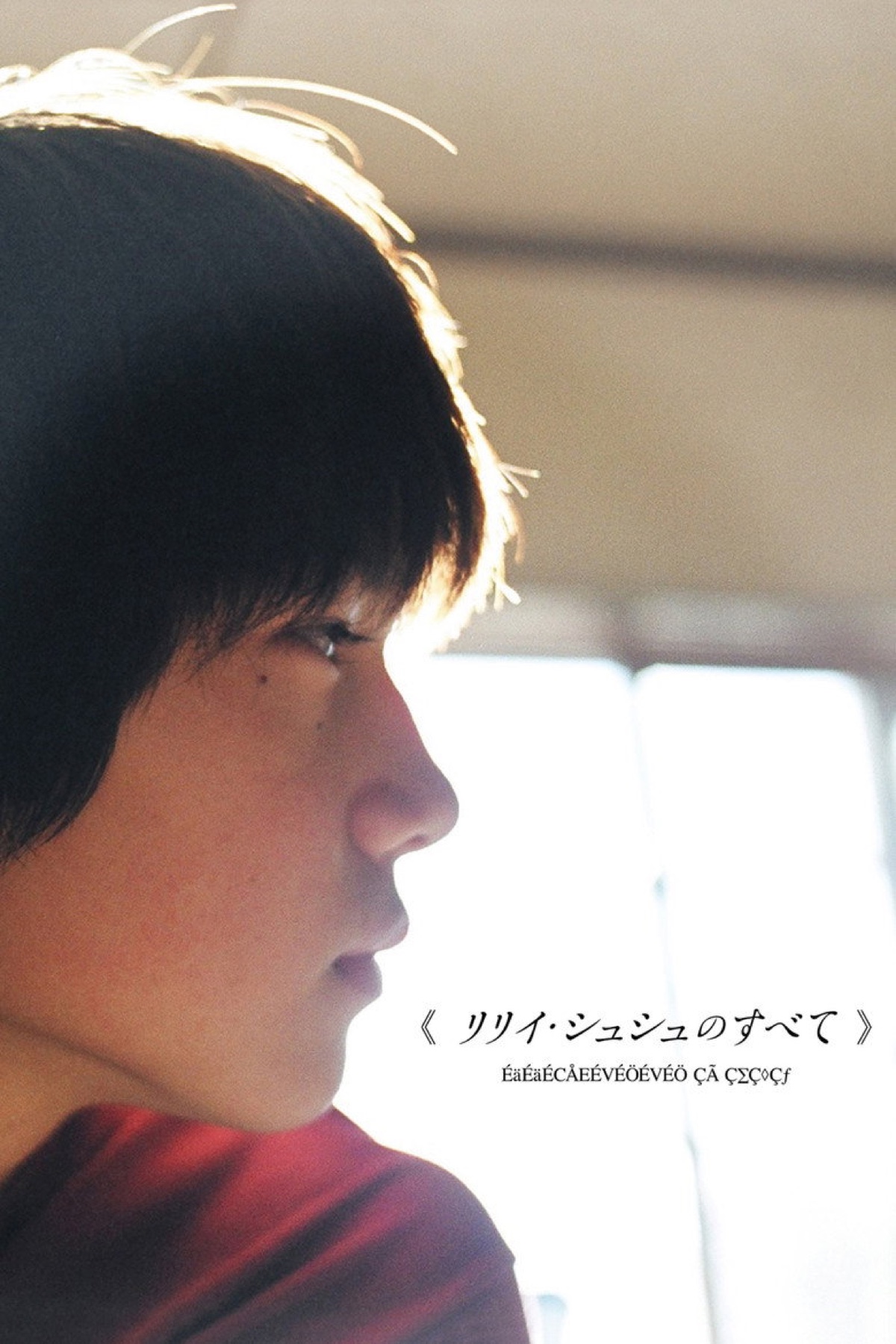
Iwai shoots almost everything into the light. Green rice fields to the horizon, sky that goes on forever, handheld digital video catching lens flare and letting the highlights blow out. Frames from this film get posted as wallpaper by people who have never seen it, and I understand why. It is one of the most photographed-looking films ever made about children being cruel to each other.
The beauty is not decoration and it is not accidental. It is the argument. Nothing about the landscape acknowledges what is happening inside it. The fields are indifferent, the light keeps arriving, and the summer is gorgeous whether or not a fourteen-year-old is having the worst months of his life in the middle of it. Anyone who was miserable as a teenager in a nice-looking place will recognize the specific insult of that.
I should be honest that this style has its detractors here as well. Iwai’s soft focus and dreaming camera get filed by some Japanese viewers under atmosphere over substance, and the criticism is not baseless. What makes it stick in this case is that the prettiness has a job. Take it away and the film becomes an ordinary account of bullying. Leave it in and it becomes a film about how the world declines to notice.
It got the internet right before the internet was worth getting right
White text on black, scrolling over the image while the film continues underneath. That is a message board of the Japanese kind circa 2001, an era when this country’s online life ran on anonymous text forums and nobody had a profile picture or a real name attached. Two people who cannot look at each other in a classroom talk as equals there, because the board does not know which of them is which.
Iwai did not simulate this. He wrote the story as a serial on an actual message board first, taking posts from readers into the narrative, and shot the film afterward. That is why the register is exact: the flatness, the sudden intimacy, the way a thread can turn. Watching it in 2026, when we have spent two decades learning what happens when people say true things to strangers under invented names, the sequences read as prophecy rather than period detail.
The singer is invented, the records are real
Lily Chou-Chou does not exist. The music does. Takeshi Kobayashi wrote it and a then-unknown vocalist performing as Salyu sang it, and the album Kokyu came out as an actual release under the Lily Chou-Chou name. Salyu went on to a substantial career in Japan, so for a Japanese audience the fictional star of this film has a discography sitting in the same streaming library as everybody else.
That matters because the film asks you to accept that a record can be the only load-bearing thing in a child’s life. If the songs were merely adequate, the whole structure would collapse into something you watch from outside. They are not adequate. Put on Ai no Jikken or Howa without context and the reverence in the film stops needing an explanation.
Deeper Themes
The word the film keeps circling is ether. It is what the fans claim to hear in Lily’s voice, and it is never defined, which is the point. It stands for the thing that makes an unbearable year survivable, and the film’s position is that it does not matter whether that thing is real as long as it holds.
The structural argument underneath is about Japanese schooling. A junior high class in Japan is a fixed group in a fixed room, and a student cannot transfer out of a bad one. When a hierarchy forms there, it has nowhere to dissipate. The film is precise about this in a way that is easy to miss from outside, and it explains why nobody in it simply leaves.
🎭 Memorable Scenes
When I listen to her sing, I can feel the ether.
My own rendering rather than the official subtitle. It is the film’s first line of real speech and it tells you the register you are in: a teenager describing a pop record in the language of religion, and meaning it exactly.
The image that stayed with me is the smaller one. Yuichi standing alone in the middle of a rice field with headphones on, doing nothing at all. Everything around him continues and none of it reaches him. It is the most accurate picture of being fourteen and unhappy that I know of, and it is the shot I see first whenever the film comes up. The kite sequence gets the same treatment for most people and deserves it, since it is the only moment in 146 minutes where anybody gets to be weightless.
💭 How It Made Me Feel
Hollowed out, and not in a way I resented. The pain this film leaves is quiet and heavy rather than sharp, and it works by finding scar tissue you had stopped checking on. It does not offer a resolution, an apology, or a lesson, and any of those would have been a lie about the material.
Here is the thing I keep circling back to. Beauty and cruelty in this film are not opposites placed side by side for contrast. They are the same fact seen from two positions, and once a film has shown you that, you cannot quite unsee it in the ordinary world either. Of every coming-of-age film I have watched, this is the one I rate highest, and it is also the one I am slowest to recommend.
Who Should Watch This?
- Anyone whose school years were survived rather than enjoyed
- People for whom a specific album was once the thing keeping the week together
- Viewers who came to Japanese cinema through the beautiful and want the difficult
- Anyone interested in how the early internet actually felt from the inside
😅 Where It Falls Short
What you are actually agreeing to watch
This section is a content note as much as a criticism, because the film’s marketing has always undersold what is in it. Alongside the bullying and extortion, the story involves coerced prostitution of a minor, sexual assault, and a suicide. None of it is filmed sensationally and none of it is played for shock, which somehow makes it land harder rather than softer. If any of that is something you need to avoid, avoid this, and no argument about artistry should override that.
Beyond the content, the film gives you nothing at the end. There is no catharsis, no reckoning, no adult who arrives and fixes it. Watch this looking for a lift and it will do real damage to your evening. It is 146 minutes long and the last third is the heaviest, so the commitment is not trivial either.
And the objection I have some sympathy with: the dreamlike photography can read as aestheticizing what it depicts. I do not think it does, for the reasons above, but a viewer who wants this material handled with documentary plainness will find the approach evasive, and that is a defensible place to land.
The Weak Points
- Heavy content: bullying, coerced prostitution of a minor, sexual assault, suicide
- No resolution and no relief, by design
- The soft-focus style will read to some as atmosphere standing in for rigor
Who Might Not Enjoy This?
- Anyone watching to feel better afterwards
- Viewers who need depictions of abuse kept off screen
- People who want plot momentum, since this drifts by design
📺 Streaming Guide by Service
The library card is the answer here
Start with the library. Kanopy and Hoopla both run through participating US libraries and universities, the film is included on both, and neither costs anything beyond the card you may already have. This is the rare case where the free option is also the one to take.
If the library route is closed to you, Roku and Plex have it free with advertising, which is a poor fit for this particular film. A commercial break during the last forty minutes is genuinely destructive to it. Renting it for a few dollars is worth the money purely to keep the run uninterrupted.
On timing: give it a full evening and do not split it across two nights. The film builds by accumulation, and the gap between sessions lets you out from under it.
Watch It Here
- Kanopy: free with a US library or university card, and the best way to see it
- Hoopla: free through participating libraries
- Cineverse / AsianCrush: subscription, also available as an Amazon Channel
- Amazon Video: rent or buy, uninterrupted
Soundtrack
The Lily Chou-Chou songs were released as the album Kokyu, credited to the fictional artist, and it is on Spotify and Apple Music like any other record. Written by Takeshi Kobayashi, sung by Salyu.
The other half of the score is Debussy, and it does most of the work in the quiet passages. Listening to the album before watching is not a bad idea, because the film assumes you already understand why someone would need it.
📀 On Disc and in Print
Iwai’s source novel has never been published in English, so the film is the only version available to most readers here. In Japanese it exists as a Kadokawa paperback assembled from the message-board serial.
For a physical copy, the restored transfer is available on Blu-ray. Worth it if the photography is what draws you, since compression is unkind to a film shot this close to the light.
🎬 If You Loved All About Lily Chou-Chou, Watch These 3 Next
EUREKA
Released the same year, and the closest thing this film has to a sibling. Shinji Aoyama shoots in sepia where Iwai shoots into the sun, and both films hand the emotional load to the image rather than the dialogue. Three hours and thirty-seven minutes, about survivors of a bus hijacking, and it takes the recovery that Lily withholds and makes it the entire subject.
Cure
Kiyoshi Kurosawa working the same seam from the adult end. Ordinary Japanese people doing appalling things without being able to say why, filmed with the same refusal to underline anything. If what unsettled you about Lily was how normal the cruelty looked, this is the next step and it is even colder.
The Summer Hikaru Died
The same rural Japanese summer, the same age group, the same suffocating closeness of a small community, rebuilt as folk horror in animation. Two boys, one of whom is not what he was, and a friendship that neither can leave. It is the modern descendant of what Iwai was doing, and it is currently much easier to find.
👉 Read our review of The Summer Hikaru Died
Harmful Insect arrived a year later and covers the same territory with almost no dialogue at all. 👉 Read the Harmful Insect review
📝 Final Thoughts
Twenty-five years on, the reason this film keeps finding new people is that nothing about it has dated except the modem noise. Children still work out their hierarchies where adults cannot see. People still say the truest things they have under names nobody can trace. Somebody is still getting through a bad year on one album played to death.
What Iwai built is a grave marker for a particular kind of adolescence, and he made it beautiful on purpose, which is the part people argue about and the part that works. If you are in a position to watch it, the American library systems are handing it out for free, and there is no better version of this offer anywhere. Just pick the evening deliberately.
⭐ Film at a Glance
| Category | Rating | Comment |
|---|---|---|
| Writing | ★★★★★ | Drifting on purpose, and in complete control |
| Visuals | ★★★★★ | Among the most beautiful Japanese films of its decade |
| Characters | ★★★★★ | Fourteen-year-olds written without a trace of condescension |
| Music | ★★★★★ | The invented pop star carries the film |
| Themes | ★★★★★ | Read as prophecy now rather than period detail |
| Watchability | ★★☆☆☆ | 146 minutes, no relief offered |
Usagi’s Recommendation Score
⭐⭐⭐⭐⭐⭐⭐⭐⭐☆
9.0 / 10
Raw adolescent feeling with nowhere to go, in one film. The best coming-of-age film I know.

