*This page contains affiliate links. We may earn a commission if you make a purchase through these links.
The murders are not the frightening part of this film. The faces afterward are. Nobody screams, nobody confesses, nobody seems to understand what they have done. They just look lighter. Like someone who finally set down a bag they had been carrying for years. Kiyoshi Kurosawa called his 1997 breakthrough Cure, and he was not being ironic.
Ringu is the Japanese horror film the world knows. Cure is the one Japanese film fans are still arguing about nearly thirty years later, and it is the one Bong Joon-ho put on his 2012 Sight & Sound ballot of the greatest films ever made. I saw it a long time ago. It has not left. What I want to explain here is why a film with no ghost, no jump scare, no chase, and no answer at the end is the one that stays.
📺 Where to Watch Cure (October 2026)
| Service | Status | Notes |
|---|---|---|
| Amazon Prime Video | Rent / Buy | A separate charge. Not included with Prime |
| Apple TV | Rent / Buy | Listed in HD |
| Fandango at Home | Rent / Buy | Listed in SD |
| The Criterion Channel | Not available | No longer on the channel |
| Netflix | Not available | Not carried in the US |
| Crunchyroll | Not available | Live-action, outside its catalog |
No US subscription carries Cure. It left the Criterion Channel, nothing picked it up, and the way in is a rental of three or four dollars from Amazon or Apple TV. That suits the film better than you might think: rent it for a night you have kept clear, not as something to have on while you scroll. Criterion put out the Blu-ray in October 2022 from a 4K restoration of the original negative, which is also why the film looks far better now than the murky copies that circulated for years.
If the appeal of this one is the idea of a Japanese film that treats dread as an everyday texture rather than an event, Takeshi Kitano’s Sonatine works the same nerve from a completely different genre.
🌀 Cure (1997) Explained: What Mamiya Does, and What the Last Scene Means
The killers in Cure are not copying each other. Each of them spent a few minutes with the same young man, Mamiya, and left carrying an instruction they did not know they had been given. His tools are small and repetitive: a lighter flame held steady, the motion of water, a question asked again and again until the other person’s answers wear thin. The X cut into every victim is the signature that ties the cases together, and the detective, Takabe, works out partway through that the young man once studied mesmerism and hypnosis.
Kurosawa hands that mechanism over early, on purpose. Knowing how it is done does not make anyone safer, which is the film’s cruelest trick. The question it leaves running is not how Mamiya does it but why it works on the people it works on, and the film never answers that in words.
Spoilers for the ending from here. Takabe tracks Mamiya to an abandoned building and shoots him. In the same building he finds an old phonograph cylinder, a recorded male voice repeating the same kind of instructions, so the practice is older than Mamiya and did not start with him. Takabe’s wife is later found dead with the X cut into her throat. Then the final scene: Takabe at a restaurant table, a waitress pouring his coffee, the waitress walking off, a few words passed to her by other staff, and her hand quietly taking up a knife.
Kurosawa never shows how it reached her. The detective was the last customer she served, and that is all the film gives you. Most readings, mine included, take it that Takabe has stepped into Mamiya’s place, and that the cure in the title has passed to him along with the method. I find the restaurant more frightening than anything before it, because it is the most ordinary room in the film, and because by then you have learned exactly what to watch for and still cannot see it happen.
🎬 Trailer
Work Info
- Title: Cure (Kyua)
- Released: December 27, 1997 (Japan)
- Director / Writer: Kiyoshi Kurosawa
- Cast: Koji Yakusho, Masato Hagiwara, Tsuyoshi Ujiki, Anna Nakagawa, Yoriko Doguchi, Denden, Ren Osugi
- Music: Gary Ashiya
- Runtime: 111 minutes
- Production: Daiei Film / Distribution: Shochiku
- Award: Best Actor, Koji Yakusho, 10th Tokyo International Film Festival
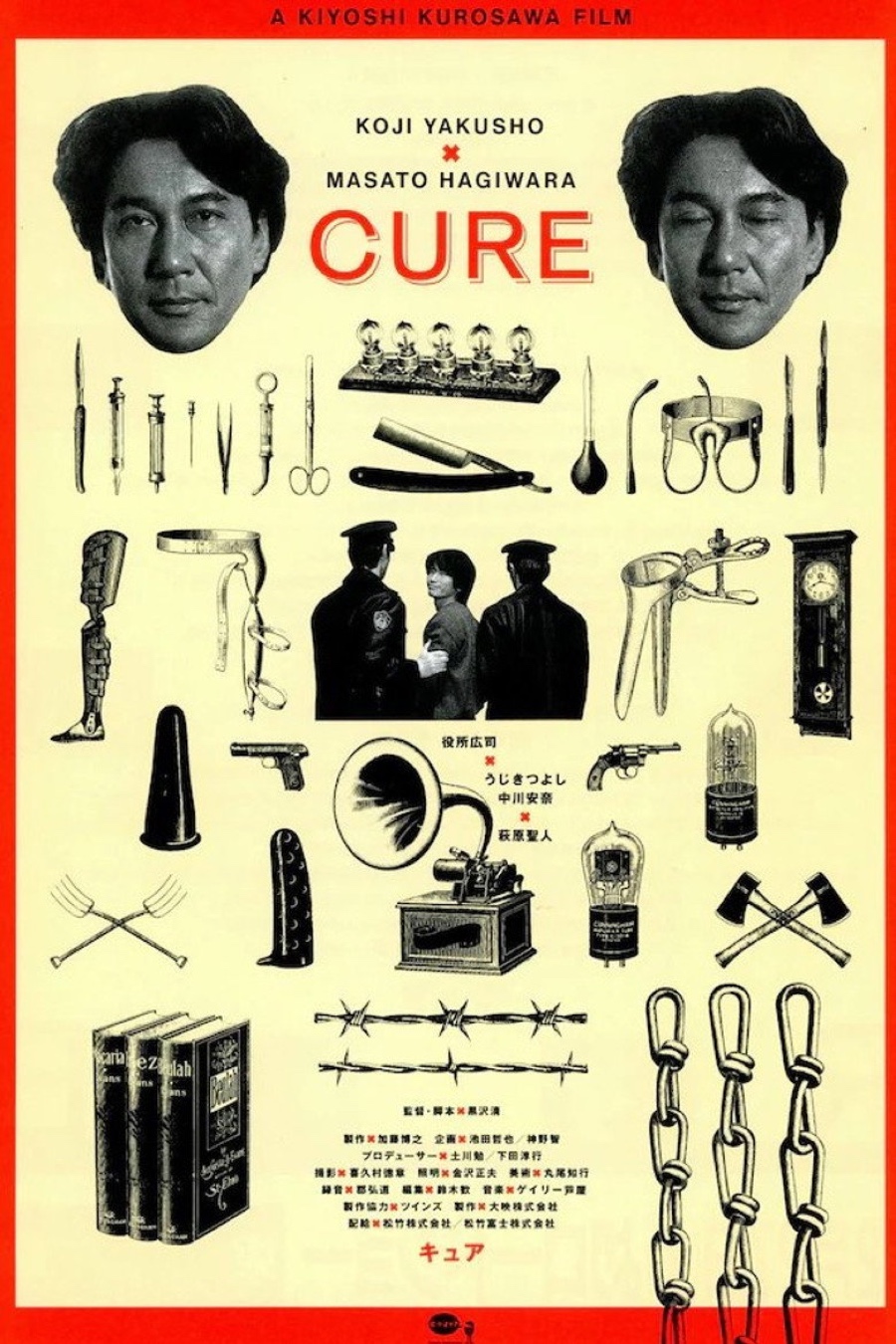
📖 Synopsis - No Spoilers
A string of killings has Tokyo detectives stumped. Every victim has been cut open in an X across the throat and chest. Every killer is a different person, none of them connected to any of the others, and all of them are picked up near the scene without resisting. They remember doing it. Not one of them can say why. Detective Takabe (Koji Yakusho) brings in his friend Sakuma (Tsuyoshi Ujiki), a psychologist, to look for a pattern. There is no pattern to find.
Meanwhile a young man (Masato Hagiwara) is drifting along a beach in Chiba with no memory. He cannot hold on to his own name, or to anything you told him a minute ago. What he does instead is ask questions. Who are you. Where is this. Tell me about yourself. The conversation goes nowhere, the other person gets irritated, and then the irritation turns into something else. Takabe eventually sits down across from this man, and the interrogation starts running in the wrong direction. One more thing worth knowing going in: Takabe has a wife who is mentally ill. That was supposed to be the part of his life the case could not touch.
✨ What Makes It Special
Why It’s Exceptional
- The word in the title turns rotten while you watch
- The antagonist is never given a motive, which is the whole point
- Every killer is an ordinary working adult with a decent job
- Dread built almost entirely from household noise
The title is not a joke at your expense
A film about mutilation killings, named after what a doctor does for you. It scans as sarcasm. Go in reading it that way and the film will take your legs out from under you, because it means the word literally.
Watch what the killers do afterward. No panic. No remorse. They sit there looking hollowed out, and then something close to relief moves across their faces. A schoolteacher who kills his own wife. A beat cop who had been swallowing a grudge against a colleague for years. A woman doctor worn down by being treated as a woman doctor first. None of them is a predator. They were all just enduring something, and the lid came off.
The film reads differently, I think, if you grew up in Japan. There is a word we use constantly, gaman, which gets translated as patience or endurance but really means putting up with something without letting it show. It is taught as a virtue from childhood. You do it at work, on the train, in your marriage. What Kurosawa built is a film in which that virtue is a loaded weapon. The teacher, the cop, the doctor: those are exactly the jobs where you are expected to absorb the most without complaint. That is not an accident of casting.
So the two things sit in the same frame at once. The thing releasing these people is unquestionably making them kill. And going by their faces alone, they have been healed. The act of harm is, for the person committing it, the cure. You cannot resolve those into a verdict, and the film spends 111 minutes making sure you cannot. That is why the word curdles.
The blank where a motive should be
I still do not know what the man in this film wanted. I have turned it over for years and it does not close. And the fact that it does not close is the sharpest thing about the film.
Naoki Urasawa built a career on the same question. PLUTO keeps circling what separates a person from a monster, and his earlier Monster gave that monster a full biography: seventy-four episodes explaining how Johan became what he is. Terrifying, but bounded. You can hold him.
Kurosawa gives you none of that. No past. No goal. The man cannot even retain his own sentences from one minute to the next. Hagiwara’s performance is remarkable for what it refuses to do: he never plays crazy, never pushes, he simply stays empty. An empty container sitting in a room makes people uncomfortable in a way a full one does not. The moment you start working out what he is thinking, you are doing his job for him.
What the subtitles cannot carry
One thing I would flag for anyone watching this in English. The line that does the damage is rendered in subtitles as something like tell me about yourself, which is accurate but flat. In Japanese it is soft, faintly coaxing, the register you would use with a child or with someone you are trying not to startle. It is a kind voice. That mismatch between how gentle it sounds and what it does is most of the horror, and English does not have a clean equivalent.
Same with the repeated question. Rendered as who are you, it reads as confusion. In the original it lands closer to a challenge you are not allowed to refuse. If your Japanese is good enough to hear the tone under the subtitle, this film gets noticeably worse for you, in the way it is supposed to.
Silence instead of stingers
Nothing here jumps out to make you flinch. In place of that you get an empty washing machine grinding away on the other side of a wall, water dripping in a tunnel, a bulb flickering, wind rising in the last stretch. All of it could be in your apartment right now. A horror score is doing you a favor when it tells you where the scary part is. This film declines to tell you.
The camera behaves the same way. It sits back and holds. No push in at the moment of violence, no cut to a reaction. You end up leaning toward the screen to check the corners of the frame yourself, which is a much worse position to be in than being startled.
Deeper Themes
Kurosawa shot this under a different title. It was called Dendoshi, meaning The Evangelist, until a producer at Daiei asked for a change. The Tokyo subway sarin attack by the Aum Shinrikyo cult was still raw in Japan, and a film about a man who moves through the population converting ordinary people into killers was going to be read one way whether Kurosawa liked it or not. So the religious framing came off the poster.
Knowing that changes the shape of the film. The version we have is not about a cult. It is about the conditions a cult needs, which turn out to be nothing more exotic than a population of people quietly holding something in. Watch for the moment the psychologist explains that hypnosis cannot override a person’s ethics. He means it as a professional reassurance. It comes back later as the most disturbing line in the film, because if the ethics never changed and the killing still happened, then the capacity was already sitting there. Nothing was installed. Something was drawn out.
🎭 Memorable Scenes
The first is the line that signals he has stopped being passive.
Hey. Tell me about yourself.
Not a threat. Warm, even. A therapist could say it. Building the most dangerous moment in the film out of the friendliest sentence in it is an extremely good piece of writing, and by the time you hear it the other person is already half gone.
The second is the loop that will not close.
Who are you?
You answer. He asks again. You answer. He asks again. It should be comic. About four rounds in it stops being comic, because you notice how thin the thing you are offering actually is. A name. A job. Try it on yourself at three in the morning sometime. If you come up short, you have found the film.
The third is a single line Takabe throws at someone.
You met Mamiya, didn’t you?
The floor drops here. The line between the people investigating this and the people caught in it stops meaning anything. This was never a manhunt. It is a contagion story. Whatever this is cannot be arrested or shot, and the air in the film changes measurably from this point on.
💭 How It Made Me Feel
What I was left chewing on afterward was not the solution to the case. It was what would happen to me if that man sat down across from me. Would I be one of the ones who goes, or one who holds. I do not have an answer. Not having one is exactly the residue this film leaves.
There are plenty of frightening films. Almost all of them run on being killed by the thing. You run, you hide, you fight, and the danger is outside you. Cure points the other way. What it wants you to be afraid of is the thing already inside you getting out. An external threat can at least be fought. This one has nowhere to run to.
(Having said all that in a very serious voice, the film is not unrelenting. Ren Osugi’s bowl haircut is properly funny, and there is a bit late on involving raw meat thrown at a wall that lets the air out on purpose.)
Who Should Watch This?
- Anyone who avoids horror but will watch a film about people being frightening
- Anyone who wants to finish a film with something to argue about
- Fans of Se7en, Zodiac, or The Silence of the Lambs who have never gone near Japanese cinema
😅 Where It Falls Short
I have been praising this without a break, so let me put the other side down. None of it moved my rating much. All of it will bother somebody.
The logic gives way partway through
For the opening stretch this holds together as a procedural. A clue surfaces, it gets chased, the next step appears. Then at a certain point the ground swaps out under you with no explanation offered. If you have been following the reasoning, this is where you get left behind. Whether you can accept that is the single thing that splits opinion on this film. Come in expecting realism to hold all the way through, though, and you will fight it the whole time.
Some threads are never picked back up
Material around Takabe’s wife, plus a passage read aloud early on from a text about Bluebeard, is clearly pointing at something. It is not resolved. You are left holding whatever you built out of it. Call that productive ambiguity or call it dropped, depending on your temperament.
Not everyone accepts the premise
The film runs on the idea that violence is sitting in everybody, waiting for a door. Some viewers read that as posturing. People carry murderous impulses around all the time without acting, often for no better reason than that it would be a hassle. The film does not really account for laziness as a moral force, which is a fair complaint. I went with it. I understand the people who did not.
Who Might Not Enjoy This?
- Anyone who needs the film to explain itself before the credits
- Anyone hoping to feel better afterward. The aftertaste is bad by design
- Anyone squeamish about aftermath. The camera stays on it a few times
📺 Streaming Guide by Service
Which service is the best way to watch Cure?
Apple TV lists it in HD. Amazon’s rental is the cheapest, but its listing is SD, and for a film this dark the difference shows. If you expect to watch it more than once, the Criterion Blu-ray below is a better buy than a digital copy.
Worth being clear about one thing on Amazon Prime Video: a Prime membership does not include this film. It is a separate charge per view, which catches people out.
Whichever you pick, treat the sound seriously. This film builds its tension out of low household noise, so playing it through laptop speakers strips out roughly half of what it is doing. Use headphones or turn the television up.
Where to Stream
- Fandango at Home: Rent or buy
- Amazon Prime Video: Rent or buy
- Apple TV: Rent or buy
- The Criterion Channel: Not available
- Netflix: Not available
- Crunchyroll: Not available
📀 Physical Release
This is a dark film made of small sounds, so streaming compression costs it more than it costs most titles. The Criterion Collection Blu-ray came out in October 2022 from a 4K restoration of the original negative, with a new conversation with Kurosawa plus interviews with Yakusho and Hagiwara. If you expect to rewatch this while chewing over what it means, the disc earns its place.
🎬 If You Loved Cure, Watch These 5 Next
Ghost in the Shell (1995)
Two years before Cure, out of the same anxious mid-nineties Japan, Oshii made a film asking the identical question from the opposite direction. Mamiya keeps demanding to know who you are and watching people fail to answer. Kusanagi asks it of herself for eighty-two minutes. Both films arrive at the position that the self is a much thinner construction than we behave as though it is. Start here if the interrogation scenes are what got you.
👉 Read the Ghost in the Shell review
PLUTO
Naoki Urasawa has spent his career on the question Cure refuses to answer: what actually separates a person from a monster. The difference is method. Urasawa builds the monster a history until you understand it. Kurosawa leaves the space blank until you fill it yourself. Reading the two against each other is the clearest way to see that being explained and being unexplained are two entirely different kinds of frightening.
Sonatine
Kitano’s yakuza film shares Kurosawa’s refusal to dramatize violence. Deaths arrive flatly, without buildup, framed from a distance, and the film moves on. Both directors worked out that withholding the crescendo makes the act land harder. If the way Cure films its killings was what unsettled you rather than the killings themselves, this is the same instinct applied to gangsters on a beach.
EUREKA
Shinji Aoyama’s three-and-a-half-hour film, made three years later, is the mirror image. Cure is about ordinary people being opened up into violence. EUREKA is about survivors of violence being slowly put back together, shot in sepia across the same quiet Japanese emptiness. The pairing works because both directors treat damage as something that spreads by proximity rather than by cause.
Jin-Roh: The Wolf Brigade
From 1999, animated, and just as cold. A man in uniform is hollowed out by the institution he serves until there is very little person left inside the armor. Where Cure has a stranger open people up, Jin-Roh has an organization do it slowly with paperwork. Both end in a place where you cannot locate the villain, which is the point.
Cure sits near the end of a long line of Japanese films about detectives who lose more than the case. 👉 10 Best Japanese Crime & Yakuza Movies
Bright Future is the Kiyoshi Kurosawa film that swaps the dread for jellyfish, and it is the strangest thing he has made. 👉 Read the Bright Future review
📝 Final Thoughts
Cure is shaped like a detective story about a series of killings. What it actually does is put the audience in the chair and start asking the questions. Koji Yakusho took Best Actor at the 10th Tokyo International Film Festival for it, and the film is what carried Kurosawa’s name out of Japan. It was never marketed as horror. It gets further under the skin than most things that are.
There is a kind of fear here that horror films do not have. Not the fear of being killed by the thing. The fear of what is already in you getting out. You can run from the first one. Watch it on a Friday night, loud, with Saturday morning free, because you will spend a while afterward taking inventory of everything you have been quietly swallowing.
⭐ Cure at a Glance
| Category | Rating | Comment |
|---|---|---|
| Script | ★★★★☆ | Logic gives way in the back half |
| Direction | ★★★★★ | Static frames that refuse to help you |
| Performances | ★★★★★ | Yakusho eroding, Hagiwara empty |
| Sound design | ★★★★★ | Household noise doing all the work |
| Accessibility | ★★☆☆☆ | No answers are supplied |
| Aftertaste | ★☆☆☆☆ | Bad. Entirely on purpose |
Usagi’s Recommendation Score
⭐⭐⭐⭐⭐⭐⭐⭐⭐☆
9.0 / 10
You watch it once. Years later it is still sitting there.
Cure is the film every entry on our list of the ten best Japanese thrillers is measured against. It is deliberately left off that page so the other ten get room, including three more by Kiyoshi Kurosawa.

 has left the Criterion Channel and is rent-only in the US. What Mamiy)