*This page contains affiliate links. We may earn a commission if you make a purchase through these links.
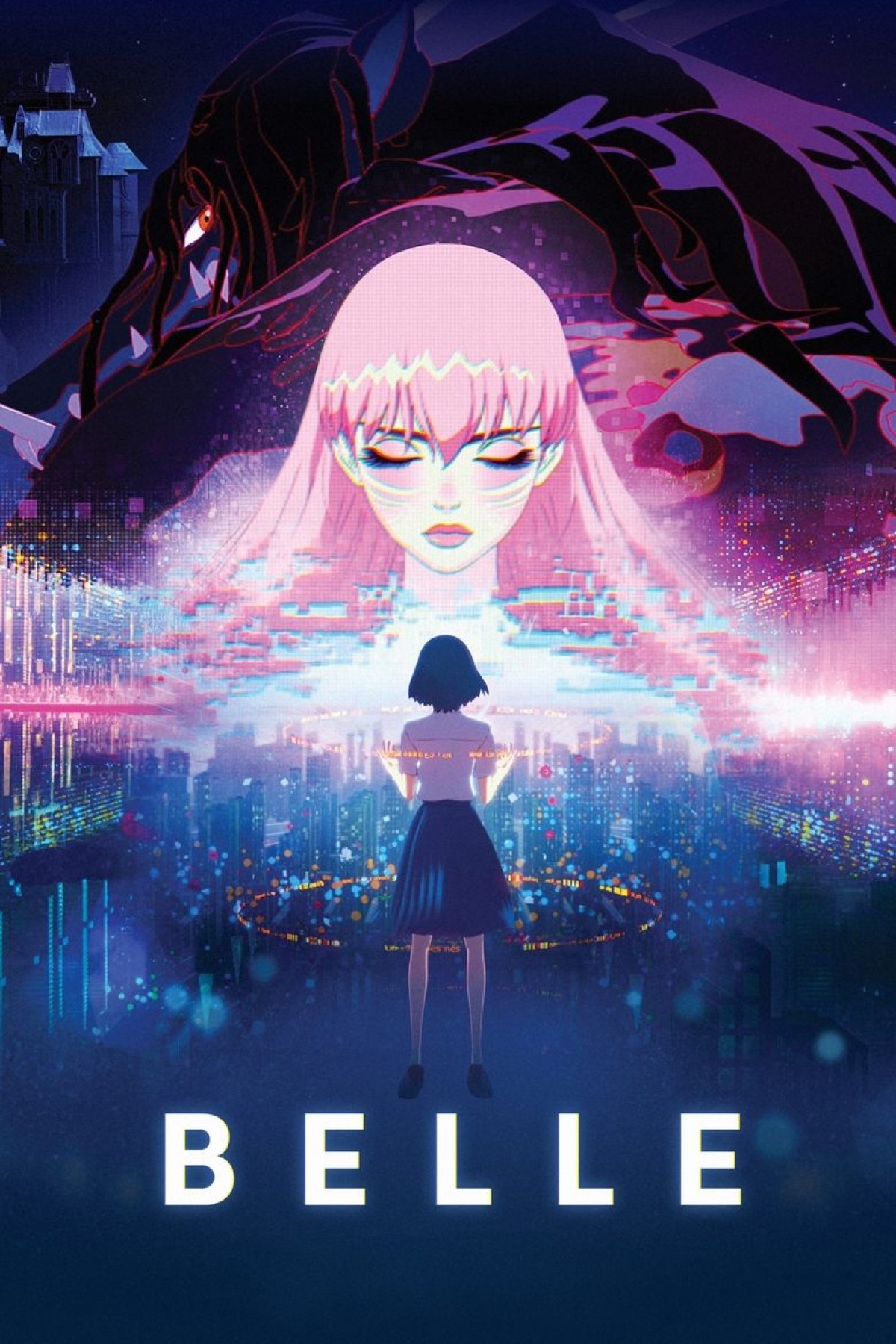
Belle is two films sharing one running time. The first is a concert: a virtual world called U, drawn with more colour than a screen can comfortably hold, and a singer, Kaho Nakamura, whose voice carries every big number in it. The second is a story about a grieving seventeen-year-old in rural Kochi, and that one does not hold together. I have no complaints about the first film. The second is the reason my score is a 4.
My yardstick here is Mamoru Hosoda himself. The two films of his I love are The Girl Who Leapt Through Time and Summer Wars, and in both of them the characters run for reasons of their own. In Belle they get carried. The destination is fixed in advance, and when they arrive, a song starts. It is a film where the scenes came first and the people were fitted to them afterwards. Even so, the visuals and the music alone justify the two hours, and that is where this review ends up.
📺 Where to Watch Belle (September 2026)
| Service | Status | Notes |
|---|---|---|
| HBO Max | Streaming | Its main US home since August 2022 |
| Philo | Streaming | Part of the base plan of this live TV package. Only worth it if you already pay for Philo |
| Hulu | Add-on | Plays through the HBO Max add-on, not the base Hulu plan |
| Prime Video | Add-on | Through the HBO Max channel. Without it, rentals start around $3.99 |
| Apple TV | Rent / Buy | Around $3.99 to rent |
| Crunchyroll | Not available | This is a GKIDS release, so it never landed here |
| Netflix | Not available | Not in the US. Netflix Japan carries it |
As of September 30, 2026, the only mainstream US subscription that includes Belle at no extra cost is HBO Max. Hulu lists it, but the page is flagged as HBO Max content, so a basic Hulu plan will not play it. The same goes for Prime Video, where it sits behind the HBO Max channel; renting it there or on Apple TV costs about four dollars. Licences move, so check the service before you plan an evening around it.
One thing worth knowing if you share a household with other anime fans: Summer Wars and Perfect Blue, two of the three films I recommend further down, are on HBO Max too. One subscription covers most of this page.
🎬 Trailer
That is GKIDS’ English dub trailer, so the voice you hear is Kylie McNeill. In the Japanese version, Suzu and Belle are both voiced by Kaho Nakamura, speaking and singing.
Work Info
- Title: Belle (Japanese title: Ryu to Sobakasu no Hime, literally “The Dragon and the Freckled Princess”)
- Released: July 16, 2021 in Japan / January 14, 2022 in US theaters (GKIDS), 121 minutes
- Director, original story and screenplay: Mamoru Hosoda
- Animation: Studio Chizu
- Music: Taisei Iwasaki, Ludvig Forssell, Yuta Bandoh / Theme song: “U” by millennium parade & Belle
- Japanese cast: Kaho Nakamura (Suzu / Belle), Ryo Narita, Shota Sometani, Tina Tamashiro, Lilas Ikuta, Koji Yakusho, Takeru Satoh
- English dub: Kylie McNeill (Suzu / Belle), Paul Castro Jr. (the Dragon), Manny Jacinto (Shinobu), Jessica DiCicco (Hiro), Chace Crawford (Justin)
- Box office in Japan: about ¥6.6 billion, the biggest of Hosoda’s career at home
- Awards: Japan Academy Film Prize for Outstanding Achievement in Music (45th ceremony)
📖 Synopsis – No Spoilers
Suzu Naito is seventeen and lives with her father in a small town in Kochi, on the island of Shikoku. Her mother died when Suzu was a child, and since then she has not been able to sing in front of anyone, though singing with her mother was once the thing she loved most. She barely talks to her father. The only thing she keeps doing is writing songs alone.
Then she signs up for U, a virtual world with more than five billion users, where each person gets an avatar, called an As, generated from their own body data. Suzu’s As is named Belle, and as Belle, she can sing. With a push from her best friend Hiro, Belle’s songs spread fast, and before long she is the most famous singer in U. One day her concert is crashed by a hunted figure in the shape of a dragon, whom U’s self-appointed police want to “unveil,” exposing the real person behind the avatar. Suzu finds herself drawn to him. Who is the Dragon? She starts searching U for his castle.
✨ What Makes It Special
Why It’s Exceptional
- The opening drops you into the sky of U on the back of a singing whale
- Kaho Nakamura sounds exactly the way a world-famous singer should
- The flood of colour in U plays against a photographic, subdued Kochi
- It rebuilds Beauty and the Beast inside a world where nobody has to show their face
U was built for a big screen and a good sound system
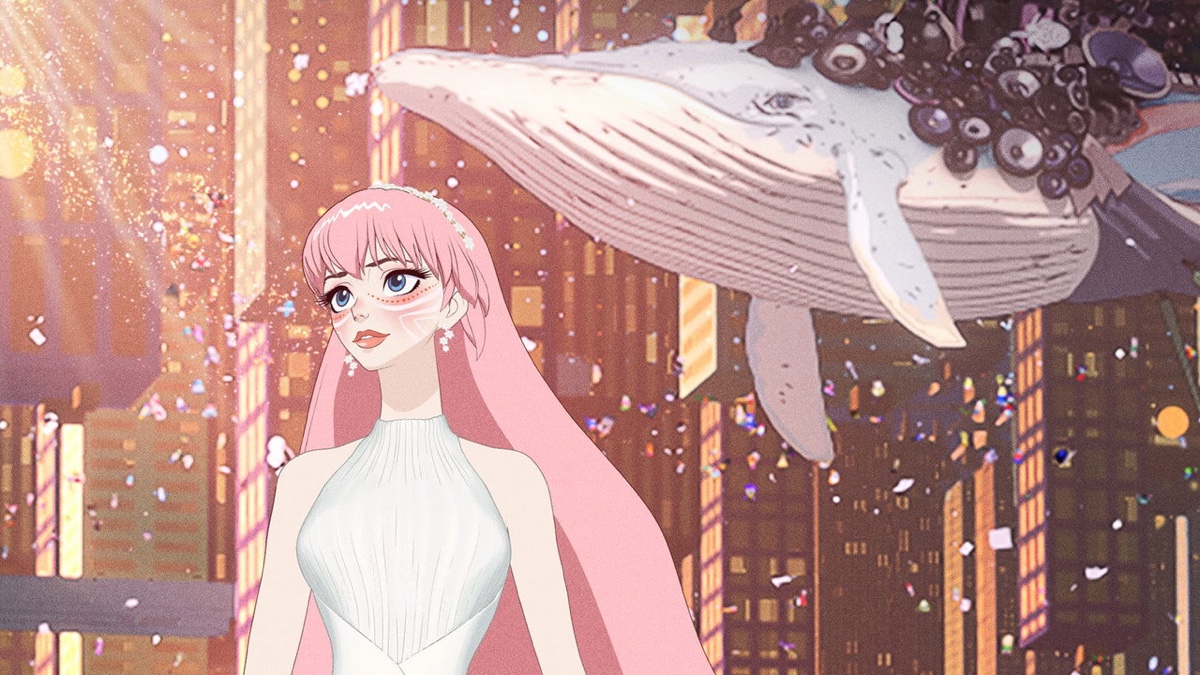
Within minutes, a giant whale is swimming through the sky of U. Belle stands on its back, singing, and countless avatars look up at her. The theme song “U” hits with a heavy low end, and you are pulled inside the world without a word of explanation. Structures stack up to the horizon, avatars hang in the air in dense swarms. There is too much information on screen to take in on one viewing.
What makes it land is the contrast with real-world Kochi. The riverbank, the station platform and the walk home from school are drawn with an almost photographic level of detail, in muted colour. Step into U and the palette jumps. Reality is plain, so U is dazzling, and the film keeps crossing between the two, so the jump hits again every time.
Part of the design comes from outside Japan, which is unusual for a Japanese animated feature. Belle herself was designed with Jin Kim, a longtime Disney character designer, while Ireland’s Cartoon Saloon worked on backgrounds for U and London-based architect Eric Wong drew the concept art for the virtual city.
This is the part of the film that deserves a cinema. At home, use the biggest screen you have, and listen through headphones or a proper speaker rather than the TV’s built-in one. How good the visuals and songs feel depends heavily on how you play them.
Kaho Nakamura’s voice is worth hearing on its own
Kaho Nakamura voices both Suzu and Belle. In Japan she is known as a singer-songwriter, not an actor, and her speaking voice is plain and unpolished. The moment she starts singing, she becomes someone else. As a matter of plot, Belle’s rise to stardom is absurdly quick and not convincing. As a matter of sound, it is completely convincing.
The lyrics of the songs track what Suzu is feeling at each point, so the singing carries what the dialogue cannot. One more casting note that English-speaking fans tend to miss: Suzu’s sharp-tongued best friend Hiro is voiced by Lilas Ikuta, better known as ikura, the singer of YOASOBI. She is the one keeping the real-world conversations moving.
Beauty and the Beast, moved into a world of masks
A heroine named Belle, a feared beast in a castle, a dance between the two. The debt to Beauty and the Beast is not hidden. The interesting part is the swap. In the fairy tale, the Beast is a prince cursed into ugliness. In U, everyone already looks the way they want to. In a world where you can hide your face, what do you do with your real one? That single change adds a question the original never had.
But I have to be honest here: the idea is better than its execution. The film races toward that question, and the race is where my problems start.
Deeper Themes
Suzu’s mother drowned after going into a flooded river to save a child she did not know. Suzu’s wound is not only that her mother died, but a question: why did she leave her own daughter behind for a stranger’s child? U is the place where Suzu can carry that question and sing without showing her face.
So the film is built as a virtual-world adventure and, underneath, as a story about whether a daughter can come to understand her mother’s choice. Read Suzu’s pull toward the Dragon through that question and it makes some sense, although the film itself never gets that far. The design is clear. The trouble is how much of the real world gets bent to make the design work.
🎭 Memorable Scenes
The first, inevitably, is the opening. Belle sings from the back of a whale fitted with loudspeakers as it glides over the city of U. Avatars turn their faces up one after another, and the screen fills as the song spreads. Within minutes, before the story has properly begun, the film has shown you its single greatest strength.
The second is the climax, when Suzu sings in U near the end. Take the song on its own and this is the peak of the film. Voices from every corner of U join in, pulling in even the people who had kept their distance from Belle. The song itself is beyond criticism. How the film gets to this moment is another matter, and since that involves the ending, it lives in the spoiler section further down.
💭 How It Made Me Feel
When it ended, my admiration for the visuals and music and my frustration with the story were still sitting side by side. Neither cancelled the other out. The songs did not excuse the plot holes, and the plot holes did not make the songs any worse.
What stayed with me was the final act. If you bring a subject this heavy into a film, you should see it through to the end. Because the visuals and songs are so good, the gap to the story is all the more obvious.
😅 Where It Falls Short
That is the end of the praise. I have serious problems with the story, and I am going to spend the same energy on how this film moves its characters as I just spent on its images and songs.
She becomes a star too fast, and finds the Dragon too easily
Once Suzu enters U, she is somehow treated as a sensational singer from day one, and becomes a global star in no time. I have no problem with the premise of a girl who cannot sing in reality but can sing in a virtual world. What I cannot buy is how smoothly everything goes: the audience flocks to Belle, the people around her push her further, and nothing resists.
Why Suzu is drawn to the Dragon is never shown in a way that clicks, either, and her route to his castle leans heavily on luck. I want to show this moving scene. I want the audience to hear this song. I want a Beauty and the Beast ballroom. I want Suzu to grow up at the end. The scenes seem to have come first, with the people and the setting pushed into place to reach them. That impression never left me.
Too many themes, none of them dug into
Suzu’s grief for her mother. The distance from her father. The real world against the virtual one. Online abuse. Belle’s secret identity. A childhood friend. The bond with the Dragon. What it means to help someone. The sheer number of subjects in one film is a lot, and packing them into 121 minutes leaves each of them rushed.
In the second half especially, the film swerves from a story about an online world to a different, very heavy real-world problem. After that turn, it becomes hard to say what the film was about, or where the U storyline went.
Hosoda needs a screenwriter
The Girl Who Leapt Through Time and Summer Wars were both written by the screenwriter Satoko Okudera. Wolf Children was co-written by Okudera and Hosoda, and from The Boy and the Beast onward, Hosoda has written his films alone. That my two favorites both come from the Okudera years is probably not a coincidence.
I am not saying he lacks talent. He is an exceptional visual filmmaker, which is exactly why this frustrates me: hand the script to a specialist and the films would be far more complete. I would love to see Hosoda focus on direction and visuals, and work with a screenwriter again. Belle is the film that convinced me of that.
(A note for readers outside Japan: this is not a lonely opinion. Type the Japanese title into a search engine in Japan and one of the most common words that follows it is hidoi, roughly “awful.” Its box office was the biggest of Hosoda’s career, and the complaints were just as loud. The ones I agree with are about the script.)
The Weak Points
- Belle’s rise to fame and Suzu’s path to the Dragon both go far too smoothly
- So many themes are packed in that none of them gets real depth
- The heavy subject brought in at the end is never handled all the way through (details in the spoiler section)
Who Should Watch This?
- Fans of Summer Wars and The Girl Who Leapt Through Time who want to see where Hosoda’s later work went
- People who pick films for their songs and sound. The concerts in U deserve a big screen and good audio
- Anyone who has heard it is bad and is on the fence. If you are there for the visuals and music, it will not let you down
Who Might Not Enjoy This?
- Viewers who want a story where characters act on their own will and the plot holds together
- Anyone hoping for another Summer Wars, with a whole crowd of people facing the crisis together
- People who find scenes of violence against children hard to watch (there are some near the end)
📺 Streaming Guide by Service
What is the cheapest way to watch Belle in the US?
If you already pay for HBO Max, the answer is simple: it is included. If you have Hulu or Prime Video but not HBO Max, the film is visible in both apps, yet it will ask you to add HBO Max before it plays. For a single viewing, a four-dollar rental is cheaper than a month of an add-on. If you would use HBO Max for more than this one film, the subscription makes more sense, since Summer Wars and Perfect Blue are sitting in the same catalogue.
About audio: the US release comes with an English dub, and in the dub the songs are sung in English by Kylie McNeill. If what you want is Kaho Nakamura’s own voice, make sure the audio is set to Japanese before you press play. The songs are the heart of this film, so it is worth the ten seconds in the settings menu.
Where to Stream
- HBO Max: Streaming, included in every plan
- Philo: Streaming, included in the base live TV package
- Hulu: Add-on, needs HBO Max on Hulu
- Prime Video: Add-on through the HBO Max channel, or rent it from about $3.99
- 4K UHD / Blu-ray: the GKIDS home release, which no licence change can take away from you
The Soundtrack
Taisei Iwasaki led the music, with Ludvig Forssell and Yuta Bandoh composing alongside him. This is the score that won the Japan Academy Film Prize for music. There are two versions to know about. The Japanese original has Kaho Nakamura singing as Belle. The English Edition, released on the day of the US theatrical opening, has Kylie McNeill singing the English versions, so pick the one that matches the audio track you watched.
- Spotify: the Japanese original soundtrack
- Apple Music: the English Edition
📚 The Novel
Hosoda wrote a novel version himself, published in Japan a month before the film opened. It has an English edition: Studio Chizu’s BELLE, translated by Winifred Bird (Yen On, 2023). If a scene in the film left you unconvinced, this is where you can check what the director had in mind, in his own words.
🎬 If You Loved Belle, Watch These 3 Next
Each of these three was chosen for the thing Belle leaves undone. Start from whichever complaint above bothered you most.
Summer Wars (Mamoru Hosoda, 2009)
Hosoda’s earlier virtual-world film, and in a sense Belle’s older sibling. OZ, an online world wired into every part of daily life, gets hijacked, and the chaos spills into reality. The people who fight back are a sprawling family gathered at an old house in the Nagano countryside. Sakae, the great-grandmother turning ninety, works the phone to steady everyone she knows, and every relative takes up a post. The children are never left to carry the crisis alone; the adults all step in. If Belle’s ending bothered you, this is where the difference becomes obvious. Screenplay by Satoko Okudera. It streams on HBO Max, and it is one of the picks in our best anime set in the Japanese countryside.
A Silent Voice (Naoko Yamada, 2016)
In elementary school, Shoya bullies Shoko, a deaf transfer student, until he becomes the outcast himself. In high school, he goes to find her. Bullying, disability, and a person pushed to the point of wanting to die: every subject here is heavy, and the film lets go of none of them. It stays with both the one who did the harm and the one who was harmed, all the way into how they live afterwards. If you bring a heavy subject in, you carry it to the end. Put it next to Belle and the difference is stark. It streams on Crunchyroll in the US.
👉 Read the A Silent Voice review
Perfect Blue (Satoshi Kon, 1998)
Belle presents U as a place where hiding your face sets you free. Perfect Blue shows the other side. Mima, a pop idol turning actress, discovers a website called Mima’s Room, where someone writes up her daily life in her own voice. What happens to a person whose face and name are public when she is surrounded by eyes she cannot identify? It never looks away, and follows the collapse of the line between real and unreal all the way down. It was made when the internet was still a novelty, and it reads more vividly now than it did then. HBO Max carries it, and it sits in our best Japanese thriller movies list.
⚠ Spoilers: Why the Final Act Did Not Work for Me
From here on I discuss who the Dragon is and how the film ends. If you have not seen it yet, skip ahead to Final Thoughts.
The Dragon turns out to be Kei, a boy living near Tokyo, who is being physically abused by his father along with his younger brother Tomo. To earn Kei’s trust, Suzu reveals her identity in U and sings with her real face. Then she travels from Kochi to find the brothers, on her own. I could not accept most of this sequence.
The danger of showing her face is treated far too lightly. With her childhood friend Shinobu urging her on, Suzu unveils herself in U. The film frames it as a brave act of self-disclosure. But a high school girl showing her face to a world of five billion users would be identified, her school and address would be dug up, she would be harassed, and she could be put in real danger. All of that is easy to imagine. For something that serious, the risks and consequences are barely shown. Real-world problems are set aside so that the singing scene can happen.
She is sent alone toward a violent father. This is what I want to criticize most. Suzu has a childhood friend who worries about her, the choir women who have watched over her almost as mothers, her friends, and her own father. None of them goes with her. Anyone in that position would call the police, contact child services, send an adult along, or at the very least ask the local police for protection. Her father trusts her and lets her go, but this reads less as respect for her choice than as the adults around her failing her. The choir women who have treated Suzu almost as a daughter not stopping her also contradicts how the film has written them.
On top of that, I disliked how the film handles what is called the “48-hour rule” in Japan. In the film, child services receive a report and cannot act right away, citing this rule. The real rule works the other way: it is a deadline, asking child guidance centers to confirm a child’s safety within 48 hours of a report. There is no rule that says they must wait 48 hours. The film’s version makes Japan’s child welfare system look worse than it is. That may be separate from the film’s quality, but I did not want to leave it unsaid.
Shinobu makes no sense either. He is written as someone who has always watched over Suzu and worried about her, yet when she heads toward a dangerous father, he does not go with her. If he really cared about her, “I’m coming with you” would be the natural line. He steps in at the important story beats, such as pushing her to reveal herself, and then at the most dangerous moment, he just sees her off. By the end, I still could not tell what his role or his feelings were.
The father fleeing after Suzu stares at him is not believable. Suzu stands between the brothers and their father, and even after he scratches her face, she does not flinch and silently stares him down. He suddenly loses his nerve and backs away. I understand it is meant to show her resolve. But would a man who has been intimidating and beating children fall apart because a high school girl looked at him? Nothing on screen explains his change of heart, so it plays as an exit written purely to get him off stage.
We never learn whether the brothers were actually saved. Did the police or child services step in? Were the boys separated from their father? Where will they live? Has the abuse really stopped? It is all left vague while Suzu, having grown, goes home to Kochi. The film should have taken responsibility for the fate of the children she set out to save, not just ended on its heroine’s growth.
I understand why the film wants to mirror her mother. The construction is forced. Suzu’s mother died saving a stranger’s child from a river. For years Suzu has carried the question of why her mother left her to save someone she did not know, and at the end, by going into danger to save two strangers herself, she comes to understand. The structure makes sense. But because the film puts “place Suzu where her mother stood” ahead of everything else, the adults do nothing and a high school girl is sent in alone. Realistic behavior is sacrificed to make the theme work.
A mother’s death, child abuse, online harassment, a minor’s personal information, risking your life to save others. Every one of these is a heavy subject. If you are going to use child abuse as material, you have to face it all the way through. A teenage girl confronting an abuser alone, glaring at him, and the problem appearing solved is not an acceptable place to end.
📝 Final Thoughts
Belle is a film whose virtual world and whose singer are far ahead of its story. The reason so many people in Japan call it awful sits in two places: a script that fits its characters to the scenes, and the way it handles the heavy subject it brings in at the end.
Remember the yardstick I started with? Both of those films satisfied me more, and if you are going to watch one Hosoda film first, I would point you to The Girl Who Leapt Through Time or Summer Wars. But if you go in planning to soak up the whale in the opening and the song at the climax on a big screen with good sound, these 121 minutes are still worth it. For more films where the music is the main event, see our best music anime list, where Belle also appears.
⭐ The Film at a Glance
| Category | Rating | Note |
|---|---|---|
| Visuals | ★★★★★ | The colours of U against the streets of Kochi. The opening alone deserves a big screen |
| Songs / Music | ★★★★★ | Kaho Nakamura and the theme song U. A film to watch with your ears |
| Story | ★☆☆☆☆ | The scenes come first, the people are moved to fit them |
| Handling of themes | ★☆☆☆☆ | It brings in heavy subjects and never sees them through |
| Characters | ★★☆☆☆ | Hiro keeps the conversations moving. Shinobu stays a blank to the end |
Usagi’s Recommendation Score
⭐⭐⭐⭐☆☆☆☆☆☆
4.0 / 10
121 minutes to soak in the visuals and songs of U. Keep your expectations for the story low.

