*This page contains affiliate links. We may earn a commission if you make a purchase through these links.
The word on this film in Japan is harsh, harsher than it was for part one, and my own score dropped between the two. Even so, if you asked me whether it was unwatchable, I would say no. Nearly every thread part one left loose gets tied off here, and watching Shinji Muroi and three children slowly turn into a family is, for long stretches, a comfortable place to be.
Some context for American readers. Muroi is the tight-lipped senior officer from Bayside Shakedown, the police franchise that ran from a 1997 TV series through four theatrical films, and in 2024 he got a two-part spin-off of his own. This is the second half. I have seen almost every entry in the series, most of them in a cinema, and from that seat most of the reason people call this film bad comes down to its ending. That part I could not accept. I say exactly why further down, under a clearly marked spoiler heading, and nowhere else.
📺 Where to Watch Muroi Shinji: Stay Alive (September 2026)
| Service | Status | Notes |
|---|---|---|
| Netflix (US) | Not available | US Netflix has the 1997 TV series, not this film |
| Amazon Prime Video (US) | Not available | No stream, no rental |
| Hulu | Not available | No entry |
| HBO Max | Not available | No entry |
| Apple TV | Not available | Not sold on the US store |
| Crunchyroll | Not available | Live-action titles are not its business |
| Kanopy / Hoopla | Not available | Not on either library service |
| Japanese services | Japan only | Netflix Japan streams it. U-NEXT, Prime Video Japan, DMM TV rent it |
As of September 25, 2026, you cannot legally stream, rent or buy Muroi Shinji: Stay Alive from any American service. Part one, Muroi Shinji: Not Defeated, is in exactly the same position. I checked both films against TMDB’s US listings and the US catalogue on JustWatch on the same day, and neither film appears on any American service. Availability does change, so check the service pages yourself before you plan around this table.
From where I sit, the gap is wide. In Japan, both halves stream on Netflix as part of the regular subscription, and Fuji TV, the network behind the franchise, is giving this one its first free-to-air broadcast on October 10, 2026, a week after part one. None of that reaches the US. The one piece of this world you can press play on in America is the original 1997 series on Netflix, which is also where Muroi was built. With a new Bayside Shakedown film, N.E.W., opening in Japanese cinemas on September 18, 2026, US rights could move this year, but for now that series is the whole door.
🎬 Trailer
This one is in Japanese. Stay Alive was only ever released in Japan, which means nobody made an English trailer for it. This is the official Japanese trailer from the channel of Toho, the distributor, released while part one was still in cinemas.
Work Info
- Title: Muroi Shinji: Stay Alive (Japanese title: Muroi Shinji: Ikitsuzukeru Mono)
- Released: November 15, 2024 (Japan). No US release
- Part two of two. Part one: Muroi Shinji: Not Defeated (October 11, 2024)
- Director: Katsuyuki Motohiro. Screenplay: Ryoichi Kimizuka
- Music: Satoshi Takebe
- Cast: Toshiro Yanagiba, Riko Fukumoto, Jun Saito, Kohei Matsushita, Koji Kato, Toshio Kakei, Miki Maya
- Runtime: 117 minutes
- Source: TMDB
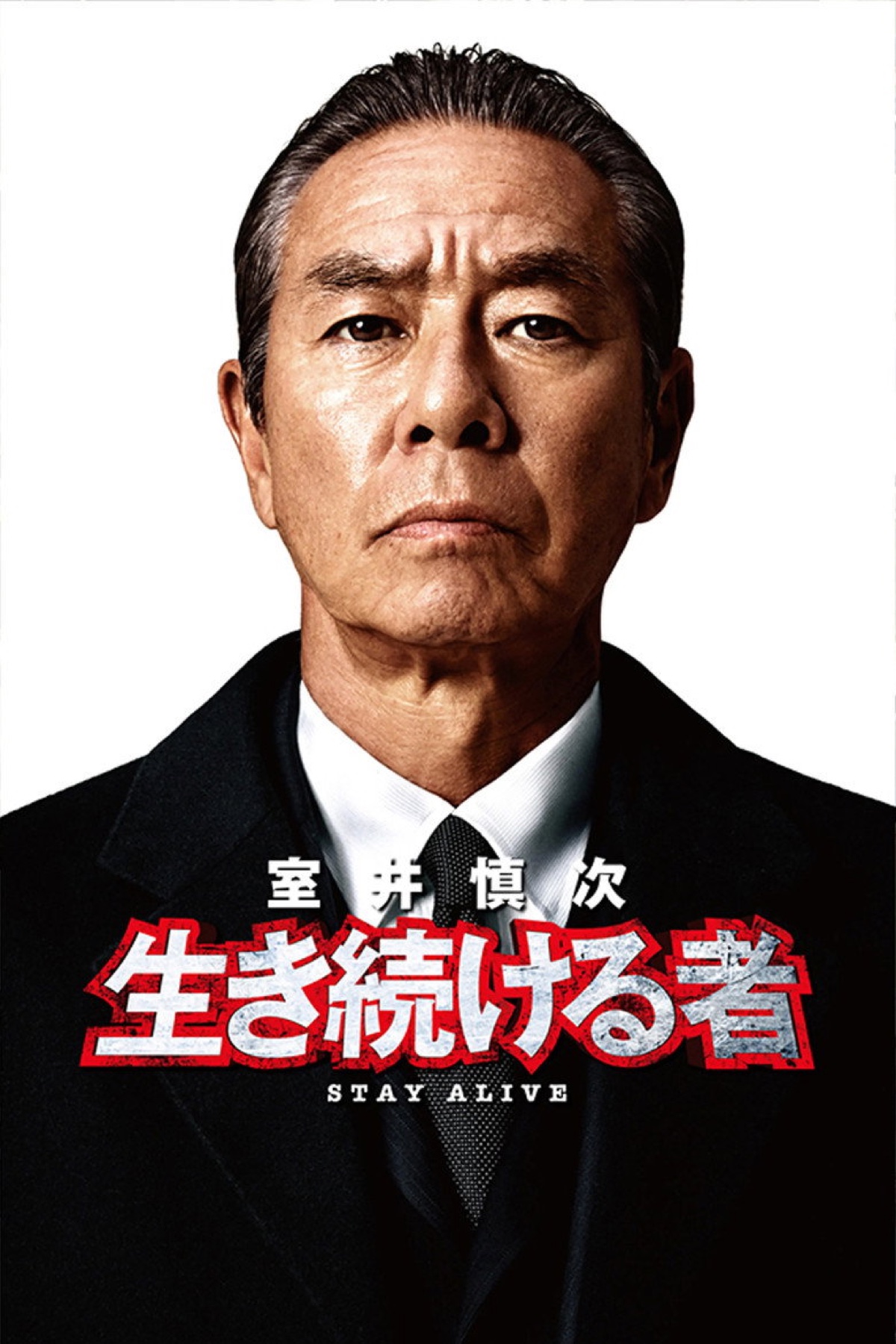
📖 Synopsis – No Spoilers
The story picks up where part one stopped. Muroi has left the police and lives in rural Akita, in northern Japan, as a foster parent to two boys, Taka and Riku. Living with them now is Anzu Hinata, the girl who turned up at his door in part one. She is the daughter of Mana Hinata, a serial killer Bayside Shakedown fans will remember from the films, and she has not yet shaken off her mother’s hold.
The body found near the house is still under investigation, and Shinjo, Muroi’s old rival and now the head of the Akita prefectural police, asks him to help. At the same time, Riku’s birth father, fresh out of prison, appears in town. A police case and a family crisis land on Muroi’s doorstep in the same stretch of weeks, and that collision is what this second half is about.
🤔 Is Muroi Shinji: Stay Alive Really That Bad?
Short answer first. The ending was the worst part of it for me, and the story has holes all over. But it is not a film without anything to offer. There were scenes I enjoyed and scenes that warmed me. After the credits, my answer was that it is too uneven to be written off with one word.
Split it up and it gets clearer. As a family story, it moves clearly forward from part one. As a crime story, it folds everything part one opened in very little screen time. Then the final stretch flips how you read everything that came before. Most of the people who score this film very low are reacting to that final stretch.
✨ What Makes It Special
Why It’s Exceptional
- Almost every setup from part one gets a payoff
- Four strangers slowly become a family, and it is pleasant to watch
- Anzu, Taka and Riku each get a real turning point
- It shows Shinji Muroi the man, with the rank taken off
Watching strangers become a family is the good part
At the end of part one, Muroi’s house was still a shared address rather than a home. Muroi could not judge how close to stand to the children. Anzu was hiding who she was. Riku was scared of his father’s shadow. The second half is, among other things, the story of that distance closing one step at a time.
The film takes the three kids in turn. Taka has his relationship with a classmate, Sayaka, and makes a decision about his own future. Riku is forced to face his birth father. Anzu works her way out from under what her mother planted in her. The children’s growth is handled well, with Anzu leading the way.
Muroi changes too. He still says very little. But the hesitation he showed in part one whenever he had to stand in front of a child is mostly gone, and he takes the responsibility for them on himself.
The setups are not abandoned, either. The body near the house, who Anzu really is, what happened to Riku before: every one of them is resolved. The catch is how fast they are resolved, which I come back to in the section on where it falls short.
The title only makes sense near the end
Part one was called Not Defeated, part two Stay Alive, and side by side the two titles are clearly a pair. What they do not tell you in advance is who, or what, is doing the staying alive. The film keeps that out of view on purpose.
Shinjo, the kids, and villagers who kept their distance from Muroi in part one all get their moment late in the film. What those moments are belongs to the ending, so I leave it for the spoiler section.
Twenty-seven years of one actor in one role
Here is a detail from the Japanese press that American viewers are unlikely to know. Before the film opened, producer Chihiro Kameyama told the Japanese press that Toshiro Yanagiba had turned down every role in a suit, every gangster and every heavy villain for 27 years, the whole time Muroi was the part people knew him for. This two-parter takes a character that actor had carried for that long out of the police meeting room and puts him at a family dinner table and on a snowy mountain road, in Akita, Yanagiba’s home prefecture.
So I do give it credit for showing Shinji Muroi as a person. A man I had only ever seen giving orders searches for the right words with a child, scolds, laughs. Because the actor’s years and the character’s years overlap, it carries something beyond good or bad acting.
Deeper Themes
Taking in children who are not your own comes with an awkwardness, a sense that everyone is playing at being a family. The second half of the Muroi two-parter answers that awkwardness with responsibility: Muroi stops asking whether he has the right and simply takes the weight. It is a quiet answer, and it is the most convincing thing in either film. The question the films never answer is the one underneath it, which is why Muroi became a foster parent at all. Across nearly four hours, nobody says.
🎭 Memorable Scenes
Three of them.
First, the household slurping ramen together on the way back from a hot spring, and the moment Muroi says out loud that life with the kids is fun, and laughs. It is a face he never showed in part one. The few minutes furthest from the case are the warmest minutes in the film.
Second, Riku walking back to Muroi’s house through the cold, in a ragged state. A child the adults decided to send away comes back on his own feet. Without a line of dialogue, the image settles where home is for this boy.
Third, Anzu taking hold of a hunting rifle. A girl who has lived under her mother’s influence starts acting on her own will after that moment. The change comes fast enough to leave some viewers behind, but it is the peak of her story.
💭 How It Made Me Feel
What I walked away with was two feelings mixed together. The family story was a pleasure to watch. Which is exactly why the drop at the end hit so hard.
I liked Muroi as a character, and that is the lens I watched this through. It is also the reason the last part of this film sits so badly with me.
Who Should Watch This?
- Anyone who finished part one and is unsure about part two (if the family scenes worked for you, this will too)
- Bayside Shakedown followers who want the whole franchise covered
- Anyone who wants to see with their own eyes where Shinji Muroi ends up (the strongest reason)
😅 Where It Falls Short
The case part one built up folds in minutes
Part one spent close to two hours spreading out the body near the house and the shadow of Mana Hinata. Part two settles it in startlingly little time. Everything around the culprit is sloppy. The arrest happens in an instant, and the hold Anzu’s mother had on her dissolves in an instant too.
As a police story, there is almost nothing to grip. What made Bayside Shakedown fun was the case and the organisation rolling at the same time, and this two-parter barely touches either. Do not go in expecting a Bayside Shakedown investigation.
Nearly four hours across two films, without the need for it
This half runs 117 minutes, and with part one the total comes close to four hours. What fills that length is mostly the side plots rather than the main line, and many of those side plots end half-finished. The clearest case is Taka and Sayaka, which is over almost as soon as it starts. If it was going to end that casually, did the film need it at all?
The script’s weak spots carry straight over from part one
What bothered me in part one still bothered me here, and new problems joined them. Any one of these I could let slide. Stacked up, they made it hard to trust the characters’ judgment at all.
The Weak Points
- The villagers suddenly warm to Muroi at a certain point, and it is never clear what set that off
- Child services take the word of a father who had been violent with his son and hand Riku back to him
- The same caseworker then tells Muroi never to see Riku again, which is wildly one-sided
- Riku trusts Anzu far too quickly. Even allowing for his age, there is barely a moment of doubt
- Muroi, a retired man, walks into a police interrogation room. That simply would not happen
- The film’s distaste for all things digital, down to how an elementary school treats smartphones, grates in places
- Why Muroi became a foster parent is still never explained
⚠ Spoilers Ahead: What Happens to Muroi, and the Post-Credits Scene
This section gives away the ending. If you have not seen the film, skip ahead to “Who Might Not Enjoy This?” This is where my biggest objection lives, and where my score went down.
The single biggest minus
Muroi dies. His dog, Shinpei, runs off, and he goes into the mountains in a heavy blizzard to find him. The next morning he is found collapsed beside Shinpei, already in cardiac arrest, and he does not survive.
I could not make sense of it. Just as life with the children has finally taken shape, Muroi walks out into a blizzard, leaving them behind, and never comes back. If he had gone down taking Riku’s father, Yanagimachi, with him, I could at least have understood it. Dying while searching for a dog has almost no connection to the story that came before. Is this really how the franchise sends off a character who gave it so much? I cannot forgive it.
The filmmakers did have a reason. In the same pre-release interview, Kameyama said it was time to free Yanagiba from the role of Muroi. So the reason for ending Muroi existed outside the film. The trouble is that nobody put it inside the film. An audience can only take in what happens on screen, and a curtain lowered for reasons offscreen can only look abrupt.
That is what makes it such a waste, because what follows his death is not bad. Shinjo sets out to make Muroi’s way of doing things real inside the prefectural police, the children each choose a path, and flowers are left at Muroi’s house. He could not change the police as an organisation, but he changed the lives of the people closest to him. That is where the title Stay Alive finally pays off. The payoff is good, which only makes the suddenness of the death before it stand out more. His face is never shown after he dies, but the film treats him as dead.
The post-credits scene did not need to exist
After the end credits, Shunsaku Aoshima, the franchise’s lead, arrives at Muroi’s house. Right after he gets there, a call comes in, and he heads back, reluctantly. That is all.
Aoshima was not needed. I had assumed he could not appear for contract reasons, but if he could appear, I wanted him to talk with Muroi. These two are the franchise’s twin pillars, and what I wanted to see was a scene between Aoshima and Muroi. Showing his face and leaving felt to me almost disrespectful to the film.
Who Might Not Enjoy This?
- Anyone who has not seen part one, Not Defeated (starting here, you cannot follow who is who)
- Viewers hoping for more Bayside Shakedown casework (the case wraps up abruptly)
- Longtime fans who care deeply about Muroi and want an ending that feels earned
🕰 Is It Worth Nearly Four Hours Across Both Films?
For anyone who has finished part one and is deciding whether to go on, here is my answer. As a way to see Bayside Shakedown’s Shinji Muroi through to the end, it was worth watching. The payoff as a crime story is small. But where a character who began in a 1997 TV drama finally ends up, you can only see in these two films.
The deciding question is how the family scenes in part one landed for you. If all they left was boredom, part two is more of the same, with little from the case side to make up for it. If the time with the children drew you in even a little, part two gives that story a proper continuation.
If you are new to the franchise, do not start here. My reviews of the first film, Bayside Shakedown (1998), and of the earlier Muroi spin-off, The Suspect: Muroi Shinji (2005), cover where he came from.
📺 Streaming Guide by Service
The Available Routes
- Netflix (US): the 1997 TV series only, not this film
- Prime Video, Hulu, HBO Max, Apple TV, Crunchyroll: not available
- Kanopy, Hoopla: absent from both library apps too
Put plainly, there is no legal way to stream this film from the US right now. I also looked for a disc: the Japanese Blu-ray, which pairs both halves in one set, did not come up on Amazon US when I searched, so I am not linking one. If you want in, the Netflix series is the place to start, and it is where the Muroi of this film first took shape.
Soundtrack
The score for both halves, by Satoshi Takebe, is collected on a single album, Muroi Shinji Not Defeated x Stay Alive (Original Motion Picture Soundtrack), released on two CDs in Japan. Unlike the film, the music is easy to get in the US.
- Spotify: streaming
- Apple Music: streaming
- Amazon Music: digital album
🎬 If You Watched Muroi Shinji: Stay Alive, Watch These 3 Next
I picked these three by working backwards from what this film got right and what it lacked. The first has the build-up this ending was missing. The second is about a family without blood ties colliding with society. The third asks head-on what makes someone a parent. Unlike Stay Alive, all three can be watched in the US.
Gran Torino (2008)
A stubborn widower and Korean War veteran gets drawn into the lives of the family next door, especially their teenage son, and changes bit by bit. Clint Eastwood directs and stars.
A stubborn, tongue-tied older man looks after a boy who is not his own. The skeleton is close to Muroi Shinji. The difference is the ending. The choice the lead makes at the end has the whole two hours stacked behind it as reasons. That build-up is what I wanted from the ending of Stay Alive. In the US it is a rental on the usual digital stores rather than a subscription title.
Shoplifters (2018)
People with no blood ties huddle together in one cramped old house. Hirokazu Kore-eda’s film won the Palme d’Or, the top prize at Cannes.
If the comfort of Muroi’s house drew you in, this family’s dinner table will too. Then the film goes further and asks how society sees a family of that kind. If the way Stay Alive handles child services bothered you, you will notice how differently this film stages the clash between the system and a family of choice. It currently streams in the US on Netflix and Prime Video.
👉 More Japanese films about family, and where to stream them
Like Father, Like Son (2013)
A couple learns that the six-year-old son they have raised was switched at birth and is not biologically theirs. Kore-eda again, this time with Masaharu Fukuyama in the lead. I have not seen this one myself yet.
I list it anyway because it seems to hold the answer to what the Muroi films leave out. Across two films, we never learn why Muroi became a foster parent. Blood, or the time spent together? A film that takes on what it means to become a parent should light up Muroi’s house from another angle. In the US it streams on AMC+ and Sundance Now, and free with a library card on Kanopy.
📝 Final Thoughts
As a family story, Muroi Shinji: Stay Alive finishes what part one started. The children each grow in their own way, and Shinji Muroi is shown to the last as a man rather than a rank. Up to that point, it is a perfectly watchable film.
Muroi was a character I liked. That way of bringing the curtain down did not suit him. If you do track the film down one day, watch it for him, and go in knowing the ending is where I, and plenty of viewers in Japan, parted ways with it.
⭐ Series at a Glance
| Category | Rating |
|---|---|
| Story | ★★☆☆☆ |
| Script | ★☆☆☆☆ |
| Ending | ★☆☆☆☆ |
| Family drama | ★★★☆☆ |
| Performances | ★★★★☆ |
| Value as a franchise entry | ★☆☆☆☆ |
Usagi’s Recommendation Score
⭐⭐⭐☆☆☆☆☆☆☆
3.0 / 10
The family story is finished. If only the curtain had come down differently.

 is not streaming anywhere in the US as of September 2026. A longtime)