*This page contains affiliate links. We may earn a commission if you make a purchase through these links.
Two of the most important actresses in Japanese cinema appeared together in one film, as teenagers, before either of them was famous, and they have never worked together since. That film is about a thirteen-year-old girl with nowhere to be, and it is close to unwatchable in the sense that matters, which is that you cannot look away and will not enjoy it.
I first saw it more than twenty years ago, late at night, with the lights off, and I could not get up for a while afterwards. I have carried it around ever since without ever once recommending it to anybody in conversation. Writing this is the first time I have tried.
📺 Where to Watch Harmful Insect (August 2026)
| Service | Status | Notes |
|---|---|---|
| Netflix | Not available | Absent from every region worldwide |
| Criterion Channel | Not available | Never picked up |
| Kanopy / Hoopla | Not available | Not on either library platform |
| Amazon Video (US) | Not available | Nothing to rent, nothing to buy |
| Japanese services | Not available | Gone from the domestic catalogs too |
As of August 18, 2026, this film is not streaming anywhere in the world that I can find, including Japan. It had a run on domestic services and has since disappeared from all of them. That is a worse position than most of the unavailable films I write about, because usually the country of origin at least keeps a copy in circulation.
It premiered at Venice in 2001 and reached Japanese cinemas the following March. Twenty-four years later the two leads are among the most recognizable actresses in the country, and the film they made together has fallen out of every catalog. That is not a licensing accident so much as a judgement about what sells, and it is wrong.
🎬 Trailer
The Japanese trailer, since no English campaign was ever cut. It is unusually honest about the register. Note how little anybody says in it, which is accurate for a film with almost no dialogue at all.
Work Info
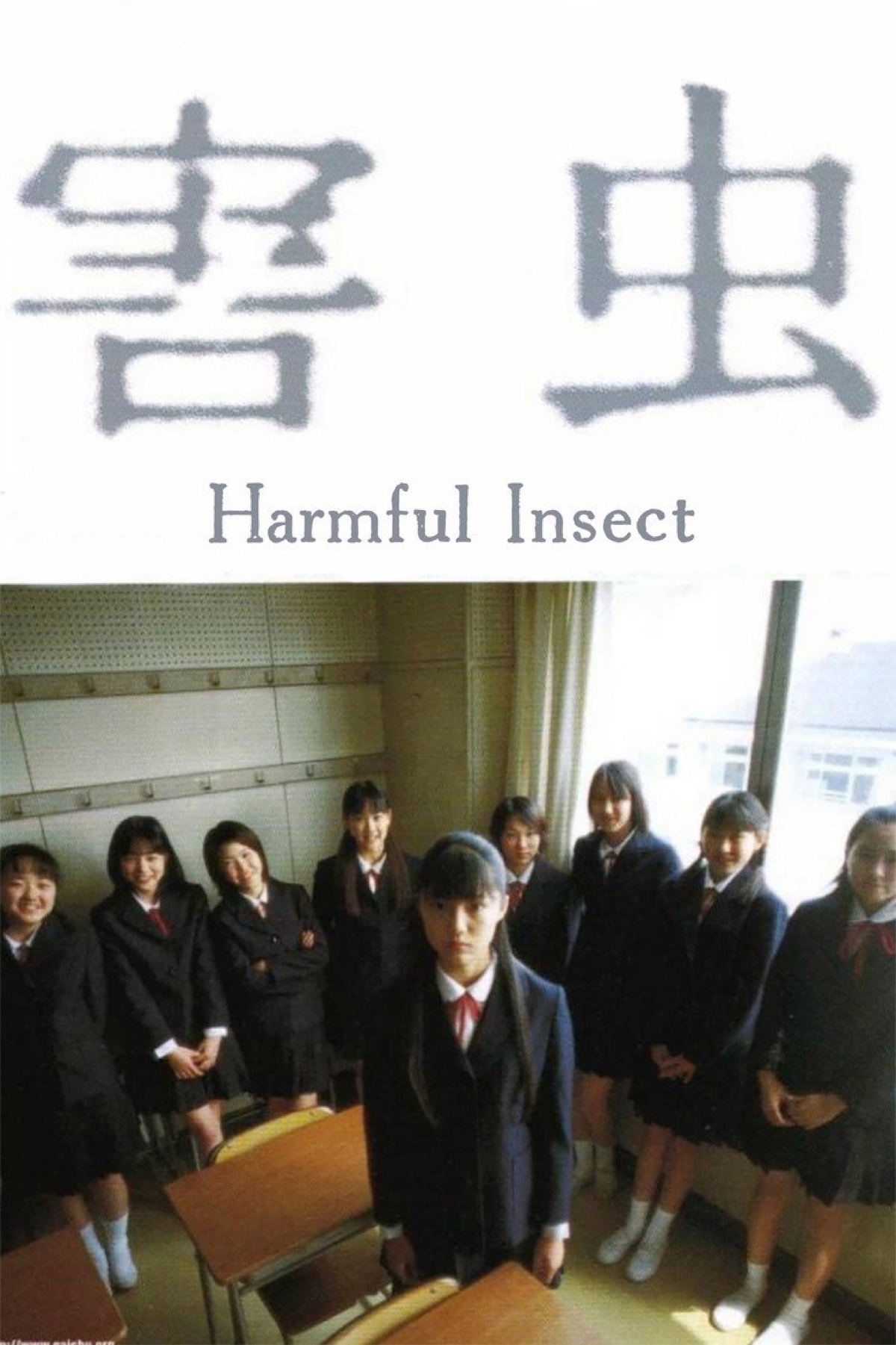
- Title: Harmful Insect (Gaichu)
- Premiered at Venice in 2001, Japanese release March 2002, 92 minutes
- Director: Akihiko Shiota. Screenplay: Yayoi Kiyono
- Starring: Aoi Miyazaki, Yu Aoi, Seiichi Tanabe, Ryo
- Theme song: I Don’t Know, by NUMBER GIRL
- Best Actress for Aoi Miyazaki at Cinemanila, plus a NETPAC special mention
- Hochi Film Award for Best Actor, Seiichi Tanabe
📖 Synopsis, No Spoilers
Sachiko is thirteen and stops attending school after her mother attempts suicide. There is no father. She lives with a woman who is not well, in a flat that is quiet in the wrong way, and she spends her days walking around a town that has no particular use for her.
She falls in with two people at the edges of everything: a boy who makes a living throwing himself in front of cars, and a much older man with an intellectual disability. Her only stable connection is a correspondence with a teacher from primary school. A classmate called Natsuko tries, with real kindness and no skill, to bring her back into school. Every time Sachiko takes a step toward an ordinary life, the ground under it gives way, and eventually something in her stops holding.
✨ What Makes It Special
Why It Is Exceptional
- A teenager carrying a film almost entirely without dialogue
- One rock song, deployed once, at exactly the right moment
- A title that changes meaning depending on who you think it refers to
- Two future stars in the only film they ever shared
Aoi Miyazaki, in her mid-teens, saying almost nothing
The film exists because of one performance. She was about fifteen during filming, playing thirteen, and she has very few lines and shows very little on her face. It should not work. Instead you cannot take your eyes off her, and the reason is that the innocence and the danger are present at the same time and the film never tells you which one is real.
There is a production detail here that I find remarkable. Akihiko Shiota kept a wind machine running on her, and only on her, throughout the shoot. His stated reasoning was that Sachiko is somebody whose presence generates friction with the world simply by existing, and the wind was that made visible. What it actually did was change her eyes. She narrows them slightly against it in shot after shot, and that involuntary expression sets the temperature of the entire film. A director’s conceit and an accident of physiology arriving at the same result.
The image that stays is her smile, which appears perhaps twice in ninety-two minutes, and one of those times is while she is committing arson. Lit from below by something burning, she looks, for a moment, like a happy child. The film’s whole argument is in that composition: the most beautiful thing in it arrives attached to the worst thing in it.
Yu Aoi is the other half of the reason to watch. As Natsuko she is visibly less polished than her co-star, unformed in a way that would be a problem in another role, and here it is perfect casting: a well-meaning good student whose kindness keeps missing its target. Both of them are now among the best-regarded actresses in Japan. This is the only time they ever appeared in a film together.
One song, once
Almost the whole film is quiet. Room tone, traffic, the sound of a girl’s shoes. There is essentially no score and very little speech, and the effect after an hour is a kind of pressure behind the eyes.
Then NUMBER GIRL arrive. For readers outside Japan: they were a Fukuoka band who broke up in 2002 and have exercised an influence on Japanese guitar music out of all proportion to their four albums, sharp and shouted and completely unpolished. The song is called I Don’t Know, and it detonates over the late sequence where Sachiko throws a petrol bomb. Ninety minutes of held breath released into a guitar riff. The line about not knowing what that girl is really like is the most accurate description of the character anybody manages, including the film.
I will register one reservation. The cue is so effective that for a minute the film risks turning into a music video, and I felt it tip that way on my most recent viewing. It is still the right decision. Without it the ending has no release valve at all.
Who exactly is the insect
The title is the question and the film declines to answer it. Is Sachiko the pest. Are the adults who cornered her the pests. Or is the act of applying that label to a child the thing under indictment.
What clarifies it, for me, is that no insect considers itself vermin. The category is applied from outside. Sachiko is not trying to cause harm to anybody. She is looking for somewhere to be, and every place she lands comes apart, and the film shows that happening without ever suggesting she intends it. Vermin produce more vermin, and nobody in the chain chose to enter it.
Deeper Themes
The film belongs to a specific moment in Japanese culture, when school non-attendance had become a national anxiety with its own vocabulary and a great deal of public hand-wringing about what was wrong with the children. Almost none of that discourse asked what the children were declining to attend.
Shiota’s answer is to show a girl for whom no available room is survivable. Not school, not home, not the street. The film does not diagnose her and does not propose an intervention, which some viewers read as nihilism. I read it as refusing to pretend that the adults in the story had a solution available.
🎭 Memorable Scenes
I do not know what that girl is really like.
The opening is a masterclass in not explaining. White feathers drifting through a room, which reads as beautiful for about three seconds. The camera moves. A woman has cut her wrists. Cut to a classroom where the other children are discussing the rumour, with one empty desk in frame. Two shots, and the entire situation of a thirteen-year-old is established with no dialogue whatsoever.
The one I never shook is a gust of wind. Sachiko is walking, and without warning the air turns violent around her. It plays as the world briefly showing its teeth. Knowing now that the wind was a deliberate, continuous choice aimed at one actress does not diminish it. It makes the whole film feel like it was built around a single physical idea.
And the last shot. A roadside restaurant somewhere north, an empty seat, one red apple left on the table. The film declines to tell you what happens next, which forces you to supply it, and what you supply will be worse than anything a script would have dared.
💭 How It Made Me Feel
Vacant, for about an hour afterwards. Bleak is not the useful word here. What I noticed was that thinking about this girl’s future frightened me, and that the fear did not behave like fiction. It sat where real news items sit.
Rewatching it for this piece, twenty-odd years on, the thing that had changed was me. At the time I identified with Sachiko. This time I kept noticing the adults, and how many small chances there were to do something, and how plausibly each one gets missed. That is a worse film to watch at forty than at twenty, which I did not expect.
Who Should Watch This?
- People who rate All About Lily Chou-Chou as one of the great films of its decade
- Anybody following Aoi Miyazaki or Yu Aoi back to the beginning
- Viewers who recognize the specific airlessness of nowhere left to go
- Anyone interested in what a wind machine can do to a performance
😅 Where It Falls Short
Where withholding becomes withholding too much
Look, I have been admiring, and now the honest part, which is that this film is sometimes simply unclear. Stripping out dialogue is the source of its power and also its main defect. Cause and effect between people become hard to trace, and there are stretches where I could not tell you why Sachiko did what she just did.
The petrol bomb is the sharpest case. It is the climax of the film, and the motivation is not adequately carried by the images alone. Why that house, why fire, why then. The line between trusting an audience and failing to give them enough is thin, and this crosses it at the single moment where crossing it costs the most.
Third, and this is a warning rather than a criticism: the film is relentless. There is no relief anywhere in it, the ending offers nothing, and even the humming over the closing credits is unsettling. Do not watch this when you are already low. I would not describe it as a good experience, and I would still say it is a film worth seeing once, which is an uncomfortable position to defend and I am going to defend it anyway.
The Weak Points
- So little dialogue that motivation sometimes fails to arrive
- The climactic act is underexplained at the worst possible moment
- Unbroken bleakness, with no relief and no resolution
Who Might Not Enjoy This?
- Readers who want a story that explains itself
- Anybody currently in a fragile stretch of their own
- Viewers who need a film to offer some way out
📺 Streaming Guide by Service
Nothing, anywhere, and what to do about it
I have no route to offer, and I want to say that clearly rather than bury it. No streaming service in any territory carries this. The Japanese disc is long out of print and carries no English subtitles. Repertory screenings happen occasionally when a Japanese film season programmes early Aoi Miyazaki, and that is genuinely the best chance.
If you can only reach one film from this cluster, take All About Lily Chou-Chou, which is free on several US library platforms and covers adjacent ground with a great deal more available to watch. That recommendation is doing real work below.
There is a version of the future where a boutique label notices that two of Japan’s leading actresses share exactly one early film and puts out a restoration. I have been waiting for that for a while.
The Available Routes
- Repertory screenings and Japanese film seasons, the realistic hope
- Secondhand disc listings: out of print, no English subtitles
- Reachable instead: our All About Lily Chou-Chou piece
The Music
There is barely a score. What the film has is silence, ambient sound, and one NUMBER GIRL song used exactly once, which is a more disciplined approach to music than almost any film I can name.
NUMBER GIRL are on streaming services and worth your time independently of this. Start with the album Sappukei if you want the sound that a generation of Japanese guitar bands has been chasing ever since. The film’s track is the obvious entry point.
📀 Where the Cast Went
Aoi Miyazaki went on to lead a Japanese public broadcaster’s year-long historical drama and to a long run of prestige film work. Yu Aoi became one of the most in-demand actresses of her generation and is probably better known abroad through her later work with international directors.
Neither of them has appeared in a film with the other since. Whatever else this is, it is the only document of both of them at the start, and that alone should have been enough to keep it in print.
🎬 If You Loved Harmful Insect, Watch These 3 Next
All About Lily Chou-Chou
The other half of the pair. Shunji Iwai made it a year earlier, about the same age group in the same country at the same moment, and it also uses music as the one thing that makes a few minutes survivable. Longer, more beautiful, equally without mercy, and free on several US library platforms.
👉 Read our review of All About Lily Chou-Chou
EUREKA
Aoi Miyazaki again, two years earlier and even younger, in Shinji Aoyama’s three and a half hour film about survivors of a bus hijacking learning to speak again. Same actress, same silence, opposite conclusion. Watch it as the version where somebody does eventually reach the child.
A Silent Voice
The same classroom, drawn instead of filmed, and with the argument that something can be repaired. Harmful Insect refuses that consolation entirely. Watching them close together shows you two completely different Japanese answers to the same question about what a child owes a room that has rejected them.
👉 Read our review of A Silent Voice
📝 Final Thoughts
I would not tell you to enjoy this film and I would not put it on for company. It withholds too much, the climax is underexplained, and there is no relief anywhere in ninety-two minutes. What it has instead is a teenage actress carrying an entire picture on a narrowed pair of eyes and a wind machine, and one rock song that arrives like a door coming off its hinges.
The thing that bothers me most is not the film. It is that a picture starring two of the most important actresses Japan has produced, in their only shared appearance, is currently available nowhere on Earth. Somebody should fix that. Until they do, this article is the only thing I can contribute.
⭐ Film at a Glance
| Category | Rating | Comment |
|---|---|---|
| Lead performance | ★★★★★ | Still in her teens, wordless, impossible to look away from |
| Direction | ★★★★☆ | Two shots to establish an entire childhood |
| Writing | ★★☆☆☆ | Withholds past the point of legibility |
| Music | ★★★★★ | One song, once, perfectly placed |
| Emotional impact | ★★★★☆ | Severe, with nothing offered in return |
| Availability | ★☆☆☆☆ | Streaming nowhere on Earth |
Usagi’s Recommendation Score
⭐⭐⭐⭐⭐⭐✨☆☆☆
6.5 / 10
Unforgettable is not the same as good. Do not watch it when you are already low.

