*This page contains affiliate links. We may earn a commission if you make a purchase through these links.
There is a line early on about the only two places left to escape to being a dream or a prison. That is the film’s opening bid, delivered by a young man who will shortly take the second option, and it tells you what kind of two hours you are in for. What it does not tell you is that the final stretch holds one of the most hopeful images in Japanese cinema from that decade.
I have watched this three times and I still could not give you a confident account of what the jellyfish mean. That is not a complaint. Kiyoshi Kurosawa makes films that decline to close, and this one declines harder than most, and I keep going back to it anyway.
📺 Where to Watch Bright Future (October 2026)
| Service | Status | Notes |
|---|---|---|
| Hoopla | Streaming | Free with a card from a participating US library |
| OVID | Streaming | Subscription, art-house catalog |
| Fandor | Streaming | Subscription |
| AsianCrush | Streaming | Subscription |
| Metrograph | Streaming | At-home subscription |
| Prime Video Channels | Add-on | Fandor, Cineverse channels, paid on top of Prime |
| Amazon Video | Rent / Buy | Pay once, no subscription |
| Netflix | Not available | Not in the US catalog |
| Crunchyroll | Not available | Live-action, outside its catalog |
Hoopla is free if your library takes part. Failing that, four small subscription services carry it, OVID, Fandor, AsianCrush and Metrograph, and the first three were offering free trials when I looked.
In Japan: U-NEXT, plus rentals.
🪼 Is Bright Future a Horror Film? Where It Fits in Kurosawa’s Work
It is not. Bright Future is a 115-minute drama about two young factory workers, a venomous jellyfish and a father who arrives too late, and it went to Cannes in competition in 2003. There is a killing near the start, and the dread you know from Kurosawa is in the air, but nothing in it is there to scare you.
The confusion is understandable, because of where it falls in his filmography. It came after Cure (1997) and Pulse (2001), the two films that made his name abroad as a horror director, and five years before Tokyo Sonata (2008), the family drama that took an Un Certain Regard prize at Cannes. Bright Future is the hinge between those two Kurosawas. The flat daylight and the sense that ordinary rooms are slightly wrong come from the first. The father and the young man with no family to speak of point toward the second.
One thing the English title cannot carry. The Japanese title, Akarui Mirai, is written in katakana, the script normally used for foreign words, rather than in the ordinary characters for those two words. To a Japanese eye it reads as a slogan with the warmth drained out, the kind of phrase printed on a poster nobody believes. Whether the film earns the phrase back by the end is the argument you will have with yourself afterward.
🎬 Trailer
There is no trailer embedded here, and the reason is worth stating. The English-subtitled trailers circulating on YouTube are all uploads from personal accounts, and the original Palm Pictures campaign from 2003 never made it onto an official channel that still exists. This site’s rule is that an embed has to come from a studio, distributor, or service, so rather than pass off a fan upload as official, there is nothing here. Search for the Palm Pictures trailer if you want a look first, and note that it oversells the thriller elements considerably.
Work Info
- Title: Bright Future (Akarui mirai)
- Released: 2003, 115 minutes
- Written, directed, edited by: Kiyoshi Kurosawa
- Starring: Joe Odagiri, Tadanobu Asano, Tatsuya Fuji, Ryo Kase
- Theme song: Mirai, by THE BACK HORN
- Kurosawa’s first film in competition at Cannes, 2003
- US distribution: Palm Pictures
📖 Synopsis, No Spoilers
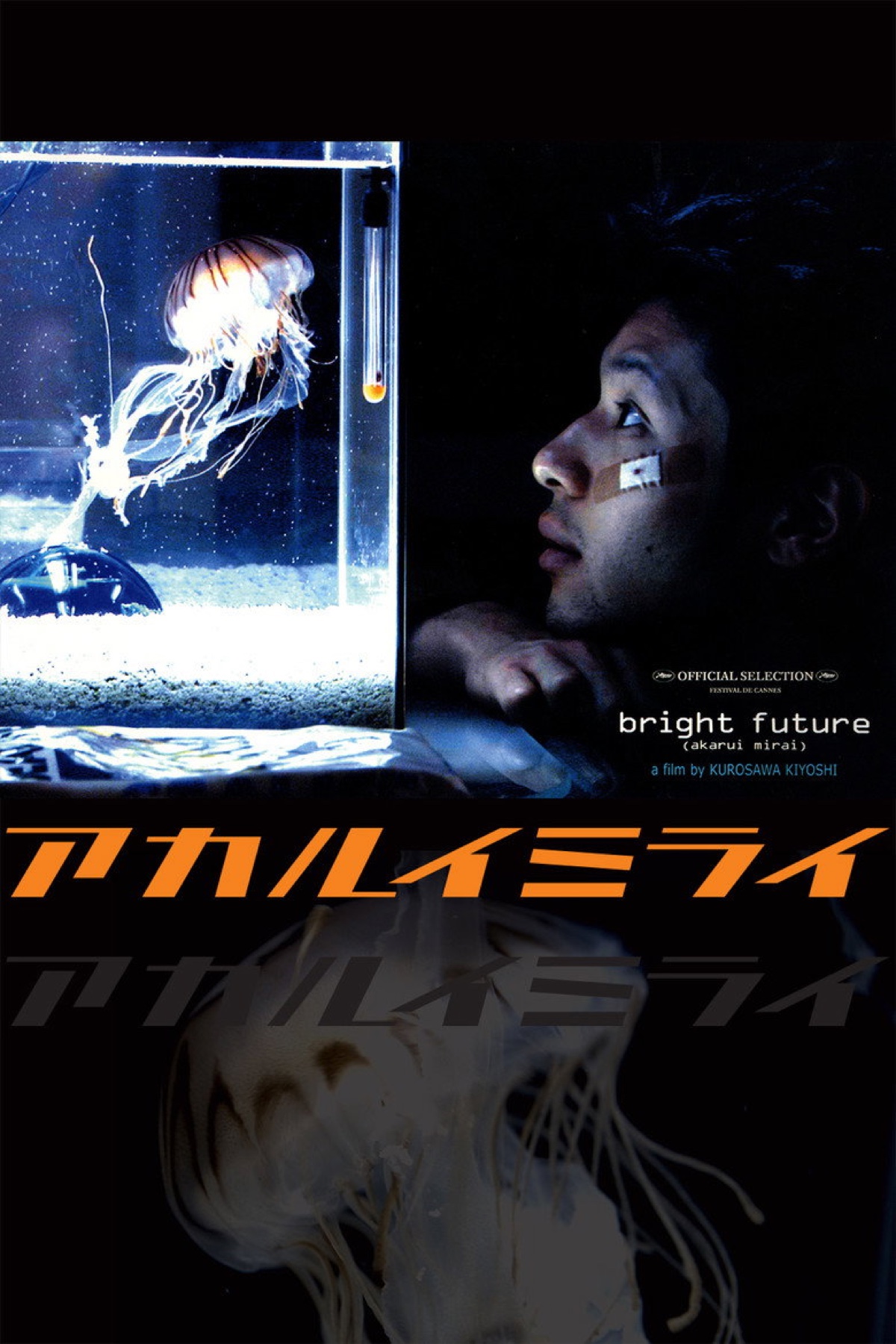
Yuji works at a factory that makes hot towels, which is about as far from a career as employment in Tokyo gets. He is irritable, directionless, and permanently on the edge of doing something he cannot undo. The one person he trusts is Mamoru, a colleague who has taught him two hand signals, one meaning go and one meaning wait, and who uses them to keep him from detonating.
Then Mamoru kills the factory owner and his wife and is arrested. What he leaves Yuji is a jellyfish, a venomous species that should only survive in salt water, which he has been slowly acclimatizing to fresh water with the intention of releasing it into Tokyo. Yuji takes over the project. Mamoru’s father, who has not seen his son in five years, turns up looking for an explanation, and the two of them end up living together.
✨ What Makes It Special
Why It Is Exceptional
- A young man learning to move without somebody telling him when
- A father and a stranger becoming the family neither of them chose
- One word of forgiveness that carries the whole ending
- A river full of luminous poison, meaning whatever you decide
Losing the person who told you when to move
Yuji cannot decide anything. That is the character, stated plainly and without much sympathy. He is angry most of the time, the anger has no object, and left alone he does damage. What was keeping him functional was another person’s hand: go, or wait.
The prison visiting room scene is where the film turns. Yuji says he will wait twenty years, thirty years, however long it takes, and he means it, and it is the most emotionally direct he ever gets. Mamoru tells him not to come back. The person who was operating him has switched him off and walked away, which is somehow crueller than abandonment.
What follows is a recovery story told almost entirely through animal husbandry. Yuji has an organism to keep alive, which requires him to do a specific thing on a specific schedule for reasons that are not his own, and it works on him. Nobody in the film says this out loud, and the film would be worse if anybody did. By the end he is moving without the signal.
The father who was never anybody’s father
Shinichiro had not seen his son for five years when the news reached him that the boy had murdered two people. He does not know what his son thought about anything. He is played by Tatsuya Fuji, whom Western viewers will know as the male lead of In the Realm of the Senses, and whose weathered, unshowy presence here is the ballast the film needs.
The relationship that develops between this man and his son’s friend is where Kurosawa is at his most Ozu-like, and I mean that specifically. The observation being made is the one Tokyo Story made fifty years earlier: adult family members are functionally strangers who happen to share a name. What this film adds is the inverse proposition, that being strangers is exactly what makes connection possible. They can build something because there is no history to be disappointed by.
It is worth flagging for viewers who only know Kurosawa as a horror director. There are no ghosts here and nothing supernatural happens. What carries over from the horror films is the sense that ordinary Japanese daytime spaces are subtly wrong, and it is applied to a story about a family, which turns out to be sufficient.
The word that resolves it
Late in the film Shinichiro tells the young men that he forgives them. It arrives without setup and does not obviously follow from anything, and it is the moment the film has been building toward for two hours.
The logic underneath is that these are people with something toxic in them that they did not choose and cannot discharge. The jellyfish is not a subtle image. What forgiveness does in this film is not absolve the killing, which is not up for discussion, but grant permission to keep existing while carrying the poison. That is why a relentlessly bleak film ends on something that feels like light.
Deeper Themes
The film is about a specific Japanese generational moment that needs a footnote for readers abroad. These young men came of age in the decade after the bubble economy burst, into a labor market that had stopped offering the lifetime employment their fathers took for granted. A hot towel factory is not a rung on a ladder. It is the whole ladder.
What Kurosawa does with that is refuse to explain it as sociology. The anger is presented as weather rather than as a consequence, which some viewers find evasive and I find accurate. Nobody living inside a condition like that experiences it as a thesis about the economy.
🎭 Memorable Scenes
The only places left to run are into a dream or into a prison.
Two options, both of them a form of removal, offered by a man who is about to demonstrate the second. I have not encountered a more compact statement of what it feels like to be unable to fit anywhere, and the film spends the rest of its running time arguing quietly that there might be a third option.
Then the ending, which is the reason people remember this film. A canal in Tokyo, at night, filled from bank to bank with jellyfish, drifting toward the sea and faintly glowing. It is beautiful and unsettling in the same frame, because the animals are venomous and there are thousands of them and they are heading into a city’s waterways. Whether that is hope or infestation is left entirely open, and both readings are fully supported.
The smaller one I keep returning to is Yuji watching the tank, adjusting the salinity, checking on something that would kill him if he touched it. A man learning care by practising on the least huggable creature available.
💭 How It Made Me Feel
Unsettled and, unexpectedly, lighter. The film is oppressive for most of its length, greenish and airless, and then it hands you a river of light at the end without earning it in any conventional dramatic sense. I resent how well that works.
The lasting effect is the song. THE BACK HORN’s theme arrives over the closing images, and for about a week afterwards I could not hear the opening of it without seeing that canal. Twenty years on it remains the single best marriage of a Japanese rock band and an art film I can name.
Who Should Watch This?
- Viewers who know Kurosawa only through his horror films
- Anyone who has felt unusable by the world they were handed
- People interested in fathers and sons who cannot speak to each other
- Anybody who will sit with an image that refuses to resolve
😅 Where It Falls Short
Two obstacles, one of them real
Look, I have been admiring, so here is the counterweight. This film is hard to hold on to. The symbols are dense and unexplained, the jellyfish will not settle into a meaning, the boys who appear late in the film are never accounted for, and there is no visible destination for most of the running time. The most common reaction I hear is that people finished it unsure whether they had understood anything, and that reaction is not a failure of attention.
The second obstacle is technical and irritating. A lot of the dialogue is muttered, and Kurosawa mixes ambient sound at levels that bury it. Even watching in Japanese I lost lines. Turn subtitles on regardless of your language, because the film is not going to help you.
Whether the opacity is a flaw depends on what you want. My own position is that a film about not knowing what your life is for would be worse if it explained itself, and that the not-knowing is the content. I also accept that this is exactly the argument people make to excuse films that are simply unclear, and I cannot prove which one this is.
The Weak Points
- Symbolism that never resolves into a reading
- No apparent destination for most of the running time
- Dialogue buried under ambient sound. Use subtitles
Who Might Not Enjoy This?
- Readers who need a film to state its meaning
- Viewers coming for Kurosawa the horror director
- People who dislike unlikeable, inarticulate protagonists
📺 Streaming Guide by Service
Free routes, and what to watch it with
Start with Hoopla. If your library participates there is no charge, and the transfer is acceptable. Without a library route, pick one subscription and use its trial: OVID if you want a catalog that also carries a great deal of adjacent international cinema, AsianCrush if you would rather stay with Asian titles. Renting on Amazon is the fallback if you do not want another account.
Subtitles only. No English dub exists for this and there would be no reason to make one. Do use headphones, since Kurosawa builds a great deal of the unease out of room tone and traffic, and laptop speakers flatten all of it into nothing.
One scheduling note. This is not a film to put on when tired. It is slow, it withholds, and if you are half asleep the middle hour will simply pass over you. Give it a clear evening or leave it for another week.
Watch It Here
- Hoopla: free through a participating US public library
- OVID: included with a subscription, as on Fandor, AsianCrush and Metrograph
- Amazon Video: rental or purchase, uninterrupted
Soundtrack
The score is sparse to the point of near absence, which is standard Kurosawa. What the film actually runs on is ambient sound, and the mix is doing considerably more work than any cue.
The song is the thing. THE BACK HORN are a rock band with a reputation in Japan for writing about despair without any of the usual posturing, and their track Mirai arrives at the exact moment the film hands you its ending. It is on every streaming service and it works alone, though not as well.
📀 On Disc
Kurosawa wrote this directly for the screen, so there is no book behind it. He did later publish a novelization in Japan, which has never been translated and is a curiosity rather than a companion.
Palm Pictures put out the US disc in 2004 and it has been out of print for a long time, which makes streaming the sensible route for once. Check current listings on Amazon if you collect, and expect secondhand prices.
🎬 If You Loved Bright Future, Watch These 3 Next
Cure
The Kurosawa that made his name in the West, and the one this film is quietly related to. Both are about a person who does not know why he does what he does, and about somebody else who could be steering. Colder, more frightening, and considerably more famous.
All About Lily Chou-Chou
Shunji Iwai on the same generation two years earlier, at fourteen instead of twenty-four. The airlessness is identical and so is the answer, which in both films is music arriving to make a few minutes survivable. The harder of the two films by some distance.
👉 Read our review of All About Lily Chou-Chou
EUREKA
Shinji Aoyama’s three and a half hours on the same question: how does a damaged person start moving again, and can strangers substitute for a family. Bright Future compresses that into a couple of acts. This gives it all the time it would actually take.
📝 Final Thoughts
Bright Future is Kurosawa working outside the genre that made him exportable, on a subject he has never returned to with quite this directness: what a young man does when the person who was holding him together is gone and the world he was promised does not exist. It is opaque, badly mixed, and hard to summarize. It also contains an ending image that I have not been able to shake in twenty years.
Watch it awake, with subtitles on, and let the jellyfish mean whatever they end up meaning to you. The film has no opinion, and I have decided that is the point.
⭐ Film at a Glance
| Category | Rating | Comment |
|---|---|---|
| Writing | ★★★☆☆ | Deliberately unresolved, occasionally opaque |
| Performances | ★★★★☆ | Odagiri plus Asano, both at their rawest |
| Direction | ★★★★☆ | Ordinary daylight made faintly wrong |
| Images | ★★★★★ | The jellyfish river is unforgettable |
| Music | ★★★★☆ | Almost no score, one perfect song |
| Accessibility | ★★☆☆☆ | Slow, muttered, unexplained |
Usagi’s Recommendation Score
⭐⭐⭐⭐⭐⭐⭐☆☆☆
7.0 / 10
Bleak for two hours, then a river of light. Stay awake for it.
For where this sits in Kiyoshi Kurosawa’s work, see our roundup of the ten best Japanese thrillers, which covers Pulse, Retribution and Creepy.

