*This page contains affiliate links. We may earn a commission if you make a purchase through these links.
If you watched Shall We Dance? in an American cinema, you did not watch Shall We Dance?. Miramax bought the film, removed eighteen minutes, and released that version in July 1997. It made $9.7 million and was the most successful Japanese film in the United States for years. It was also not the film Masayuki Suo made. North America did not get that one until Film Movement put a 4K restoration into theaters in May 2025, uncut for the first time.
I should declare my starting position, which was low. A 1996 comedy about a middle-aged salaryman taking secret ballroom lessons is not something I would have picked off a shelf, and I put it on out of obligation. Two hours later I was looking at dance studios near my station, and then closing the tab, which turns out to be the exact behavior the film is about.
📺 Where to Watch Shall We Dance? (October 2026)
| Service | Status | Notes |
|---|---|---|
| MUBI | Streaming | Included with a subscription |
| MUBI on Prime Video Channels | Add-on | The same MUBI catalog, paid on top of Prime |
| Amazon Video | Rent / Buy | No subscription needed |
| Apple TV | Rent / Buy | Add 1996 when you search |
| Fandango at Home | Rent / Buy | Pay once |
| Netflix | Not available | No US listing |
| Crunchyroll | Not available | Anime only |
In the United States the film is on MUBI, and the major storefronts will rent it to you instead if one title does not justify another monthly charge. Wherever you watch, glance at the running time before you press play: about 136 minutes is the full film, and the reason that matters is further down this page.
The contrast with Japan says something about how the film traveled. Here it sits on U-NEXT and Hulu, mass-market catalogs, filed next to television dramas, the kind of title a family puts on because it is Sunday. In the US it is a MUBI title, which is to say an art-house import with a restoration campaign behind it. Same film. One country treats it as furniture, the other as a rediscovery.
💃 Which Shall We Dance Is the Original? 1937, 1996 and 2004
The 1996 Japanese film by Masayuki Suo is the original of this story. The 2004 Shall We Dance? with Richard Gere, Jennifer Lopez and Susan Sarandon, directed by Peter Chelsom, is its American remake, and it runs 106 minutes against the original’s 136. The 1996 film reached US cinemas in July 1997, with eighteen minutes taken out, and the remake opened in October 2004.
The name itself has an older owner. Shall We Dance, with no question mark, is a 1937 Fred Astaire and Ginger Rogers musical with songs by George and Ira Gershwin, and its story, a ballet dancer falling for a tap dancer, is not Suo’s. Suo’s title points somewhere else again: the Rodgers and Hammerstein song from The King and I, which is what you hear at the end of his film.
If you saw the remake first, as most Americans did, the original is not spoiled for you. The plot beats are close. The reasons behind them are not, and the reasons are where the Japanese film keeps its weight. When you search, the year does the work: 1996, about 136 minutes, Koji Yakusho on the poster.
🎬 Trailer
Film Movement’s trailer for the 2025 restoration. Watch what it does with faces rather than footwork. Almost every shot is somebody deciding whether to admit to something.
Work Info
- Title: Shall We Dance? (Shall we dansu?)
- Released: 1996, 136 minutes (137 in the restoration)
- Written and directed by: Masayuki Suo
- Starring: Koji Yakusho, Tamiyo Kusakari, Naoto Takenaka, Eri Watanabe, Reiko Kusamura
- Music: Yoshikazu Suo. Theme sung by Taeko Ohnuki
- Awards: 14 Japan Academy Prizes, including Best Film
- Japanese box office: 2.72 billion yen
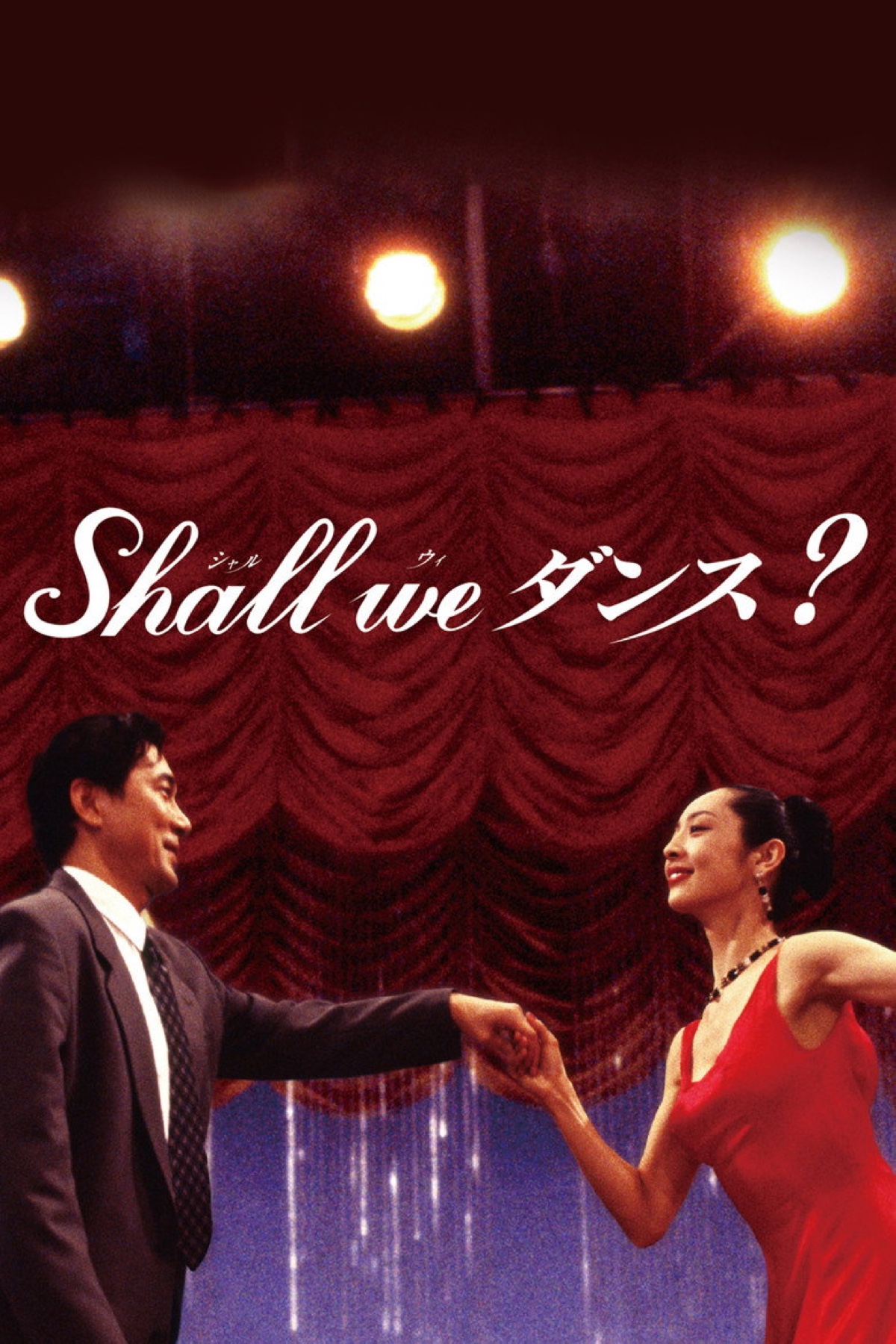
📖 Synopsis, No Spoilers
Shohei Sugiyama is forty-two, an accountant, and finished. He has the house in the suburbs, the mortgage that came with it, the wife, the daughter, the commute. Nothing is wrong. That is the problem, and he cannot say it out loud to anybody, because there is no acceptable way in his world to complain about a life this correct.
From the train home he keeps seeing a woman standing at the window of a dance studio, looking at nothing. One evening he gets off at that station. He signs up for group lessons for reasons he would not be able to defend to anyone, least of all himself, and he tells his wife nothing. The woman is not what he finds. Inside there is a room of unglamorous people taking something seriously, and a version of himself he had written off years earlier.
✨ What Makes It Special
Why It Is Exceptional
- The shame is the engine: in 1996 Japan, this was an embarrassing hobby
- Koji Yakusho building a man out of posture, twenty-seven years before Perfect Days
- The supporting dancers get real interior lives, not comic slots
- A showtune from The King and I doing the emotional accounting
The premise only works if you know what Japan thought of ballroom dancing
This is the piece that gets lost in translation, and without it half the film reads as overreaction. Sugiyama does not hide his lessons because he fancies the teacher. He hides them because in 1990s Japan a married man taking ballroom lessons was, socially, a slightly disgraceful thing to be. Not illegal, not scandalous. Just faintly improper, in the way that suggests a man is not where he should be after work.
Suo puts a voice-over at the top of the film explaining how ballroom dance reached Japan from Europe, which sounds like a dry way to open a comedy until you realize it is load-bearing. The dance arrived as a foreign import in a culture where married couples did not hold hands on the street. Physical contact with a stranger, in public, in a room with mirrors, on purpose. The film needs you to feel that as a transgression, and Japanese audiences did without being told.
Everything follows from it. Why he lies to his wife about a hobby with no sexual content whatsoever. Why she hires a private detective rather than simply asking him. Why Aoki, his colleague, wears a wig to competitions and pretends at the office to be somebody else entirely. The plot is not about dancing. It is about a man doing something he cannot explain to the people who know him.
The 2004 Richard Gere remake had to rebuild the whole mechanism, because in America a man taking dance lessons is at worst mildly funny. Losing the shame means losing the stakes, and the remake spends its running time hunting for a replacement. That is also, I suspect, why Miramax added its own explanatory framing to the 1997 cut. They understood the problem. They just solved it by trimming eighteen minutes of the thing that made the problem worth having.
Thirty years on, the shame has largely gone in Japan too, which changes how the film plays for younger viewers here. It has quietly become a period piece about a country that no longer exists. That has not hurt it. If anything it sharpened the thing underneath, which is about permission rather than dancing, and nobody has ever needed less of that.
Koji Yakusho, twenty-seven years before Perfect Days
Western audiences met Yakusho properly in 2023, when Wim Wenders cast him as a Tokyo toilet cleaner in Perfect Days and Cannes gave him Best Actor for it. If that performance impressed you, this is the same instrument at forty, and the assignment is harder: play a man who is bad at something, then good at it, without letting the audience see the joins.
He does it almost entirely with his spine. Early Sugiyama collapses into himself on the train, a body folded around a briefcase. The change arrives long before he can dance, in the way he begins to stand while waiting for things. The scene people remember is him practicing alone in a park at night, no audience, no teacher, just a man in a suit repeating a box step under a streetlight because he wants to be less bad at it tomorrow.
But I should be honest about something before going further. I came to this film from the other end of his filmography, and the whiplash is real. One year after this, Yakusho played the detective in Kiyoshi Kurosawa’s Cure, a man being dismantled from the inside by something he cannot name. Same face, same year, opposite direction. Watching them close together tells you more about Japanese screen acting in the nineties than any amount of criticism will.
The showtune that does the accounting
The title is borrowed. It comes from the Rodgers and Hammerstein number in The King and I, the one where a Western woman teaches a Siamese king to waltz, which may be the most efficient piece of thematic shorthand ever handed to a film for free.
Taeko Ohnuki sings it over the ending, in English, arranged by the director’s brother. Ohnuki is one of the great Japanese vocalists of her generation, and hearing that voice deliver an American showtune in its original language, in a Japanese film about an imported dance, is the whole cultural argument of the movie compressed into three minutes. I have had it stuck in my head for a week and I am not looking for a cure.
Deeper Themes
The film is unusually clear-eyed about what a hobby is for. Sugiyama is not unhappy at home and the film refuses to pretend otherwise. What he lacks is a room where he is nobody’s father, nobody’s employee, and measurably bad at something. Japan had no vocabulary for that in 1996 beyond drinking with colleagues, which is not a third place so much as an extension of the office.
The other thread is his wife, Masako, who is given far more than the plot requires. She notices, says nothing, and quietly grieves a marriage she assumes is ending. Her arc is not about catching him. It is about discovering that the thing her husband could not tell her was, of all the possibilities, this one.
🎭 Memorable Scenes
Shall we dance?
Four syllables the film withholds for two hours. When it finally arrives it is not a seduction, it is an offer of return, extended to a man who had decided he was finished with the whole business. The title stops being a title at that moment and becomes a sentence somebody says to somebody else.
The one I did not expect to floor me is smaller. Sugiyama’s daughter, who has spent the film mildly embarrassed by him, tells him to dance with her mother, and the two of them step around the garden in the dark, badly, in their house clothes. No music worth the name. It is the only conversation in the film where either of them says the true thing, and neither of them uses words for it.
Then there is Aoki’s wig, which comes off mid-competition in front of a full hall. He keeps dancing. Naoto Takenaka is a specific kind of national figure in Japan, a comedian who commits so completely that the comedy curdles into something moving, and this is the definitive example. The line about him finally shedding a skin lands as a joke and then does not.
💭 How It Made Me Feel
Restless, in a good way. Not moved to tears, moved to activity, which is rarer and more useful. The film makes a quiet case that the years between thirty and sixty are not a corridor you walk down waiting for something, and it makes it without once saying anything as tidy as that.
Two weeks later the residue is still there. I have not signed up for dance lessons. What I did do was go back to an instrument I stopped playing in my twenties, badly, in a room by myself, which is the same gesture in a different key. That is the film still running weeks after the credits, and it is the only evidence I have that any of this is true.
Who Should Watch This?
- Anyone who has wanted to start something and decided they were too old for it
- People who only know Koji Yakusho from Perfect Days
- Viewers who saw the Richard Gere version first, which is most of America
- Anyone who wants Japanese cinema that is warm without being sentimental
😅 Where It Falls Short
Three things worth knowing before you start
Look, I have been selling this hard. Not all of it holds up. Tamiyo Kusakari, who plays Mai, was a working ballerina with no acting experience when Suo cast her, and it shows in every scene where she has to say something. The line readings are flat in a way that subtitles will partly hide from you but not entirely. She won both Best Actress and Newcomer of the Year at the Japan Academy Prizes for this, which tells you how completely the dancing overrides the objection for Japanese audiences. When she moves, nobody else could have played the part. When she talks, you notice.
Second, the gender politics are thirty years old and have not aged into anything better. Toyoko, the heavier woman in the class, is written as a comic engine first and a person second, and the film keeps returning to her body for laughs longer than it needs to. Mai spends the film as an object of longing before she is allowed to be a person with a stalled career. Suo is more sympathetic than most directors of his generation, which is not the same as being good on this.
Third, the running time. At 136 minutes it takes its time, and the middle section that follows the supporting dancers is exactly where the Miramax scissors went. I am glad the full version exists and I would not cut it, but I understand the impulse. If you are used to a ninety-minute romantic comedy, budget accordingly and do not start it at eleven at night.
The Weak Points
- Tamiyo Kusakari dances superbly, acts stiffly
- 1996 gender politics, particularly around Toyoko’s body
- 136 minutes, with a slow middle stretch
Who Might Not Enjoy This?
- Viewers who need a fast opening act
- Anyone allergic to broad comic supporting characters
- People who want the romance to actually happen
📺 Streaming Guide by Service
Check the runtime before you press play
This is the one piece of practical advice this article exists to give you. Two versions of this film have circulated in North America for nearly thirty years, and the difference is eighteen minutes of the material that makes the supporting cast into people. The listed runtime tells you which one you have. Roughly 136 minutes is Suo’s film. Roughly 118 minutes is the Miramax edit.
Which cut each US platform is currently serving is not something I can check from Japan, so treat the paragraph above as a method rather than an answer. The 4K restoration went out through Film Movement in 2025, so anything sourced from that campaign will be the full version. If a page lists 118 minutes, that is the old one, and it is worth spending a rental elsewhere to avoid it.
On subtitles there is no dub to argue about, which settles that. One small warning for anyone searching: the 2004 American remake shares the title exactly, and storefront search will hand you Richard Gere unless you add the year.
Watch It Here
- MUBI: included with a subscription, also available as an Amazon Channel
- Amazon Video: rental or purchase, no subscription needed
- Fandango at Home: rental or purchase, as on Apple TV
Soundtrack
Both big audio platforms carry Yoshikazu Suo’s score. The piece you want is Taeko Ohnuki’s reading of the Rodgers and Hammerstein title song. Restrained, unhurried, sung in English by a vocalist who spent the eighties defining a certain kind of Japanese sophistication.
If it sends you further into Ohnuki’s own catalog, start with Sunshower from 1977, which has had a second life abroad through the city pop revival. It has nothing to do with this film. You will thank me anyway.
📀 On Blu-ray
Film Movement Classics put out the North American Blu-ray debut in November 2025, from the new 4K restoration of the full-length film, region A locked with English subtitles. A limited edition with a slipcover was sold through Vinegar Syndrome.
This is the version to own if you care about the difference between the two cuts, and it is the only home release that settles the question for you. Check current listings on Amazon.
🎬 If You Loved Shall We Dance?, Watch These 3 Next
Wood Job!
The same shape, moved to a forest. A young man enters a discipline he has no business entering, for a reason he could not defend, and the discipline remakes him. Shinobu Yaguchi has built a career on this exact story and this is his best version of it. No US streaming, unfortunately, but the source novel is translated.
👉 Read our review of Wood Job!
Medalist
Competitive dance again, this time on ice, with the judging politics and the costume budgets intact. Its coach is Sugiyama’s darker twin: an adult whose own attempt failed, choosing to stand at the barrier anyway. If the competition floor scenes were your favorite part, go straight here.
Blue Giant
The maximalist version of the same impulse. Where Sugiyama practices a box step under a streetlight, Dai practices tenor saxophone on a riverbank in winter until his hands stop working. Same disease, no restraint about it. Watch this one when you want the feeling turned all the way up.
👉 Read our review of Blue Giant
Our list of the best Japanese comedy movies left this film out for one reason only, which is where it streams in the US. Treat Sugiyama’s dance class as the eleventh entry on it.
📝 Final Thoughts
Shall We Dance? swept fourteen Japan Academy Prizes in a year when it was competing against films with considerably more prestige on paper, and it did that because it is about the thing nearly everyone in that room was privately dealing with. Not romance. The suspicion, arriving somewhere in your forties, that the interesting part is over and the rest is administration.
What it argues, gently and across 136 minutes, is that this is a scheduling problem rather than a life sentence. The film is old now, the country in it has changed, and the version most of the West saw was missing a fifth of itself. It still works. If you have been carrying around something you keep not starting because of what people would think, watch it on a night when you have nowhere to be afterwards.
⭐ Film at a Glance
| Category | Rating | Comment |
|---|---|---|
| Writing | ★★★★☆ | Every supporting dancer gets a real interior |
| Lead performance | ★★★★★ | Yakusho builds a man out of posture |
| Visuals | ★★★☆☆ | Plain 1996 craft, restored beautifully |
| Music | ★★★★★ | Ohnuki’s title song earns the whole ending |
| Emotional impact | ★★★★☆ | Sends you looking up classes near your station |
| Supporting acting | ★★★☆☆ | Kusakari’s line readings are the weak seam |
Usagi’s Recommendation Score
⭐⭐⭐⭐⭐⭐⭐⭐☆☆
7.8 / 10
Get the 136-minute version. The eighteen minutes Miramax removed are the ones with the people in them.

