*This page contains affiliate links. We may earn a commission if you make a purchase through these links.
Think of this less as a film about bullying than as a device for excavating the reader. It has a plot, and the plot concerns a boy who tormented a deaf classmate and then spent five years being destroyed by what he did. But the reason people come out of it unable to speak for a while has less to do with Shoya Ishida than with whichever role in that classroom they recognize as their own.
I put off watching it for exactly the reason you might be putting it off. Bracing for a heavy film about bullying turned out to be half right. The opening is worse than I expected, and the thing it eventually does is not what I was braced for at all.
📺 Where to Watch A Silent Voice (October 2026)
| Service | Status | Notes |
|---|---|---|
| Crunchyroll | Streaming | Subtitled, plus the English dub |
| Prime Video Channels | Add-on | Needs the Crunchyroll channel on top of Prime |
| Amazon Video | Rent / Buy | No subscription needed |
| Apple TV | Rent / Buy | Google Play, YouTube, Fandango at Home too |
| Netflix | Not available | Streams on Netflix in Japan only |
Listings as of October 2, 2026.
Crunchyroll is the subscription that streams A Silent Voice in the United States, and Prime members can reach it through the Crunchyroll channel instead. Every major storefront rents it if you would rather not add a service. The English dub is good, unusually so for a film that depends this much on how speech sounds.
The split with Japan is neat enough to be funny. In Japan it is a Netflix title and Crunchyroll does not have it. In the US it is a Crunchyroll title and Netflix does not have it. Same film, same year, two catalogs that swapped. If you have friends in both countries, you cannot watch it together on the same service.
🧒 What Is A Silent Voice Rated, and Is It OK for Teens?
It has no MPA rating. A Silent Voice went out in US theaters as Not Rated, and the home release kept the same label, so there is no PG-13 or R to lean on when deciding.
What you are actually weighing is two subjects. The first half hour is the sustained bullying of a deaf eleven-year-old, shown in specifics: hearing aids pulled out and broken, a notebook thrown into a pond, a class that watches. The second is suicide. Shoya has planned his own death when the story jumps to high school, and the film later includes an attempt. Neither is played for shock, and neither is skipped over.
One detail says a lot about how Japan filed this film: in August 2018 it aired on NHK’s educational channel, the one Japanese kids know from the programs shown at school. My own answer to the age question has less to do with age. A thirteen-year-old having a rough year in class may get more out of it than an adult would, as long as somebody is around to talk afterward. Anyone standing close to either subject right now, at any age, might be better off waiting a month.
🎬 Trailer
The GKIDS trailer, which is honest about the tone without showing you the worst of the first act. Note how much of it is faces not quite looking at each other. That is the film.
Work Info
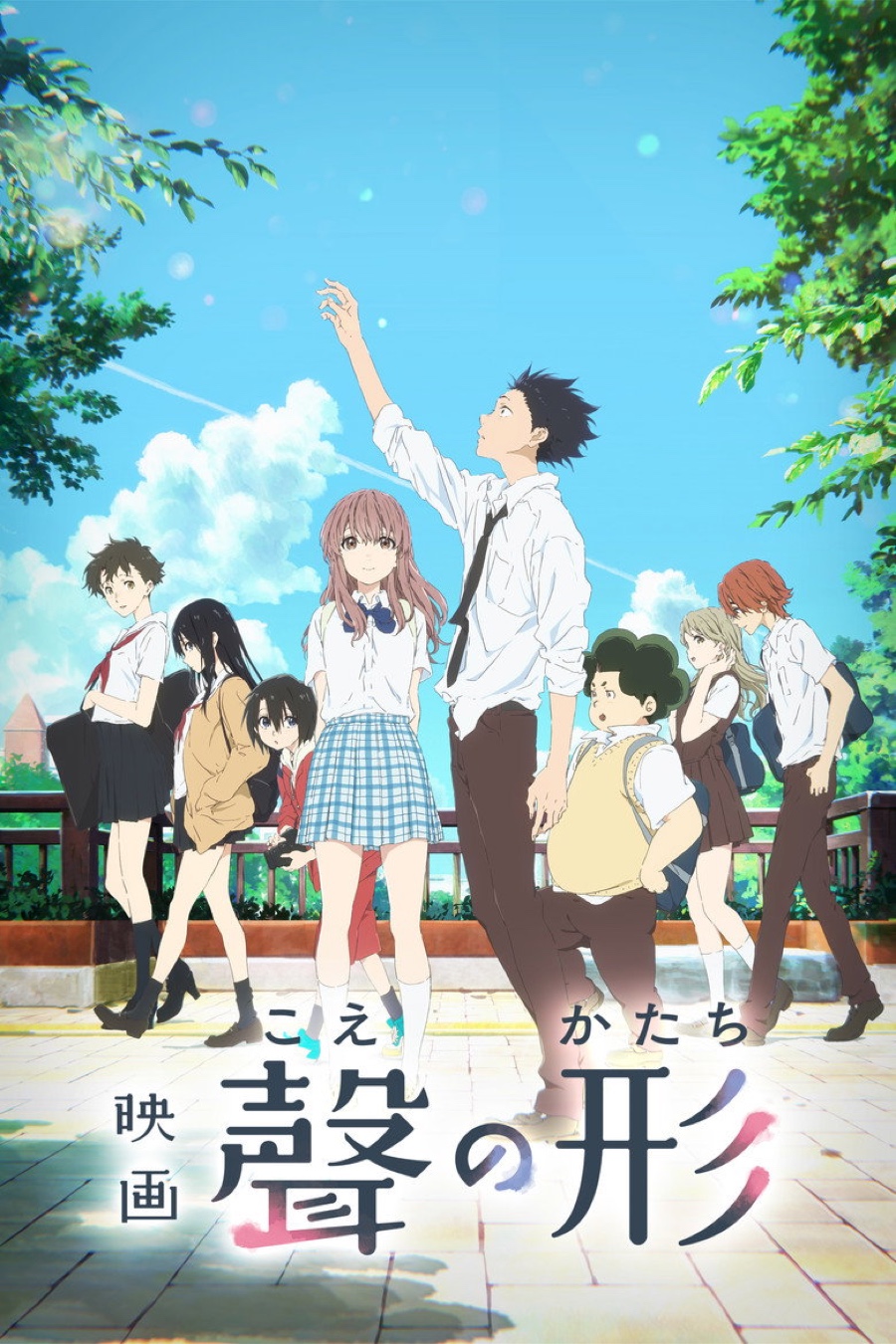
- Title: A Silent Voice: The Movie
- Released: 2016, 129 minutes
- Director: Naoko Yamada
- Screenplay: Reiko Yoshida
- Animation: Kyoto Animation
- Source manga: Yoshitoki Oima, seven volumes
- Music: Kensuke Ushio
📖 Synopsis, No Spoilers
Shoya Ishida is eleven, bored, and the loudest boy in his class when Shoko Nishimiya transfers in. She is deaf. What starts as curiosity becomes a campaign: hearing aids pulled out and broken, her notebook thrown in a pond, months of it, with the class watching and the teacher not intervening.
Shoko transfers away. The class needs someone to blame and picks Shoya, and by high school he cannot look anyone in the face. The film renders this literally: every person he passes wears a large X across their features. He has decided to end his life, and before he does there is one thing outstanding, which is to find Shoko and give back the notebook. That is where the story actually begins.
✨ What Makes It Special
Why It Is Exceptional
- It finds whichever role in that classroom was yours
- The X marks, and a score deliberately smeared out of focus
- The characters you hate are the ones doing the real work
- Seven volumes compressed into 129 minutes without visible seams
Everyone watches a different film
Calling this a bullying film is not wrong so much as beside the point. Bullying is where it starts. What it is doing is holding up a classroom and waiting for you to find yourself in it.
People who did the tormenting get Shoya’s self-hatred. People who were on the receiving end get Shoko’s apologizing, which is worse than anger. And the largest group, the ones who saw it happening and said nothing, get Kawai and Ueno, whose self-justifications are written with a precision that is genuinely uncomfortable. The film has a different weapon for each of you.
What surfaced for me was not any incident. It was the small maneuvers: the moment of looking elsewhere, the decision to keep some distance from someone to stay safe. Nothing that would qualify as a memory of doing wrong. The film simply leaves you nowhere to file it.
The X marks, and the blurred score
Kyoto Animation’s craft here is aimed at a specific job rather than at beauty. Shoya’s inability to face people appears as a large X pasted over every face he passes. It is a completely artificial device, and that is why it works better than a naturalistic treatment would: it is legible instantly, and the slow business of the marks peeling away as he lets people in does the work an entire subplot would otherwise need.
The sound design deserves more credit than it gets. Kensuke Ushio’s score is deliberately smeared, notes blurred at the edges so the music itself is slightly hard to resolve. Whether that is meant as Shoko’s hearing or as Shoya’s refusal to listen is never settled. Choosing that treatment for a film about deafness is the kind of decision that separates good animation from serious filmmaking.
Naoko Yamada directed this, and it is worth saying plainly that she is one of very few women directing feature anime in Japan, and among the best directors working in the medium regardless. The film is also one of Kyoto Animation’s last major works before the 2019 arson attack on the studio, which killed thirty-six people. Nobody in Japan watches a Kyoto Animation film from this period without that sitting somewhere in the room.
The word that does not survive subtitles
There is one moment this film cannot fully deliver in English, and it is the moment. Shoko tries to say she likes him. The Japanese word is suki. What her speech produces sounds to Shoya like tsuki, which means moon, and he takes it as a remark about the sky.
Two syllables apart, one consonant, and an entire relationship stalls on it. Subtitles have to explain the confusion rather than let you hear it, which turns the most devastating few seconds in the film into a footnote. If you watch one scene twice, watch that one in Japanese with the subtitles off and listen to what she actually manages to produce. Everything the film is about is in those two syllables: deafness, love, and the fact that the failure to communicate is nobody’s fault.
Deeper Themes
The film keeps the entire story inside Shoya’s head. Even Shoko is only visible through his reading of her, which is why audiences tend to file her as sweet and uncomplaining. That impression is the setup for what happens in the middle of the film, and it is a structural trick rather than a characterization failure.
Underneath is a question about whether being forgiven is the same as being finished. Shoya wants absolution and treats getting it as the goal. What the film argues instead is that the debt does not clear, and that living anyway, in company, is the available option.
🎭 Memorable Scenes
I want you to help me live.
Not save me, not I love you. Help me. A boy who had decided to die asking for assistance rather than rescue, because rescue is a thing he does not believe he is entitled to. The whole character is in the choice of verb, and the line took me apart on first viewing.
Then the school festival at the end. Shoya, who has not looked at a face in five years, walks into a crowd and the X marks come off one after another. I was not in a fit state to describe what the animation was doing at that point. There is also the notebook, which returns at intervals throughout the film and means something different every time, and which is the most efficient object in any anime I can think of.
💭 How It Made Me Feel
Unable to do anything else for a while afterwards. Not moved in the ordinary sense, more like something had been dug up. It is painful and I wanted to watch it again immediately, which is a contradiction I have never resolved.
The lasting effect showed up the next day. I found myself thinking about somebody I went to school with, for no reason and about nothing in particular. Just wondering where they ended up. That is the film continuing to operate after it has finished, and it is the most honest thing I can tell you about what watching it does.
Who Should Watch This?
- Anyone with unfinished business from their school years
- Live-action viewers who assume animation cannot do this kind of adult material
- People who avoided it because of the bullying label
- Anyone interested in what Kyoto Animation was doing at its height
😅 Where It Falls Short
Three things I could not get past
First, the content, stated plainly. The opening half hour contains sustained bullying of a disabled child, and the film includes an attempted suicide. None of it is gratuitous. All of it is hard to sit through. If either subject is somewhere you cannot go right now, this is not the week for it.
Second, and this is the real critical problem: why does Shoko come to love Shoya? He learned sign language, he turned up, he apologized. Is that sufficient to produce romantic feeling toward the person who ran a campaign against you at eleven? The entire film balances on that relationship, so how much weight you can put on it decides what you think of the whole. I could not shake the sense that the world bends conveniently around Shoya, that he is forgiven, given friends and delivered to recovery. The sharpest version of the objection I have heard is a question: would this story work at all if Shoko were a boy?
Third, the adults. The elementary school teacher watches a disabled student being tormented for months, does nothing, and at one point calls on her to read aloud. The absence of competent adults is clearly a structural decision to keep the children isolated, but it strains belief, and a more plausible teacher would have made the film more convincing rather than less dramatic. None of this stops me recommending it, and I would rather list the objections than pretend I do not hold them.
The Weak Points
- Heavy content: prolonged bullying of a disabled child, attempted suicide
- Shoko’s feelings for Shoya are underwritten, which strains the central relationship
- The adults are implausibly absent throughout
Who Might Not Enjoy This?
- Viewers who cannot sit through depictions of bullying
- Anyone looking for something light
- People who object on principle to a story where the aggressor is forgiven
📺 Streaming Guide by Service
Subtitles or dub, and when to press play
Crunchyroll if you have it, a rental if you do not. There is no meaningful quality difference between the routes, so this comes down to whether one film justifies another subscription.
On the sub-versus-dub question I would normally shrug, but here I lean subtitled, for one reason. The film turns on how Shoko’s speech sounds, and the original performance is doing something specific with that. The dub is genuinely well made and I would not argue with anyone who prefers it. Just be aware that the moon scene works differently depending on which track you choose.
Scheduling matters more than usual. Do not put this on late at night before a working day, and do not split it in two, because the first act is the hardest part and stopping there leaves you with the worst of the film and none of the rest.
Watch It Here
- Crunchyroll: included with a subscription, subtitled plus dubbed
- Amazon Video: rent or buy, no subscription needed
- Apple TV: rent or buy, as do Google Play, YouTube, Fandango at Home
Soundtrack
Kensuke Ushio’s score was released as a shape of light, and both major streaming platforms carry it. Prepared piano, room noise, tape hiss, very little that behaves like conventional film music.
It is a rewarding listen on its own, though be warned that it will put you straight back inside the film. Ushio went on to score Devilman Crybaby and Chainsaw Man, and this is where the approach was worked out.
📚 The Source Manga
Yoshitoki Oima’s manga runs to seven volumes and is fully translated into English by Kodansha. The film narrows everything to Shoya’s point of view, so the book is where the supporting cast gets its interior life.
That matters most for Kawai and Ueno. If you finished the film hating one of them, the manga will complicate that, which is either the appeal or the warning depending on how attached you are to the hatred.
🎬 If You Loved A Silent Voice, Watch These 3 Next
Violet Evergarden
The same studio on the opposite problem. A Silent Voice is about things failing to get through; this is about someone learning to put feeling into words on other people’s behalf. Also carrying a debt she does not think can be paid. Start here if you want the version with more air in it.
👉 Read our review of Violet Evergarden
All About Lily Chou-Chou
If the classroom scenes cut close, Shunji Iwai’s 2001 film goes to the same place in live action with no animation to soften it and no reconciliation waiting at the end. It is the harder film by a distance. Free with a US library card, which is worth knowing.
👉 Read our review of All About Lily Chou-Chou
EUREKA
Three hours and thirty-seven minutes on the single question of how a damaged person starts moving again. Shoya’s recovery is compressed into a couple of acts; Shinji Aoyama gives the same process the running time it would actually take. Watch it when you have the evening.
A Silent Voice also anchors my list of anime about depression, because few films show so plainly what it looks like when someone can no longer raise their eyes to anyone.
📝 Final Thoughts
This is not a film that comes for your tear ducts. It comes for a specific memory you have not examined in twenty years, and it does not care which side of the classroom you were standing on when it happened. The guilt of the one who did it, the resignation of the one it was done to, the discomfort of everybody who watched: it has something for all three.
In Japan it came out in a year dominated by Your Name and In This Corner of the World, and it spent a long time being the third animated film of 2016. Ten years on it is the one people are still arguing about. Approach it deliberately, keep the evening clear, and understand that whatever it digs up is going to be yours rather than the film’s.
⭐ Film at a Glance
| Category | Rating | Comment |
|---|---|---|
| Writing | ★★★★☆ | Seven volumes compressed with no visible seams |
| Visuals | ★★★★★ | Kyoto Animation at full stretch, aimed at meaning |
| Characters | ★★★★★ | The supporting cast is the reason it lasts |
| Music | ★★★★★ | Ushio’s blurred score is a thesis in itself |
| Emotional impact | ★★★★★ | Reaches back into your own school years |
| Central romance | ★★★☆☆ | The one thread that never fully convinces |
Usagi’s Recommendation Score
⭐⭐⭐⭐⭐⭐⭐⭐☆☆
8.0 / 10
Bring a clear evening. It will find whichever role in that classroom was yours.

